3.3.3 - Brendgen’s twin study
Brendgen and colleagues’ 2005 study compared genetic and environmental contributions to physical and social aggression in six-year-old twins. It also investigated why the two forms were related. You will learn how aggression was measured, what the twin models found, and why those estimates describe variation in a sample rather than a child’s fixed destiny.
Two forms of aggression and a twin sample
The study began by distinguishing physically hurting someone from harming them through relationships.
Physical aggression includes hitting, kicking or fighting. Social aggression uses social relationships to harm another person, for example excluding someone or spreading hurtful rumours. Social aggression can be overt or covert and need not involve physical contact. These forms may overlap in the same child, but they are not the same measurement. An explanation of physical aggression should not automatically be treated as an explanation of all social aggression.
Brendgen et al. asked two questions. First, how much of the variation in each form was associated with genetic factors, shared environments and unique environments? Second, could the relationship between the forms be explained by overlapping influences or by a directional link between the behaviours?
The children came from the population-based Quebec Newborn Twin Study, recruited at birth in the greater Montreal area. At the age-six wave there were 234 twin pairs, or 468 children, with a mean age of 72.7 months. The pairs comprised 94 MZ pairs and 140 DZ pairs. Of the DZ pairs, 67 were mixed-sex; the genetic analyses compared MZ with same-sex DZ pairs, giving 167 pairs for that comparison. The paper reports findings from this age-six wave of a wider longitudinal project; these particular aggression models were not based on repeated changes in aggression across several ages.
Zygosity was initially assessed using physical resemblance, with DNA testing in a subsample providing a check. The broader sample was predominantly of European descent and drawn from one region, so it was not a universal sample of all cultural environments. Follow-up retained many families, but fathers in retained families had slightly more education than fathers in families lost to follow-up. This matters because selective retention can change the range of environments represented.
Teacher ratings and peer nominations
The researchers measured aggression from both teachers’ and classmates’ perspectives rather than relying on twins to assess themselves.
Data were collected in spring of the kindergarten year, allowing teachers and children time to get to know one another. Teacher ratings used three items for each aggression type on a scale from 0, never, to 2, often. Social items concerned making others dislike a child, revenge through friendship and spreading hurtful information. Physical items concerned fighting or physically attacking others. Item scores were added within each type to create separate aggression scores.
For peer nominations, researchers gave children booklets containing classmates’ photographs and checked that the photos were recognised. Children selected three classmates who best matched each behavioural description. Two descriptors concerned social aggression and two concerned physical aggression. The number of nominations was standardised within each classroom to account for different class sizes, then combined within aggression type. Peers may see interactions that teachers miss, particularly covert exclusion.
Most twins were in separate classrooms: 175 pairs were separate and 59 were together. The procedure covered 409 classrooms. Teachers and peers were therefore not simply one identical source observing every pair. Instruments were administered in English or French, with translation and back-translation checks on meaning. Ethical approval and active written parental consent were obtained, and children were encouraged not to share their responses.
Using two informants strengthened the design by testing whether the main pattern depended on one perspective. However, ratings still involve judgement. A teacher may miss covert behaviour, while a child’s nomination may partly reflect reputation or dislike. The agreement between teacher and peer aggression measures was moderate, rather than perfect. This makes convergence in the main findings useful without establishing that either measure captured all aggression accurately.
Interpreting the genetic and environmental estimates
The researchers used patterns of MZ and DZ similarity to estimate sources of variation in aggression scores.
The models used A for additive genetic effects, C for shared environmental effects and E for nonshared or unique environmental effects. Shared environment refers to influences that make twins alike, while unique environment refers to influences that make them differ; E also includes measurement error. A family or a classroom is not automatically entirely “shared”: twins can experience different treatment or friendships within it.
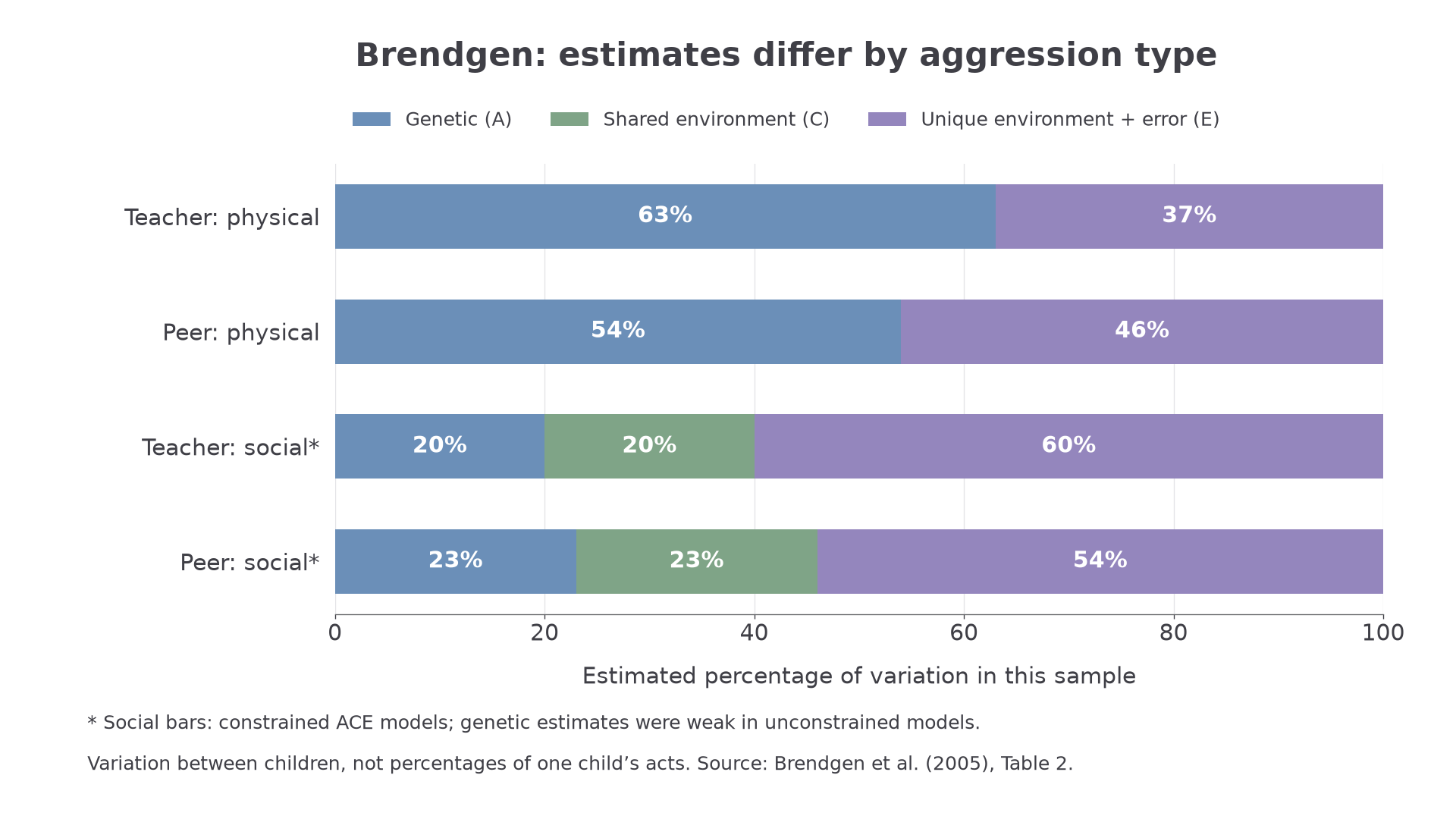
MZ twins were more similar than same-sex DZ twins for physical aggression. The best-fitting physical-aggression models estimated 63% genetic and 37% unique-environmental variation for teacher ratings, and 54% genetic and 46% unique-environmental variation for peer ratings. Shared-environment estimates were zero in these fitted models; this is not proof that families or schools never influence physical aggression in any population.
For social aggression, MZ and DZ similarity was much closer, pointing to greater environmental contribution. In the authors’ selected constrained models, teacher-rated social aggression was estimated as 20% genetic, 20% shared environmental and 60% unique environmental. The corresponding peer estimates were 23%, 23% and 54%. These constrained estimates require caution: unconstrained genetic estimates were weak and not statistically significant, and different simpler models fitted similarly well. The sound headline is stronger environmental contribution and weaker genetic evidence for social than physical aggression, not a precisely established universal “20% genetic rule”.
[DIAGRAM: asset_name: Brendgen variance estimates; asset_slug: edexcel_9ps0_b08_variance_estimates; recommended_method: deterministic_plot; description: Four stacked bars show the reported selected model estimates for teacher and peer ratings of physical and social aggression, with social constrained-model caveat.; caption: These estimates concern variation among children in this sample; they do not divide an individual child’s aggression into genetic and environmental percentages.]
Physical and social aggression were moderately positively related: teacher ratings gave a correlation of 0.43 and peer ratings 0.41. Models of their overlap suggested much shared genetic influence but little overlapping environmental influence. A different model also fitted a directional link from physical to social aggression, rather than the reverse. These were statistical accounts compatible with the observations, not experimental proof of a developmental causal sequence.
The sex pattern depended on the informant. Teachers rated boys as more physically aggressive and girls as more socially aggressive; peers rated boys higher in both forms. Therefore the study cannot justify a simple claim that social aggression is inherently female. The sample was insufficient for a detailed sex-specific genetic analysis.
Developmental interpretation and limits
The findings suggest that the form aggression takes may depend on development and experience as well as inherited differences.
The authors proposed that children with aggressive tendencies might initially use physical means and later acquire socially manipulative strategies as language and social understanding develop. Modelling and reinforcement from other people could influence which strategies are used. This interpretation helps explain how related dispositions might appear in different behaviours. It is a proposed account: the study did not experimentally identify a particular parenting style, gene or peer experience as the cause of a child’s social aggression.
Convergence across teachers and peers supports the main contrast between physical and social aggression, and the twin design could address inherited similarity more directly than an ordinary correlation between parenting and aggression. Population-based recruitment also avoided selecting only children receiving treatment. Nonetheless, estimates depend on twin-model assumptions, including similar relevant environments for MZ and DZ twins. More similar treatment of MZ twins could contribute to their similarity. Measurement error is included in E, so the unique-environment estimate cannot all be read as verified effects of different friends or teachers.
Six-year-old behaviour cannot be assumed to have the same pattern in adolescents or adults. The narrow age reduces age variation within the study, but limits developmental generalisation. Attrition, regional recruitment and a relatively modest sample for complex genetic models increase uncertainty. The finding of a compatible physical-to-social model needs longitudinal measurements of the behaviours at different times to test temporal order more directly.
Ethical protection extends beyond consent. Nominations and aggression ratings can harm children if classmates learn who was labelled aggressive. Confidential handling, avoiding public labels and respecting withdrawal matter. A contemporary classroom practical should not reproduce peer accusations simply because the historical study used nominations.
Brendgen’s findings support a greater environmental contribution to social than physical aggression at age six. They leave room for change and do not establish genetic inevitability, a specific “aggression gene”, or a causal physical-to-social pathway.