4.1.1, 4.1.2 - Classical conditioning and Pavlov
A sound can come to produce a response that it did not originally produce. Classical conditioning in 4.1.1 explains how this happens and how the response can weaken, return or spread to similar stimuli; Pavlov’s dog experiments in 4.1.2 provide evidence for these processes.
Stimuli and reflexes
Classical conditioning begins with a response that already occurs without the particular association being learned.
A stimulus is an event that can affect an organism, such as food entering a dog’s mouth. A response is what the organism does, such as secreting saliva. An unconditioned stimulus (UCS) elicits an unconditioned response (UCR) without the relevant learning: food in the mouth produces salivation. Unconditioned means unlearned in this relationship, not uncontrolled by the experimenter.
A neutral stimulus (NS) initially does not elicit the target response. A metronome may make a dog look towards a sound, but before conditioning it does not produce the learned salivation being investigated. Neutral therefore does not mean that the sound has no effect at all.
Classical conditioning
Learning an association between stimuli, through which a previously neutral stimulus comes to elicit a conditioned response.
After suitable pairing with food, the metronome becomes a conditioned stimulus (CS). Salivation elicited by the metronome alone is the conditioned response (CR). The UCR and CR can look similar, but their labels depend on what elicits them. Food still elicits the UCR after learning; it does not become a CS merely because time has passed.
Consider a fictional person who feels nausea after a strong motion-sickness experience on a boat. The boat’s particular engine sound could become associated with the nausea-producing motion and later elicit nausea before sailing. The sound is the candidate CS, not the nausea itself. Establishing these labels requires knowing the person’s learning history; the example illustrates a mechanism rather than diagnosing a disorder.
Acquiring the association
Acquisition is the process in which the neutral cue becomes an effective signal for the unconditioned stimulus.
In a straightforward conditioning procedure, the metronome starts shortly before food is presented. Food elicits salivation, and the cue and food are paired repeatedly. A later test presents the metronome without food. If the metronome now elicits salivation, it has become a CS. Giving food alone establishes that the food elicits the reflex, but does not establish learning about the metronome.
[DIAGRAM: asset_name: Learning an association; asset_slug: edexcel_9ps0_l01_conditioning_sequence; recommended_method: image_gen; description: Before conditioning food elicits salivation and the metronome does not elicit learned salivation; during conditioning the metronome precedes food; afterwards the metronome alone elicits salivation.; caption: The metronome changes from a neutral stimulus to a conditioned stimulus through association with food.]
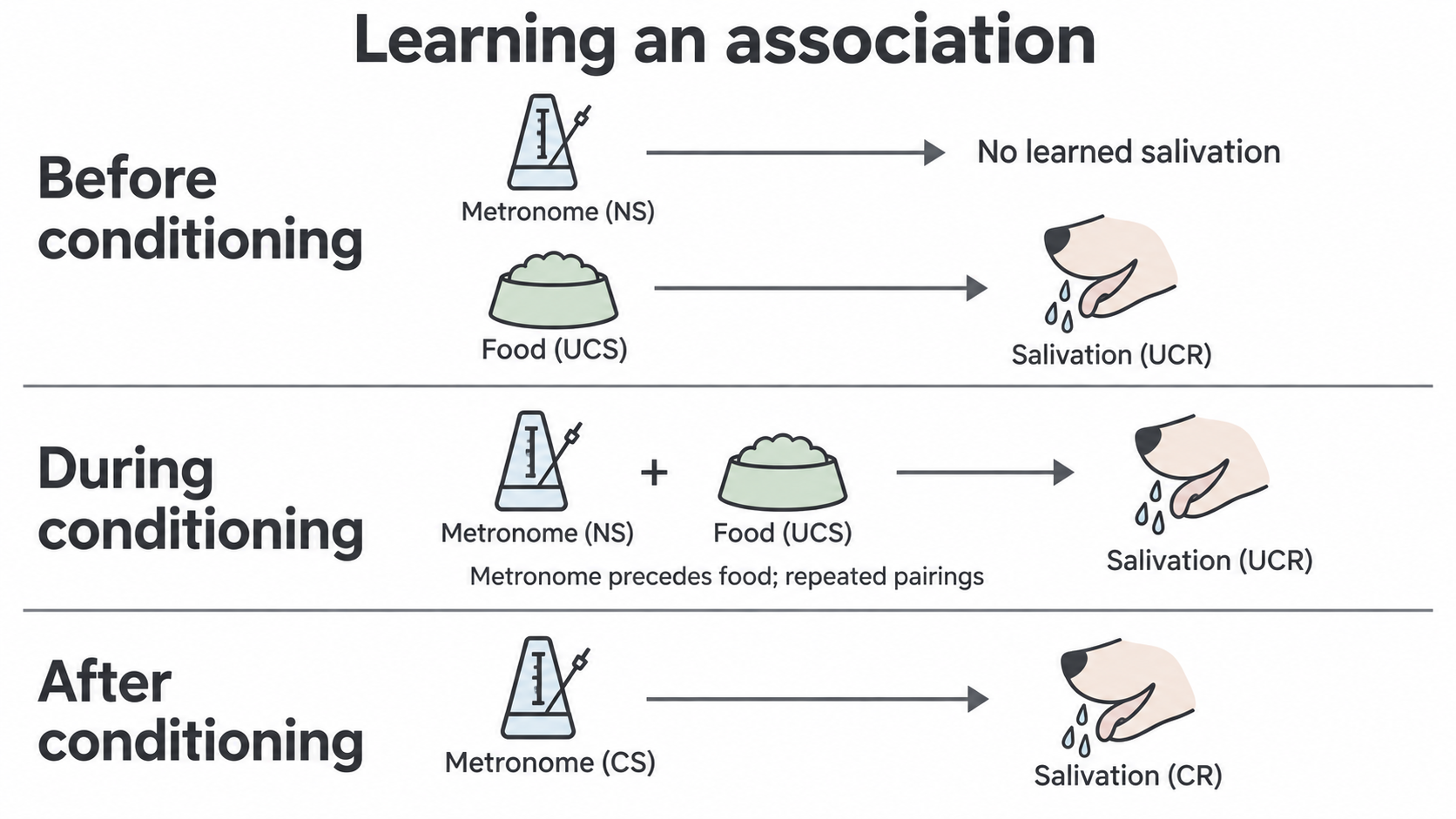
The sequence matters because a cue that reliably precedes food can signal its arrival. Pavlov’s demonstrations used several kinds of cue, including a metronome, rather than one universal bell experiment. Conditioning is not simply “hearing a sound many times”: a sound repeatedly presented without the UCS need not acquire the target response. Nor does the dog have to perform a deliberate action to earn the food. The experimental relationship is between stimuli, rather than a consequence made dependent on a voluntary behaviour.
Acquisition is demonstrated by comparing the response to the cue before and after pairing. A useful experiment controls other signals so that food smells, the observer’s movements or a door opening do not become the effective CS instead. The familiar shorthand “sound → salivation” is the outcome to be explained, not a description of the entire learning procedure.
Extinction, recovery and generalisation
A conditioned response can change when the signal no longer predicts the UCS or when similar signals are encountered.
Extinction occurs when repeated presentation of the CS without the UCS weakens the CR. If the metronome is repeatedly sounded without food, salivation to it decreases. This is different from not playing the sound for several days: extinction involves experiencing the CS without its usual outcome. It is also different from hunger being satisfied, which changes the animal’s state rather than teaching that this particular cue is no longer followed by food.
Continue this lesson.
You’re previewing NovaLearn without an account. Create a free account to read the rest.
Create free account