7.1.1 - Bowlby’s attachment theory
Learn how Bowlby explained attachment as a system that protects a developing child, how early relationships may shape later expectations, and why evidence supports some parts of this account more strongly than others.
Attachment and survival
Attachment is a lasting emotional bond with a particular person, rather than simply enjoying company or depending on someone for food.
Attachment
An enduring emotional bond in which a person seeks proximity, comfort and security from a particular attachment figure.
An infant can be attached while happily playing away from a caregiver. The bond persists even when attachment behaviour is inactive. Attachment behaviours, such as crying, smiling, reaching, clinging and following, help bring the child and caregiver together. The behaviour and the underlying relationship are therefore different things.
Bowlby’s evolutionary explanation proposes that humans have an inherited readiness to form attachments because proximity to a protective adult increased infants’ chances of surviving. Human infants are dependent for a long period. A child who signals distress and an adult who responds to that signal form a protective system: the signal makes care more likely, and care can reduce distress. These signals are sometimes called social releasers because they can elicit a caregiver’s response. They are not deliberate manipulation by the baby.
The account is interactionist. An evolved capacity does not specify the identity of a caregiver or every feature of a relationship. Repeated experience helps focus behaviour on familiar people. Feeding can be an occasion for this interaction, but attachment is not explained solely by associating a person with milk. Comfort, protection and responsive interaction also matter. Bowlby’s original papers often used “mother”; the psychological function can be performed by another consistent caregiver. The theory should not be turned into a claim that only a biological mother can provide an attachment relationship. Bowlby’s original theoretical paper
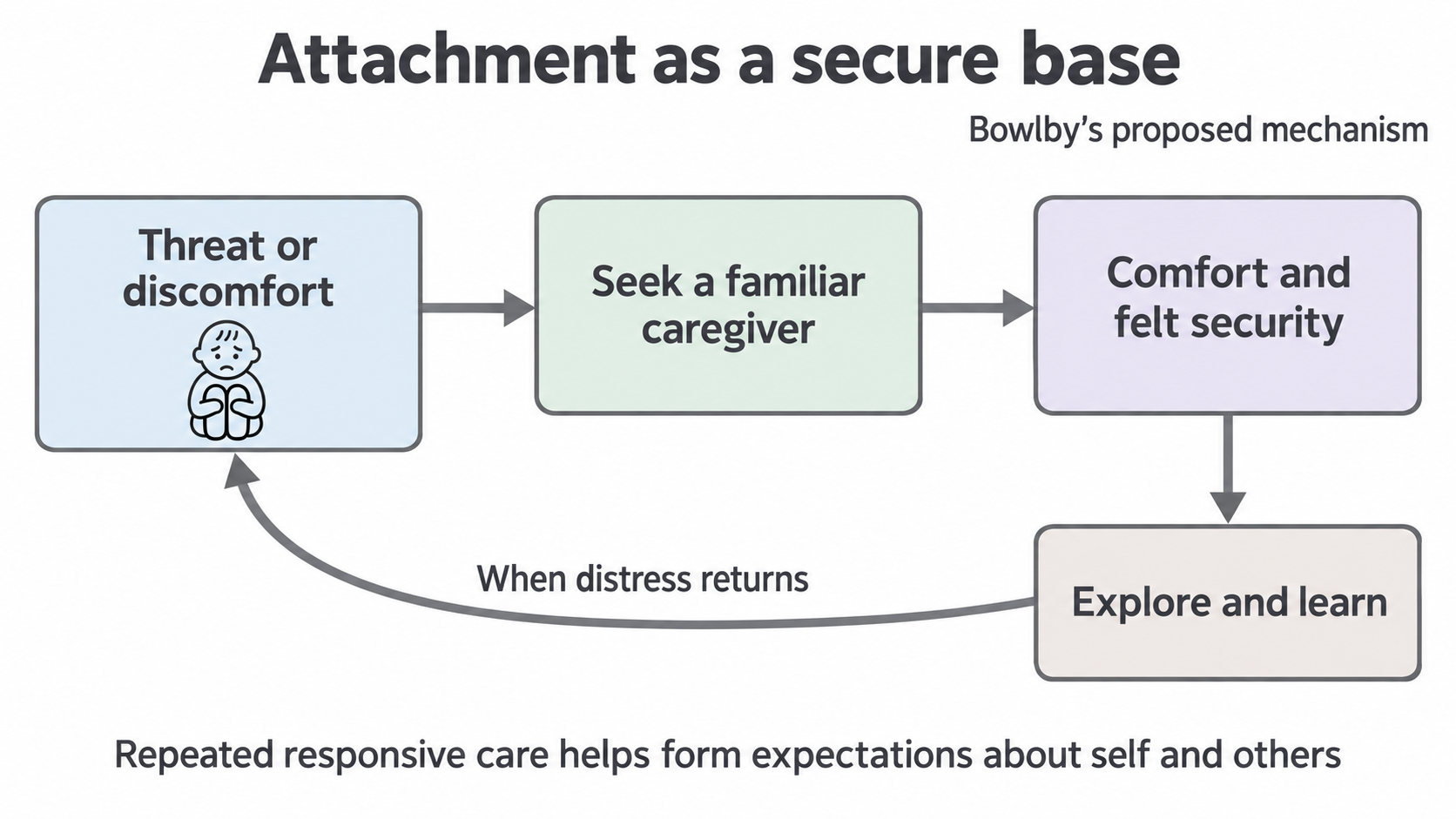
Consider a toddler who plays confidently until a loud noise occurs, then runs to a familiar adult. Bowlby would explain the change as activation of attachment behaviour by threat. Once reassured, the child may resume exploration. The ability to return for comfort can support independence rather than contradict it.
[DIAGRAM: asset_name: Attachment as a secure base; asset_slug: edexcel_9ps0_ch01_secure_base; recommended_method: image_gen; description: Bowlby’s proposed sequence from threat to seeking a familiar caregiver, comfort and renewed exploration, with a return when distress recurs.; caption: A familiar caregiver can provide a secure base from which a child explores and a haven of comfort when distressed.]
Monotropy and care networks
Monotropy concerns the special importance Bowlby gave to a principal attachment figure, rather than a prohibition on all other relationships.
Monotropy
Bowlby’s proposal that attachment behaviour tends to become especially focused on one principal figure, with other attachment figures potentially arranged in a hierarchy.
A child may prefer one familiar adult when intensely distressed while also having attachments to another parent, grandparents or other regular caregivers. In Bowlby’s account the main figure has a particularly important organising role. Continuity means reliable access to a stable relationship over time; it does not mean an adult must remain physically beside the child every minute. Sensitivity means noticing the child’s signals, interpreting them appropriately and responding suitably. It does not mean satisfying every request or preventing all frustration.
The distinction matters for application. Replacing an unfamiliar adult every day may supply food and supervision but give a child little opportunity to build a predictable relationship. A small stable care network can provide familiarity across a necessary separation. Conversely, counting hours spent with someone does not establish how responsive that person is.
Monotropy is a testable claim about relative importance. Evidence of several meaningful attachments challenges a rigid “only one attachment counts” interpretation. It does not automatically disprove a weaker hierarchy claim, because several relationships could coexist with a preferred figure. To discriminate between these accounts, research would need to compare the functions and predictive importance of different relationships, not merely count familiar adults. Care arrangements and cultural practices differ; no particular family structure alone establishes security or insecurity.
Development and sensitive periods
Attachment becomes more selective as infants gain experience and develop the abilities needed to recognise, approach and communicate with particular people.
Early in life, behaviours such as crying and smiling can attract care before a baby has a clearly organised selective attachment. Familiarity and discrimination develop gradually. During later infancy, selective proximity-seeking, following and separation distress become more evident. As language and understanding develop in the preschool years, the child can increasingly appreciate a caregiver’s plans and negotiate separation and reunion. Bowlby described this later relationship as a goal-corrected partnership. For example, understanding “I will return after lunch” can help an older child in a way that the same words may not help a young infant.
Bowlby’s early account emphasised a critical period for forming an attachment in early childhood. A strict critical-period claim means missing the opportunity produces lasting consequences that later experience cannot fully repair. A sensitive period is a more flexible claim: early experience is especially influential, but meaningful development can still occur later. These are different predictions, not interchangeable labels.
Continue this lesson.
You’re previewing NovaLearn without an account. Create a free account to read the rest.
Create free account