7.3.4 - Li’s child-care timing study
Li and colleagues (2013) investigated whether the timing of high-quality child care mattered for cognitive, language and preacademic development. Following children across infancy and preschool allowed them to compare care histories, while statistical matching addressed some of the family differences that make causal interpretation difficult.
Question, sample and measures
The study examined quality across two developmental periods rather than treating all non-parental care as one experience.
The main questions were whether high-quality infant–toddler care was associated with early cognitive performance, whether high-quality preschool care was associated with later skills, and whether high quality in both periods was associated with the strongest outcomes. Preacademic skills are skills relevant to readiness for school, such as recognising letters and solving early number problems; they are not a measure of every aspect of wellbeing.
Li's team analysed existing longitudinal data from the NICHD Study of Early Child Care. In 1991 the original study enrolled 1,364 families with healthy full-term newborns at hospitals in ten US sites. Recruitment used a conditionally random plan intended to reflect diversity within those sites. Exclusions included teenage mothers, families planning to move from the catchment area, obvious disabilities at birth and mothers insufficiently conversant in English. This was neither a nationally representative random sample nor random assignment to care. The original cohort size must not be confused with the number in every later analysis.
From one month after birth, the study collected family interviews and questionnaires, home and care observations, and child assessments. Li included children with observed care-quality scores. The quality measure was the Observational Record of the Caregiving Environment (ORCE). Trained observers rated child-focused interactions on four-point scales. Each assessment used four 44-minute observations, across two days at 6, 15, 24 and 36 months and on one day at 54 months. Higher scores represented warmer, more responsive interactions, greater cognitive stimulation and exploration, and less emotional detachment. This captures interactions experienced by the child rather than using cost or building appearance as a proxy for quality.
At 24 months, the Bayley Mental Developmental Index assessed cognitive development. At 54 months, measures included Memory for Sentences, a language composite, Letter–Word Identification and Applied Problems. These cover memory, language and early literacy/mathematics. The analysis did not test an all-purpose outcome such as “happiness”, attachment security or aggression. Conclusions must remain about the measured domains.
Care histories and propensity matching
Because families chose their care arrangements, the researchers needed to reduce selection differences before comparing outcomes.
They averaged ORCE observations at 6, 15 and 24 months for infant–toddler quality, and at 36 and 54 months for preschool quality. A cutoff of 3.0 distinguished lower from higher quality, with scores above 3.0 counted as high. The four observed histories were low–low, high–low, low–high and high–high, in chronological order. Table 2 of the report lists 251, 162, 139 and 186 children respectively in these four groups: 738 children with observations for both periods. Other contrasts used different available groups, so there was no single universal matched sample of 1,364.
[DIAGRAM: asset_name: Care-quality histories; asset_slug: edexcel_9ps0_ch08_care_quality_histories; recommended_method: image_gen; description: Four observed low or high care-quality histories across infant–toddler and preschool periods, compared on four 54-month outcomes, with explicit non-random assignment and measured-confounder caveats.; caption: Li compared four observed quality histories; the arrows show time, not random assignment or guaranteed improvement.]
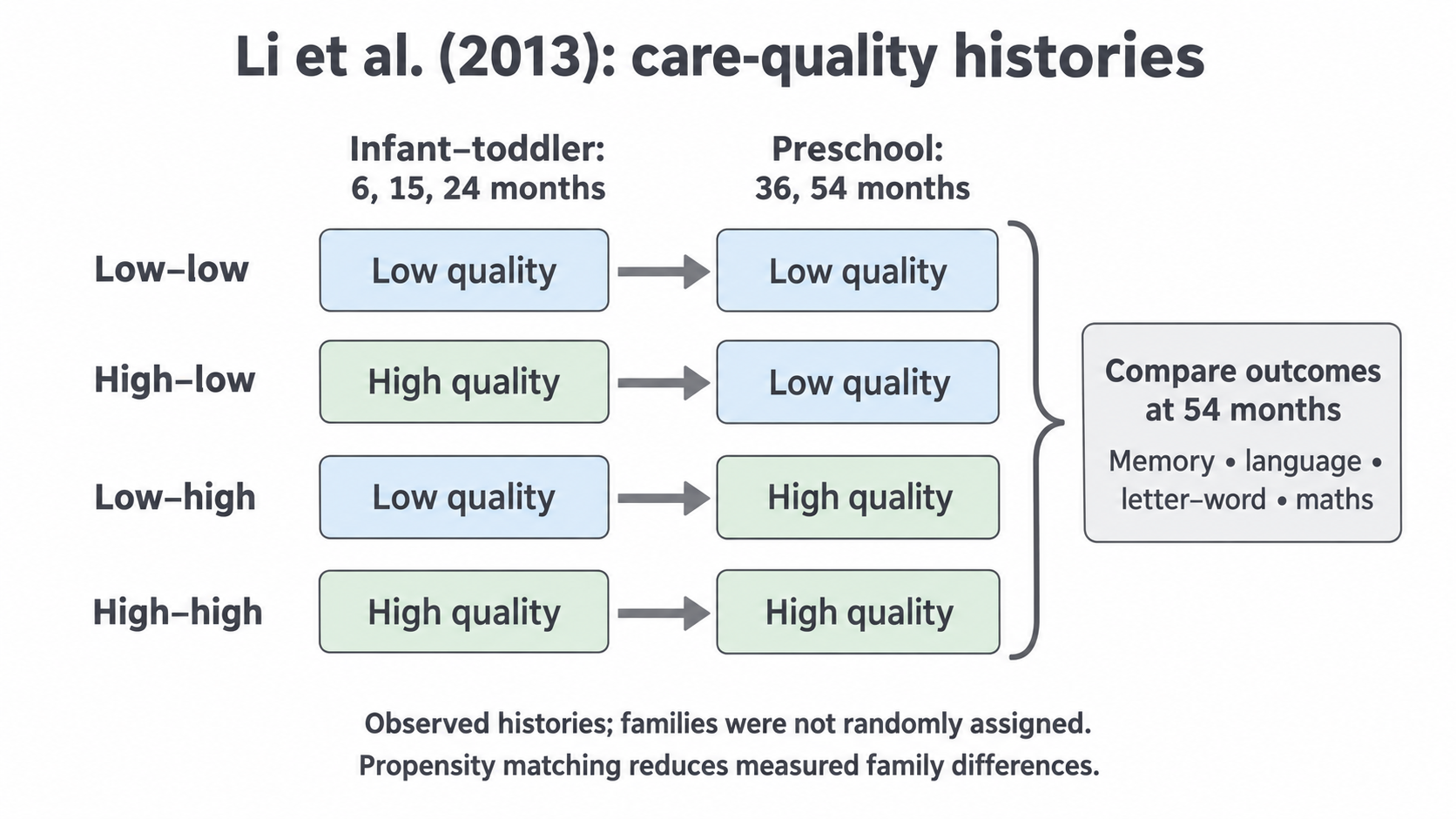
Children in high-quality care often had more advantaged family circumstances. Income, parental education and beliefs about child rearing could influence both access to care and developmental outcomes. A raw difference might therefore reflect those factors as well as care quality.
Propensity score
A propensity score estimates the probability of membership in a care-quality group from measured characteristics. Matching compares people with similar estimated probabilities, to reduce measured selection differences.
Li used logistic models based on detailed covariates such as parental education, income-to-needs, maternal attitudes and child characteristics. Models for the preschool-quality contrast also used updated family measures and the child's 24-month cognitive score. For each contrast, a child in the target group was matched to a comparison child with a similar propensity score within the same research site. The researchers checked whether measured covariates were balanced after matching, then compared outcomes and used regression adjustment. Further propensity-weighted analyses checked robustness.
Continue this lesson.
You’re previewing NovaLearn without an account. Create a free account to read the rest.
Create free account