8.7-8.10 - Stellar colour, temperature and evolution
Stars are not all the same colour, and that colour is not just decoration: it gives information about the star's surface temperature. This lesson also follows what happens to stars after their long main sequence stage. The key exam skill is to give the correct sequence for a star of similar mass to the Sun, then give the different ending for a star with a larger mass.
Classifying stars by colour
Stars can be classified according to their colour. At this level, classification means sorting stars into groups using an observable property. For colour, the useful groups are usually described with words such as blue, blue-white, white, yellow, orange and red.
This is a qualitative classification. You are not expected to calculate a star's colour, measure a spectrum, or place the star on a Hertzsprung-Russell diagram in this lesson. You only need the idea that the colour of the light from a star can be used as a way of grouping stars.
The Sun is often described as a yellow star. A red star and a blue-white star would be placed in different colour classes because the dominant colour of their emitted light is different.
Colour and surface temperature
A star's colour is related to its surface temperature. The important order is:
As you move along that order from blue / blue-white to red, surface temperature decreases. So blue or blue-white stars have the highest surface temperatures, while red stars have the lowest surface temperatures.
[DIAGRAM: asset_name: Stellar colour, temperature and evolution - diagram 01; asset_slug: p65_stellar_colour_temperature_and_evolution__diagram_01; recommended_method: image_gen; description: White 16:9 NovaLearn pale-palette diagram with grey outlines and dark-grey labels. Five equal-sized stellar discs progress from blue/blue-white through white, yellow and orange to red, beneath one decreasing-temperature arrow.]
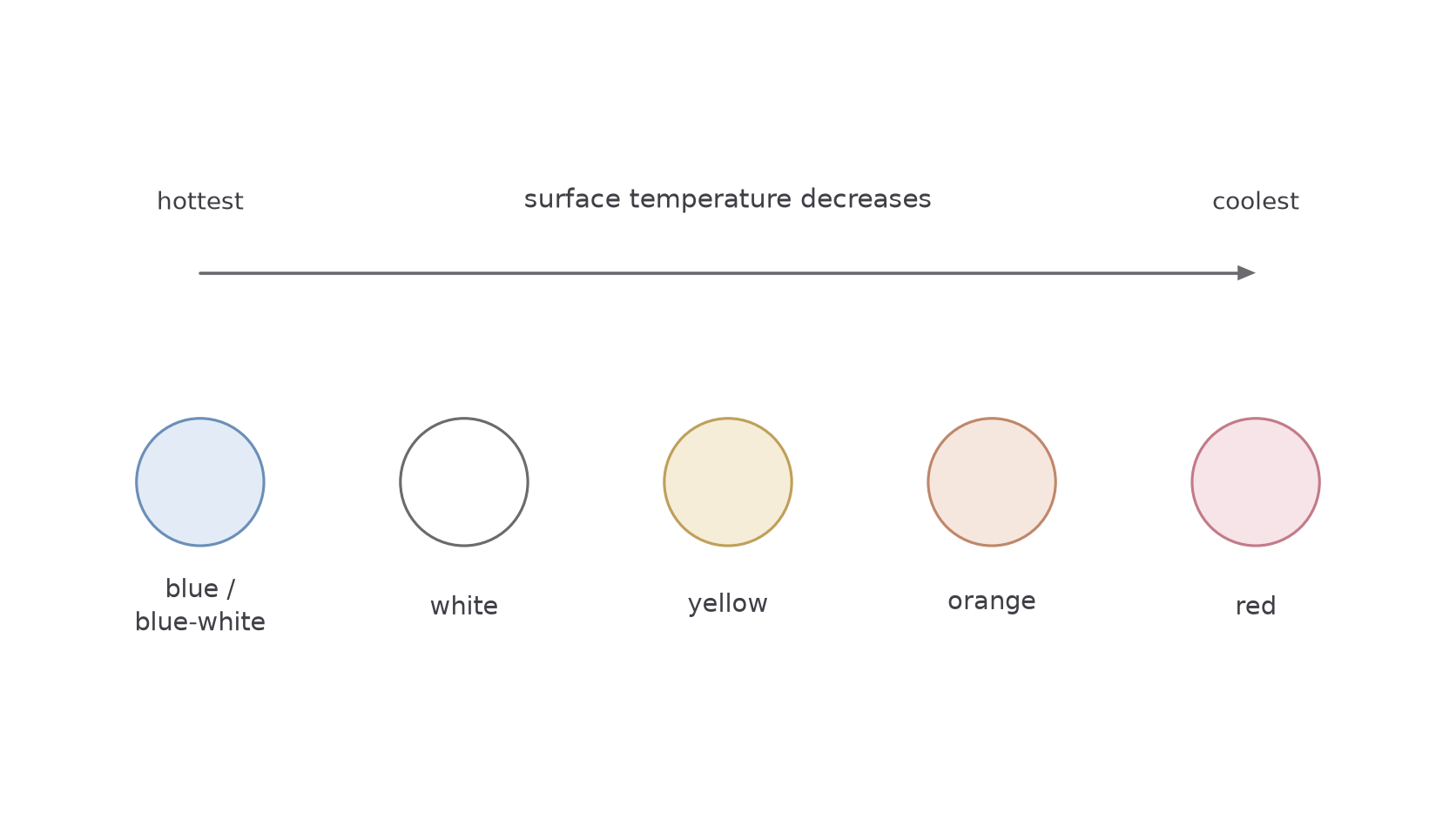
You can see the same pattern on Earth when a piece of metal is heated: it glows red first, then orange and yellow, and then white as it gets hotter.
Be careful with the word temperature. This lesson uses the temperature at the star's surface, not the temperature deep in the core. Also avoid the everyday misconception that red means hottest, as with red flames or the red tap for hot water: in stars, a blue or blue-white colour means hotter than red.
Worked example: a question says that Star A appears blue-white and Star B appears red.
The correct comparison is that Star A has the higher surface temperature. Star B has the lower surface temperature because red stars are cooler than blue-white stars.
Sun-like star evolution
Stars form from a nebula, a large cloud of gas and dust. Gravity pulls material in the nebula together, and the material heats up as it is pulled in. When the centre is hot enough, nuclear fusion starts and a star is formed. When a star is formed and spends most of its life steadily releasing energy, it is a main sequence star.
For a star of similar mass to the Sun, the required sequence is:
Main sequence star
A main sequence star is a star in the long, stable stage of its life in which hydrogen fuses into helium in its core.
During the main sequence stage, a star is stable for a long time: the inward pull of gravity is balanced by the outward pressure from the energy released by fusion. As hydrogen in its core runs low, the core contracts and the outer layers expand and cool: the star becomes a red giant. Its red colour fits the colour rule: a cooler surface looks red. It later sheds its outer layers, leaving a small, hot, dense white dwarf. The white dwarf no longer sustains fusion and gradually cools. This explains the four named stages; it does not require extra stages to be memorised.
The Sun is not expected to become a neutron star or a black hole. Those are outcomes for stars with much larger starting masses, not for stars of similar mass to the Sun.
Continue this lesson.
You’re previewing NovaLearn without an account. Create a free account to read the rest.
Create free account