3.23-3.24P - Sound waves and human hearing
Sound is a wave, but not the kind of wave that looks like a drawn up-and-down curve. In this lesson you will describe sound as a longitudinal wave, recognise that sound waves can reflect and refract, and use the Edexcel human hearing range of 20-20 000 Hz.
Sound is longitudinal
A sound wave in air is produced when something vibrates. The vibration pushes and pulls on nearby air particles. Those particles then push and pull on neighbouring particles, so the disturbance travels away from the source.
Because each particle passes the vibration on to its neighbours, sound needs a medium (a solid, liquid or gas) to travel through. Sound cannot travel through a vacuum, where there are no particles to pass the vibration on.
The important Edexcel word is longitudinal. In a longitudinal wave, the particles vibrate parallel to the direction of energy transfer. For sound in air, this means the air particles vibrate backwards and forwards along the same line as the sound wave travels.
This produces compressions and rarefactions. A compression is a region where particles are closer together than usual. A rarefaction is a region where particles are further apart than usual. The compressions and rarefactions move through the air; the individual particles only vibrate about their positions.
[DIAGRAM: longitudinal_sound_wave: Sound waves and human hearing - diagram 01; asset_slug: p31_sound_waves_and_human_hearing__diagram_01; recommended_method: image_gen; description: Monochrome 16:9 diagram of a tuning fork producing a longitudinal sound wave in air, with alternating compressions and rarefactions, a rightward direction of energy transfer arrow, and a horizontal double-headed particle vibration arrow parallel to the direction of travel.]
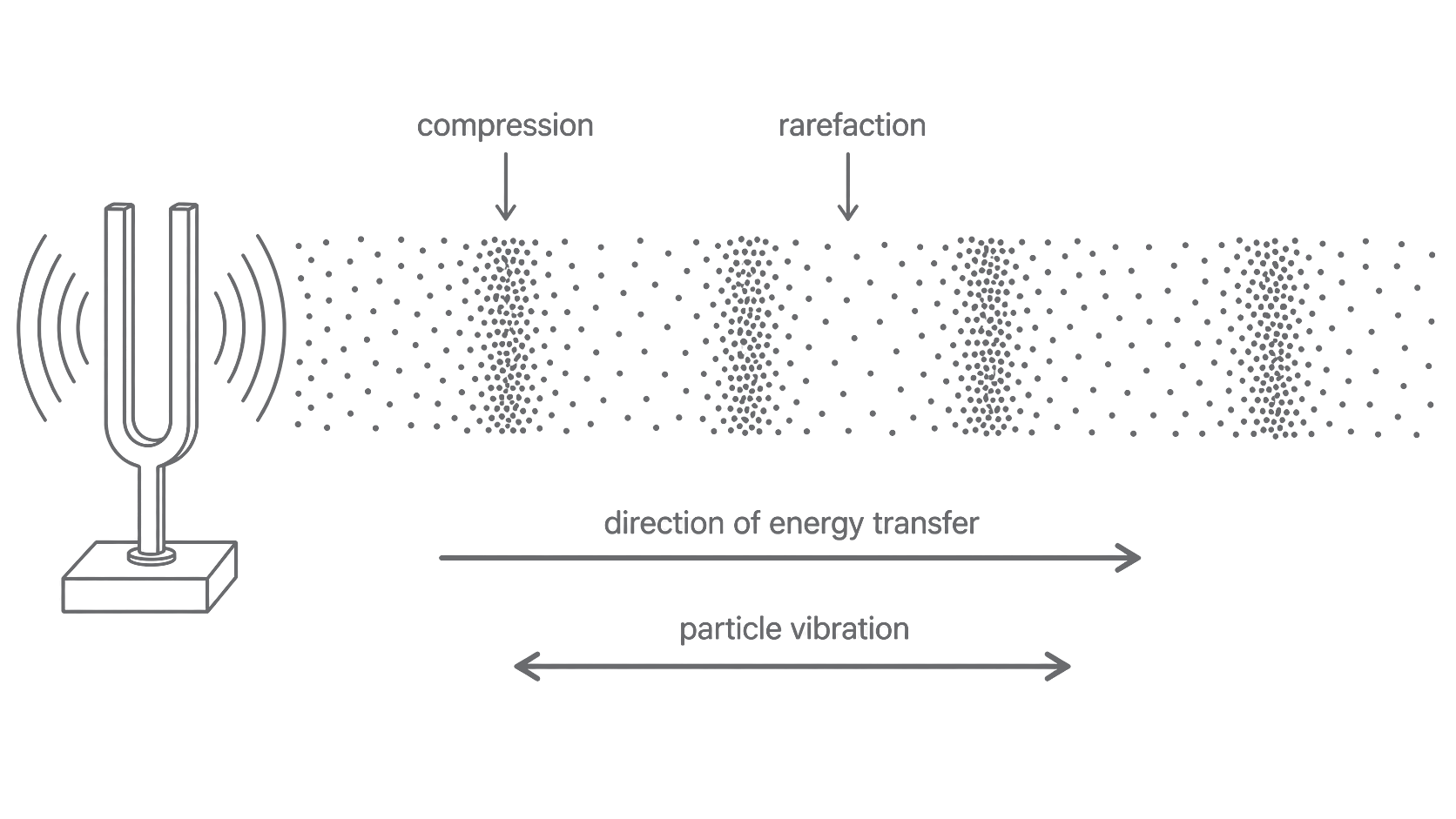
Avoid describing sound as "up and down" just because a sound wave is sometimes drawn as a curve on a graph. That graph is a representation of changing pressure or displacement; the physical sound wave in air is longitudinal.
Sound reflection
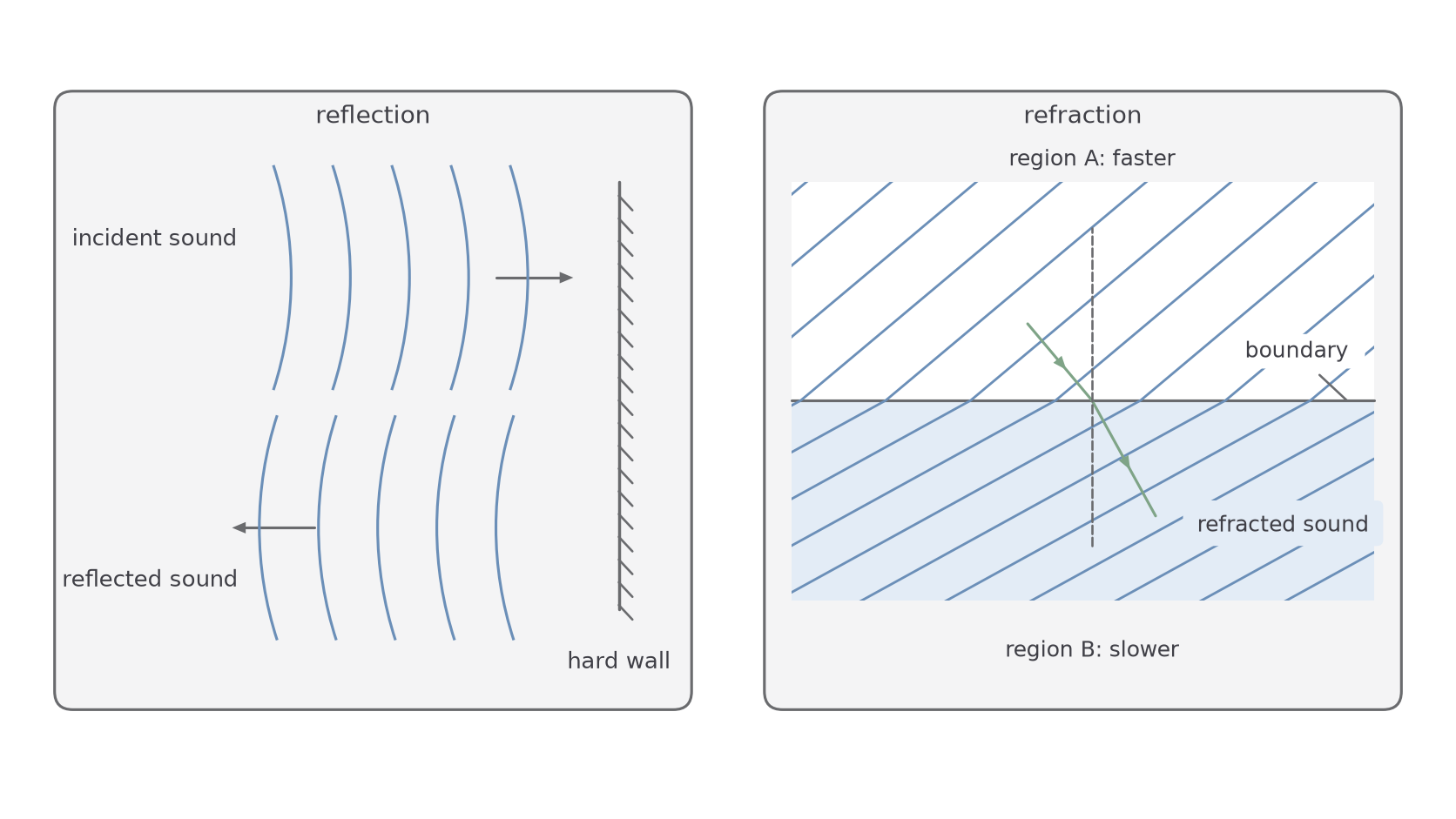
Sound waves can be reflected. Reflection means the wave meets a boundary and travels back into the original region instead of continuing straight through.
A familiar example is an echo. When a sharp sound reaches a large hard surface, such as a wall or cliff, some of the sound wave is reflected back. If the reflected sound arrives noticeably later than the original sound, you hear it as a separate echo.
Reflection does not turn sound into a different type of wave. The reflected sound is still longitudinal: particles in the air still vibrate backwards and forwards parallel to the direction the reflected wave travels.
[DIAGRAM: sound_reflection_and_refraction: Sound waves and human hearing - diagram 02; asset_slug: p31_sound_waves_and_human_hearing__diagram_02; recommended_method: image_gen; description: NovaLearn pale-palette two-panel sound diagram: incident and reflected wavefronts at a hard wall; continuous straight wavefronts refract from a faster to a slower region with angles 40° and 28.822°, shorter wavelength and perpendicular propagation arrows.]
Continue this lesson.
You’re previewing NovaLearn without an account. Create a free account to read the rest.
Create free account