8.1-8.3 - Solar system, galaxies and universe
This lesson is about scale: where our solar system fits, what a galaxy is, and what the universe contains. It also links that scale to gravity by explaining why gravitational field strength, g, is not the same on every planet or moon. The most important exam habit is to use the correct words for each level: solar system, galaxy and universe are not interchangeable.
Required units
In astrophysics questions, familiar mechanics units still matter. Pearson can ask for a unit directly, or expect it at the end of a calculation or comparison.
Use these units accurately:
| Quantity | Unit name | Unit symbol |
|---|---|---|
| mass | kilogram | kg |
| distance or length | metre | m |
| time | second | s |
| speed | metre per second | m/s |
| acceleration | metre per second squared | m/s² |
| force or weight | newton | N |
| gravitational field strength | newton per kilogram | N/kg |
Gravitational field strength can be written in N/kg. Near a planet or moon, the same numerical value can also be thought of as an acceleration in m/s², but in this lesson N/kg is the clearest unit because g tells you the gravitational force on each kilogram.
For example, g = 9.8 N/kg means each 1 kg of mass has a weight force of about 9.8 N at that place.
Solar system and Milky Way
Our solar system contains the Sun and the objects held near it by gravity, including planets, dwarf planets, moons, asteroids and comets. For this specification point, you do not need orbit calculations; you just need the correct scale relationship.
Our solar system is inside the Milky Way galaxy. The Sun is one star in that galaxy, so the solar system is much smaller than the Milky Way.
[DIAGRAM: asset_name: Solar system, galaxies and universe - diagram 01; asset_slug: p63_solar_system_galaxies_and_universe__diagram_01; recommended_method: image_gen; description: White 16:9 NovaLearn pale-palette diagram with grey outlines and dark-grey labels. Three neutral panels show complete solar-system orbits, the Milky Way with an off-centre solar-system marker, and multiple galaxies in the universe.]
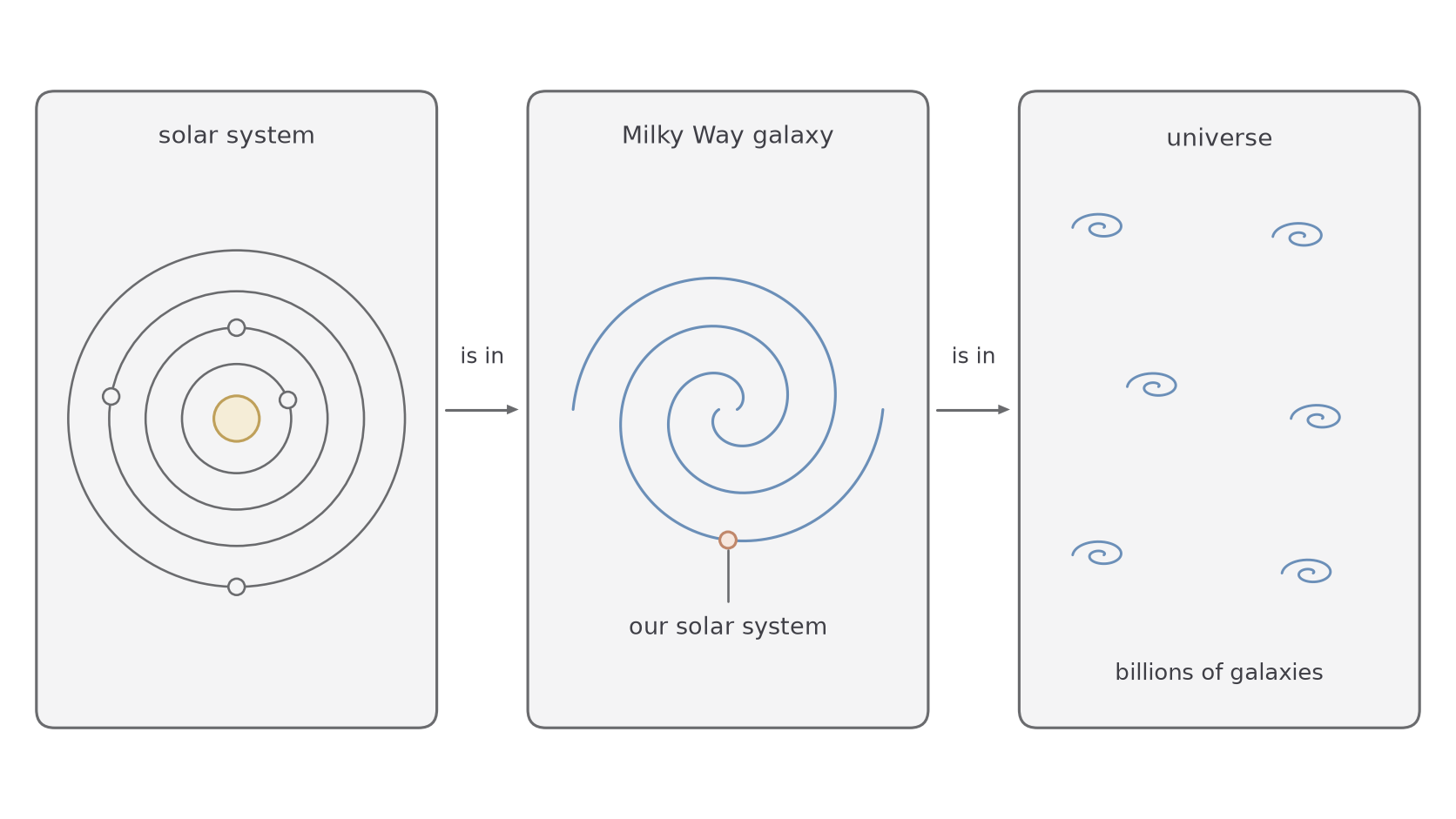
A common mistake is to call the solar system "a galaxy". It is not. The solar system is a system around one star, the Sun. A galaxy is a much larger collection of stars.
Galaxies and the universe
A galaxy is a collection of stars held together by gravity. Large galaxies such as the Milky Way contain billions of stars (some dwarf galaxies contain fewer). The Milky Way is our galaxy, but it is not the only galaxy.
The universe contains all space, matter and energy, including billions of galaxies. That means the scale order is:
- solar system
- galaxy
- universe
The word billions appears twice in this topic, but at different levels. A galaxy contains billions of stars. The universe contains billions of galaxies.
Keep these distinctions sharp:
| Term | What it means in this lesson |
|---|---|
| Solar system | The Sun and objects associated with it |
| Galaxy | A large collection of billions of stars |
| Milky Way | The galaxy that contains our solar system |
| Universe | A large collection of billions of galaxies |
The universe is not described here using evidence for the Big Bang, red-shift or expansion. Those are later specification points. Here, the required idea is the nested scale of stars, galaxies and the universe.
Continue this lesson.
You’re previewing NovaLearn without an account. Create a free account to read the rest.
Create free account