5.5-5.7 - Pressure in solids, liquids and gases
Pressure tells you how concentrated a force is over an area. The same force can have a very different effect depending on whether it is spread out or focused onto a small contact area. In liquids and gases at rest, pressure also has a special property: at one point it acts equally in every direction, while the pressure difference between two depths depends on height, density and gravitational field strength.
Pressure, force and area
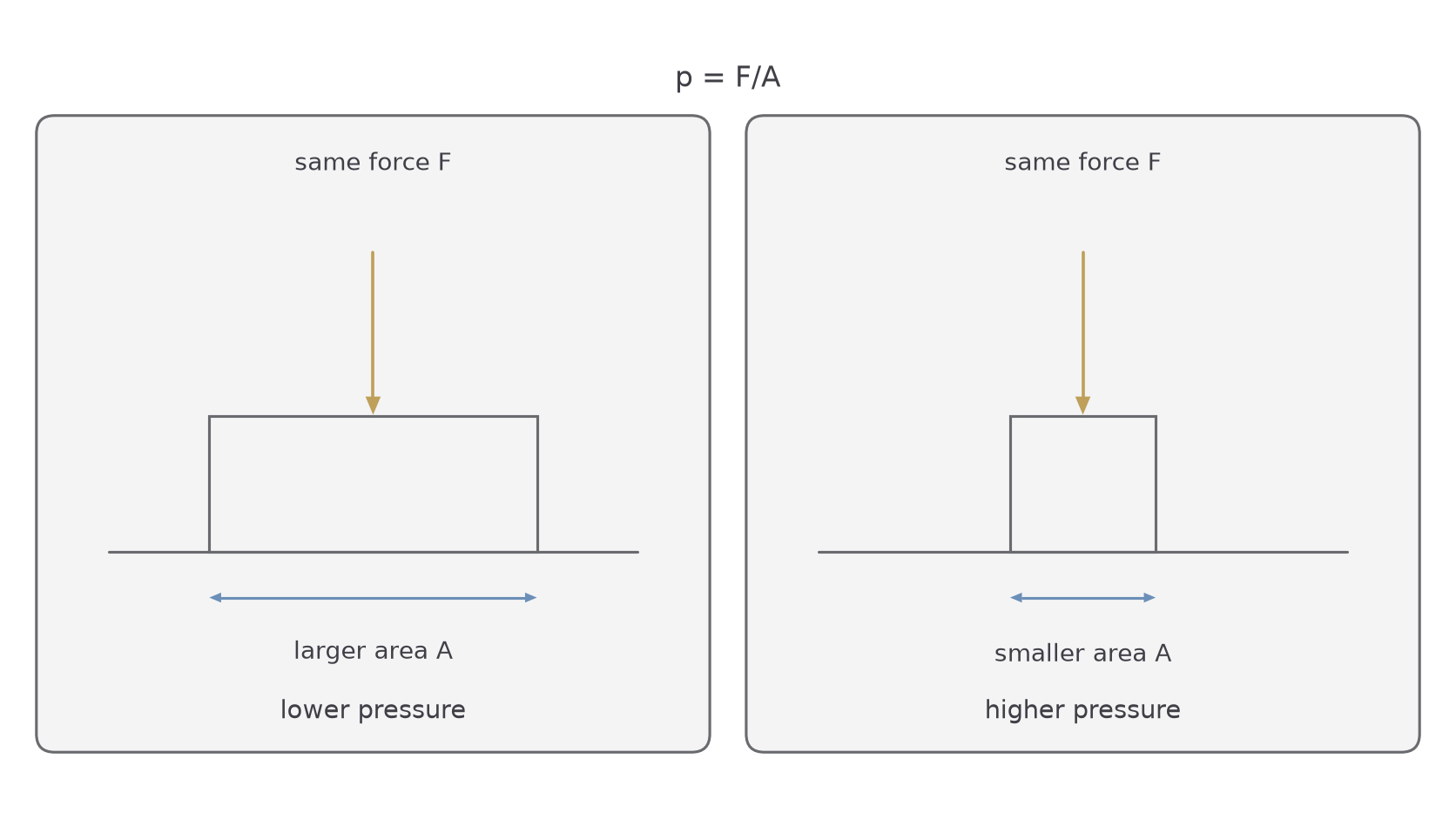
Pressure is the force acting on each square metre of area. If a force is spread over a large area, each square metre gets less force, so the pressure is smaller. If the same force is concentrated on a small area, each square metre gets more force, so the pressure is larger.
Pressure
Pressure is normal force per unit area.
In this lesson, force is measured in newtons, , and area is measured in square metres, . The unit of pressure is the pascal, , and:
The required relationship is:
Pressure, force and area
In this equation, is pressure in pascals, is force in newtons and is area in square metres. The area is the contact area over which the force acts, perpendicular to the force; use the normal component if a force is oblique.
[DIAGRAM: solid_pressure_area: Pressure in solids, liquids and gases - diagram 01; asset_slug: p43_pressure_in_solids_liquids_and_gases__diagram_01; recommended_method: image_gen; description: White 16:9 NovaLearn pale-palette diagram with grey outlines and dark-grey labels. Two neutral panels compare equal downward forces over larger and smaller contact areas, with separate pressure labels and p = F/A.]
Worked example: a force of acts on an area of .
The answer is large because is a fairly small area. Always check that the area is in square metres before using the equation. Since , . Thus ; dividing by 100 would convert a length, not an area.
Changing pressure in solids
The equation shows two direct ways to change pressure.
| Change | Effect on pressure | Reason |
|---|---|---|
| Increase the force, same area | pressure increases | more force acts on each square metre |
| Decrease the force, same area | pressure decreases | less force acts on each square metre |
| Increase the area, same force | pressure decreases | the force is spread out more |
| Decrease the area, same force | pressure increases | the force is concentrated more |
This is why a sharp blade can produce a high pressure with a modest force, while snowshoes reduce pressure by spreading a person's weight over a larger area. In an exam answer, link the change in area or force to the equation. A vague answer such as "it is sharper" is not enough unless it connects to smaller area and therefore higher pressure.
The equation can be rearranged:
Worked example: a support force of produces a pressure of . Find the contact area.
The unit is because the unknown is an area, not a force or a pressure.
Fluid pressure at a point
A fluid is a substance that can flow, so liquids and gases are both fluids. In a gas or liquid at rest, the pressure at one point acts equally in all directions.
This does not mean every point in the fluid has the same pressure. It means that if you choose one exact point, the pressure there is the same whichever direction you face. A tiny pressure sensor held at that point would read the same pressure if it faced up, down, left or right.
Pressure itself is not an arrow quantity. It is a scalar. The force caused by pressure does have a direction: it acts perpendicular to the surface being pushed on. For example, fluid pressure on the side of a container pushes perpendicular to the side wall, while fluid pressure on the bottom pushes perpendicular to the bottom.
A common mistake is to say that liquid pressure acts only downwards because of weight. Weight is the reason pressure increases with depth, but at a single point in a fluid at rest the pressure acts equally in all directions.
Continue this lesson.
You’re previewing NovaLearn without an account. Create a free account to read the rest.
Create free account