2.27P-2.28P - Dangers and uses of static electricity
Static electricity is useful when tiny charged particles need to be moved without touching them. The same effect can also be dangerous when a large amount of charge suddenly discharges as a spark. In this lesson, the key skill is to explain the chain of cause and effect: charge builds up, a force or spark happens, and the outcome follows.
Why static can become dangerous
When fuel flows through a pipe or hose, rubbing and contact between the fuel and the pipe can transfer electrons. This can leave the fuel, pipe, tanker or aircraft with an electrostatic charge. If two nearby objects build up different charges, there is a potential difference between them.
Air is normally an insulator, so charge does not flow across a small air gap easily. But if the potential difference becomes large enough, electrons can jump through the air. That sudden discharge is a spark.
Around aircraft and tankers, the danger is not just the spark itself. Fuel vapour mixed with air can ignite. A spark near this vapour can cause a fire or explosion, especially while fuel is being transferred.
[DIAGRAM: asset_name: Dangers and uses of static electricity - diagram 01; asset_slug: p22_dangers_and_uses_of_static_electricity__diagram_01; recommended_method: image_gen; description: NovaLearn pale-palette two-panel aircraft fuelling comparison: without bonding, separated charge and a spark near fuel vapour; with a clamped bonding cable, electrons can flow both ways so potentials equalise.]
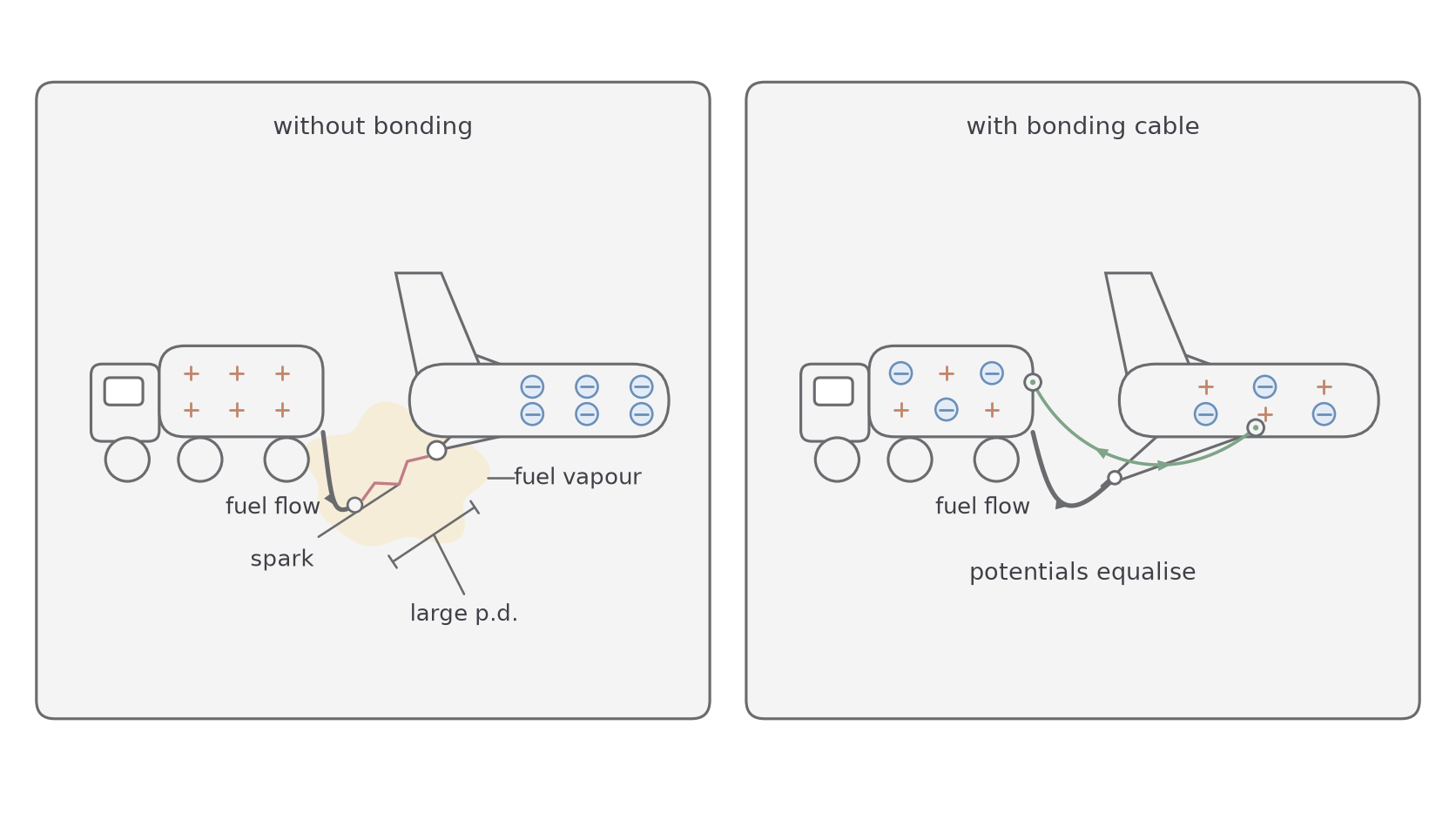
A strong explanation links all three steps:
- fuel movement causes charge to build up
- charge difference can cause a spark
- fuel vapour can ignite, causing fire or explosion
Making fuel transfer safer
The main safety idea is to stop a large potential difference forming between the tanker and the aircraft or tank. This is done by joining the metal parts with a conducting bonding cable before fuel flows. A conductor allows electrons to move, so charge can spread out and the connected objects are kept at the same potential.
Bonding does not mean "there is no charge anywhere". It means there is no large potential difference between the connected objects, so there is much less chance of a spark jumping between them. Equal potential does not require equal amounts of charge on differently sized objects. Earthing is related: a conductor connects the object to the ground, so electrons can flow to or from the ground until the object is no longer charged. In fuel transfer, the exam point is usually that bonding or earthing gives charge a safe conducting path instead of a spark path through air.
The order matters. The bonding cable should be connected before fuel starts to flow and kept connected while fuel is being transferred. If it is connected only after charge has already built up, the act of connecting could itself allow a sudden discharge.
Using electrostatic forces
Static electricity becomes useful when the charged object is very small and light. A tiny toner particle or ink droplet needs only a small electrostatic force to move it. This makes static electricity useful in devices that place material very precisely.
The useful rule is simple:
- unlike charges attract
- like charges repel
- charged objects can be moved by an electric field between charged plates
Electrostatic paint spraying uses the first two rules together. The spray gun gives every paint droplet the same charge, so the droplets repel each other and spread into a fine, even cloud. The object being painted is earthed or given the opposite charge, so the droplets are attracted to it, even to its sides and back, and less paint is wasted.
In exam answers, avoid saying that the device "uses static" as if that is enough. Say what is charged, what it is attracted to or repelled from, and what useful result this causes.
Photocopiers
A photocopier uses charge to make toner stick only where the copy image should appear. The exact charge signs can vary between machines, but the GCSE-level mechanism is the same: an electrostatic image is made on a drum, charged toner is attracted to the image, and the toner is transferred to paper.
Continue this lesson.
You’re previewing NovaLearn without an account. Create a free account to read the rest.
Create free account