3.1-3.4 - Wave units, types and definitions
Waves are one of physics' neatest ways of moving something important without moving a lump of matter from one place to another. In this lesson you will learn the core wave vocabulary, the units Edexcel expects you to recognise, and the difference between transverse and longitudinal waves. The calculations come later; this lesson is about making the words and symbols mean something precise.
What waves transfer
A wave is a travelling disturbance. It may travel through a material, such as water, air or a stretched rope. It may also travel through space, as light and radio waves do. The key idea is the same: the wave transfers energy from place to place.
Waves can also transfer information. A sound wave can carry speech from a speaker to an ear. A radio wave can carry data from a transmitter to a phone. The information is carried by the changing pattern of the wave.
The wave does not carry matter along with it. In water ripples, a floating leaf mostly moves up and down while the ripple travels across the surface. In sound, air particles vibrate back and forth about their positions; the pattern travels onwards, but the same parcel of air is not carried all the way from the speaker to the listener.
This wording matters in exams. Say that waves transfer energy and information without transferring matter. Do not write that particles never move; in many waves the particles do vibrate, but they do not travel with the wave overall.
Wave units
Edexcel expects you to use five units in this part of the waves topic.
| Unit | Symbol | Used for |
|---|---|---|
| degree | ° | angles, such as angles in wave or ray diagrams |
| hertz | Hz | frequency |
| metre | m | distances, such as wavelength |
| metre/second | m/s | wave speed |
| second | s | time, such as period |
Hertz is the unit that students most often leave vague. A frequency in hertz tells you how many complete waves, vibrations or cycles occur each second. For example, 12 Hz means 12 complete vibrations per second.
Metre/second is a speed unit. You do not need the wave speed equation in this lesson, but you should recognise that a wave speed might be written as 340 m/s (roughly the speed of sound in air) or (the speed of light in a vacuum). Those numbers say how many metres the wave disturbance travels each second.
The degree symbol is used for angle, not temperature here. Temperature would use degree Celsius, °C, which is a different unit symbol.
Shape words
Some wave quantities describe the shape you would see in a snapshot of the wave.
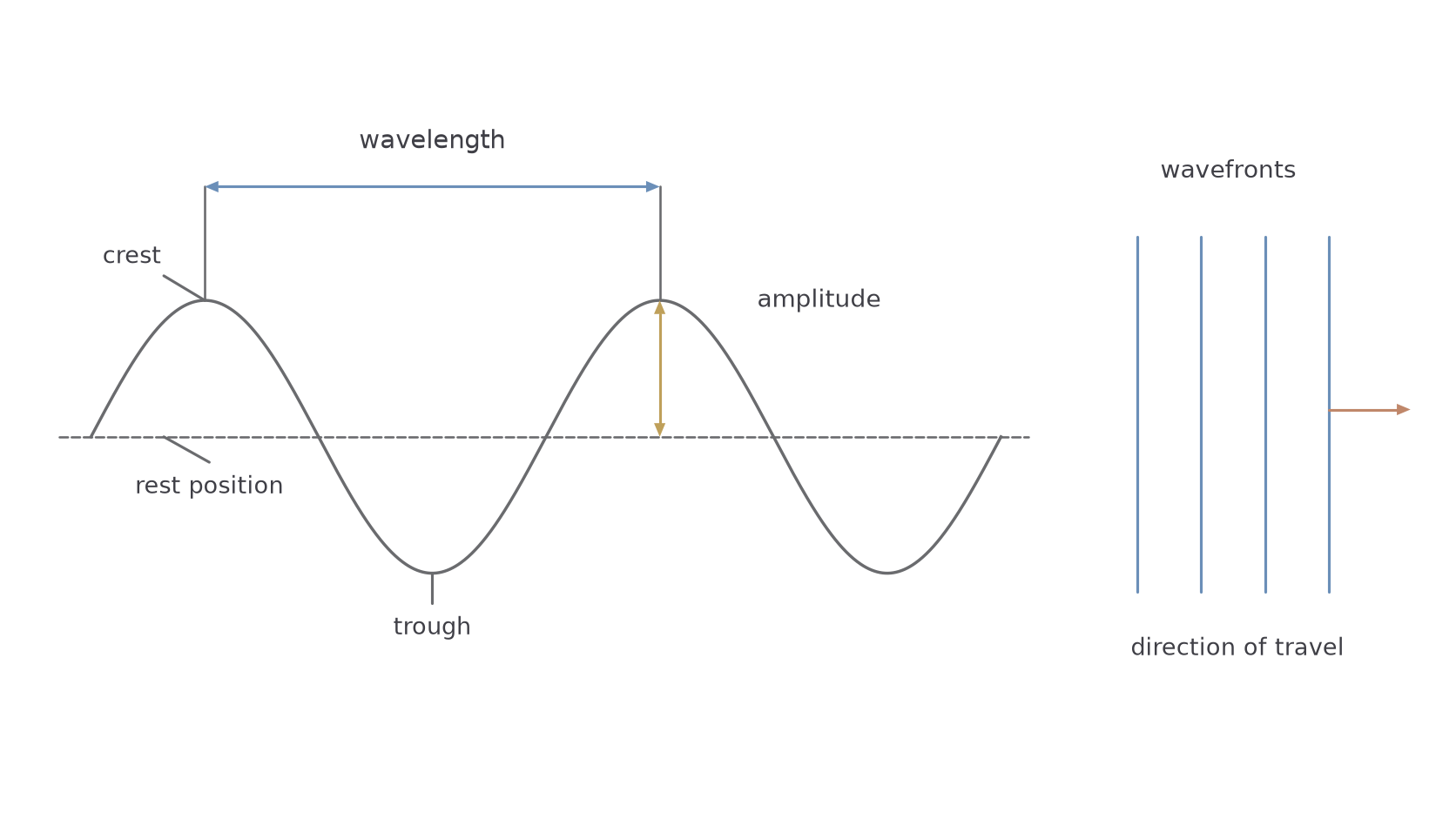
Amplitude is the maximum displacement of a point on the wave from its rest position. In a transverse wave drawn as a curve, it is the distance from the rest position to a crest, or from the rest position to a trough. It is not the distance from crest to trough; that would be twice the amplitude.
Wavelength is the distance from one point on a wave to the matching point on the next wave. On a transverse wave, you can measure it from crest to crest or trough to trough. On a longitudinal wave, you can measure it from one compression to the next compression, or from one rarefaction to the next rarefaction. A crest and the next trough are not matching points: the distance between them is only half a wavelength.
A wavefront is a line joining points on a wave that are in the same stage of vibration. For a set of straight water ripples, each ripple crest can be drawn as a wavefront. Wavefronts are useful because the direction of travel is at right angles to the wavefronts.
[DIAGRAM: asset_name: Wave units, types and definitions - diagram 01; asset_slug: p23_wave_units_types_and_definitions__diagram_01; recommended_method: image_gen; description: NovaLearn pale-palette true sinusoidal wave with crest, trough, rest position, exact crest-to-crest wavelength and rest-to-crest amplitude arrows; inset parallel wavefronts with a perpendicular direction-of-travel arrow.]
Continue this lesson.
You’re previewing NovaLearn without an account. Create a free account to read the rest.
Create free account