5.2P, 5.12P-5.14P - Specific heat capacity units, equation and practical
Specific heat capacity tells you how much energy is needed to change the temperature of a material. Pearson Edexcel expects you to know the unit, use the equation for change in thermal energy, and describe how to investigate specific heat capacity for water and solids. The practical is really a careful energy accounting task: measure the energy transferred, measure the temperature change, then judge how well the experiment kept that energy in the material being tested.
Meaning and unit
For an object with net energy input, negligible work done and no change of state, its thermal store and temperature increase. Different materials need different amounts of energy for the same temperature change.
Specific heat capacity
Specific heat capacity is the energy required to change the temperature of an object by 1 degree Celsius per kilogram of mass.
The Edexcel unit for specific heat capacity is:
Read this as joules per kilogram degree Celsius. For example, if a material has a specific heat capacity of , then of energy is needed to raise the temperature of of that material by .
The "per kilogram" part matters. A object of the same material needs twice as much energy for the same temperature rise as a object. The "per degree Celsius" part also matters: a temperature rise needs ten times the energy needed for a rise, for the same mass and material.
A larger specific heat capacity means more energy is needed for each kilogram to change temperature by the same amount. It does not mean the material is hotter; it means the material is harder to warm up or cool down by a given temperature change.
For example, water has a specific heat capacity of about , while aluminium's is about . A kilogram of water needs more than four times as much energy as a kilogram of aluminium for the same temperature rise, which is why water is slow to heat up and slow to cool down.
Equation and calculations
The change in thermal energy depends on three things: the mass being heated, the specific heat capacity of the material, and the temperature change.
Change in thermal energy
In this equation:
| Symbol | Quantity | Unit |
|---|---|---|
| change in thermal energy | ||
| mass | ||
| specific heat capacity | ||
| change in temperature |
The temperature change is:
For a temperature rise, is positive. For a cooling calculation, use the size of the temperature change unless the question is specifically asking about direction of energy transfer.
Worked example: a block has a specific heat capacity of . Calculate the change in thermal energy when its temperature rises from to .
First find the temperature change:
Then substitute:
So the thermal energy of the block increases by .
If the question asks for specific heat capacity, rearrange the equation:
Always check the mass unit before substituting. If a mass is given in grams, convert it to kilograms first.
Practical setup
To investigate specific heat capacity, you need to measure the mass of the material, the energy transferred to it, and its temperature change. The method works for water and for solids, but the apparatus is arranged slightly differently.
[DIAGRAM: asset_name: Specific heat capacity units, equation and practical - diagram 01; asset_slug: p45_specific_heat_capacity_units_equation_and_practical__diagram_01; recommended_method: image_gen; description: NovaLearn pale-palette solid specific heat capacity practical: insulated metal block on a mat with a heater and thermometer in separate holes, closed supply–ammeter–heater circuit, voltmeter across the heater terminals, and stopwatch.]
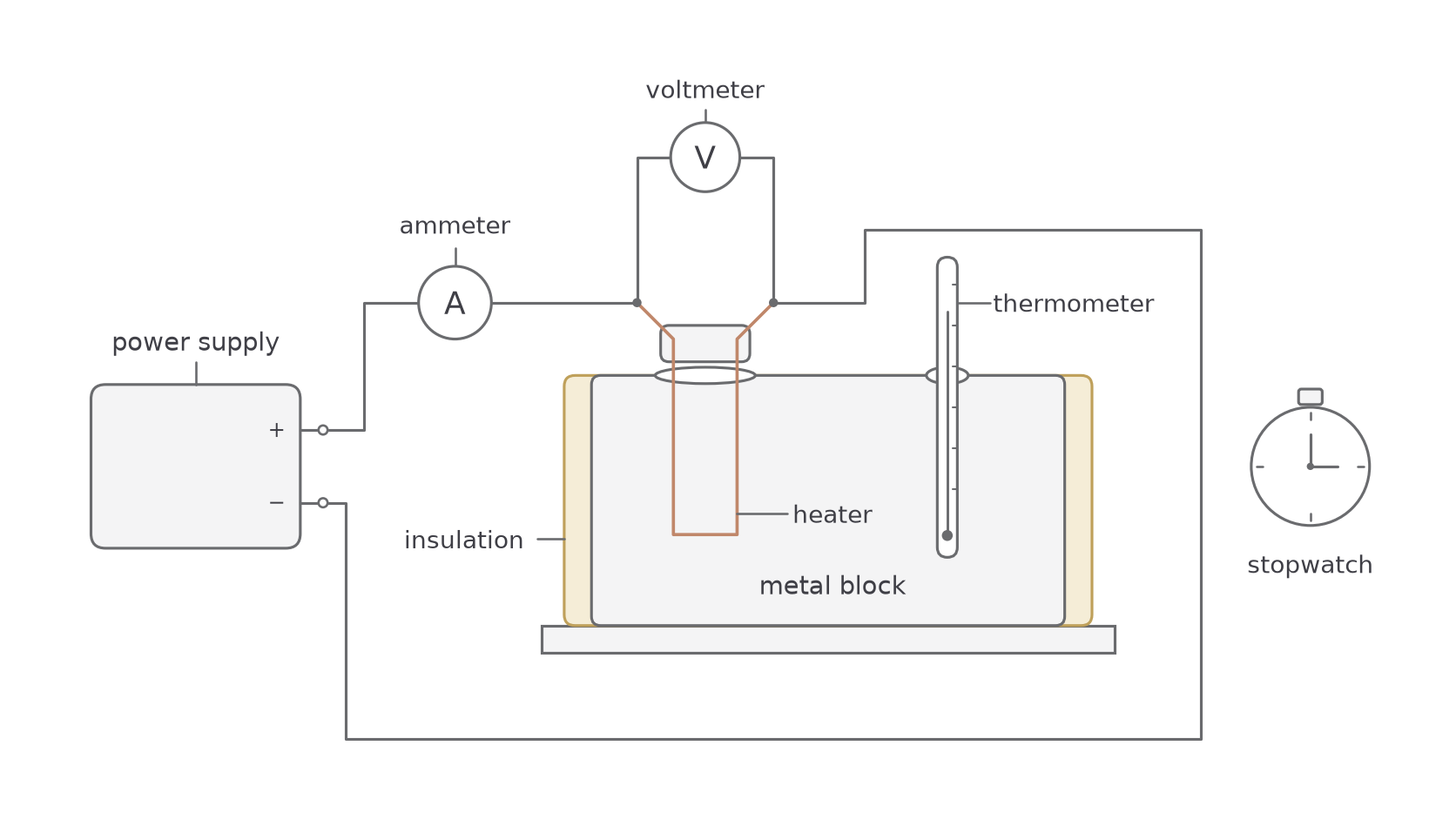
For a solid block:
| Step | What to do | Why it matters |
|---|---|---|
| 1 | Measure the mass of the block in . | Mass is needed in . |
| 2 | Put the heater and thermometer into holes in the block. | The heater transfers energy to the block and the thermometer measures the block temperature. |
| 3 | Insulate the block. | Less energy is transferred to the surroundings. |
| 4 | Record the initial temperature. | This is needed to find . |
| 5 | Switch on for a measured time and record voltage and current. | The electrical energy transferred can be found from . |
| 6 | Record the highest temperature reached. | This gives the temperature change used in the calculation. |
Use a low-voltage heater, keep electrical connections dry and switch off before removing it. Hot blocks and water can burn; allow them to cool before handling. A little suitable thermal contact liquid in the block holes improves contact.
For water, use an insulated container or beaker with a lid. Measure the water mass by subtracting the empty container mass (or tare the balance), place the heater fully in the water, stir gently to keep temperature uniform, keep the thermometer tip in the water away from the heater and container, and record the same quantities: voltage, current, time, initial temperature and final temperature. A lid is especially useful for water because it reduces energy loss from evaporation as well as ordinary cooling to the surroundings.
Continue this lesson.
You’re previewing NovaLearn without an account. Create a free account to read the rest.
Create free account