4.18P-4.19P - Electricity generation and energy resources
Electricity generation is about transferring energy from a resource into electrical energy. Some resources make a turbine turn before a generator produces electricity; solar cells are the important exception because they transfer energy from sunlight directly to electricity. In this lesson, the focus is the energy-transfer route for each named resource and the advantages and disadvantages of using these resources on a large scale.
Routes to electricity
An energy resource is something that can be used as a source of energy. For electricity generation, the resource might be moving air, moving water, hot rocks underground, sunlight, fossil fuel or nuclear fuel.
Renewable resource
A renewable resource is naturally replaced as it is used, or is available from a continuing natural process such as sunlight, wind or flowing water.
A non-renewable resource is finite on human timescales. Fossil fuels and nuclear fuels are non-renewable because the useful fuel is not replaced as quickly as it is used.
Most large-scale electricity generation uses the same final step:
resource transfers energy → turbine turns → generator transfers energy electrically
The turbine is the rotating part. It may be turned directly by wind or water, or indirectly by steam made from heating water. The rotating shaft transfers energy mechanically to the generator, which transfers energy electrically. In steady operation the turbine need not slow down: continuing input replaces the energy transferred out. You do not need to explain electromagnetic induction in this lesson; just use "generator" as the device that produces electricity when turned.
Solar cells are different. A solar cell transfers energy from sunlight directly into electrical energy, so there is no turbine or steam stage.
[DIAGRAM: asset_name: Electricity generation and energy resources - diagram 01; asset_slug: p41_electricity_generation_and_energy_resources__diagram_01; recommended_method: image_gen; description: White 16:9 NovaLearn pale-palette diagram with grey outlines and dark-grey labels. Three aligned generation routes: moving air or water, a heat source with steam, and sunlight with a solar cell; turbine, generator and electrical-output colours remain consistent.]
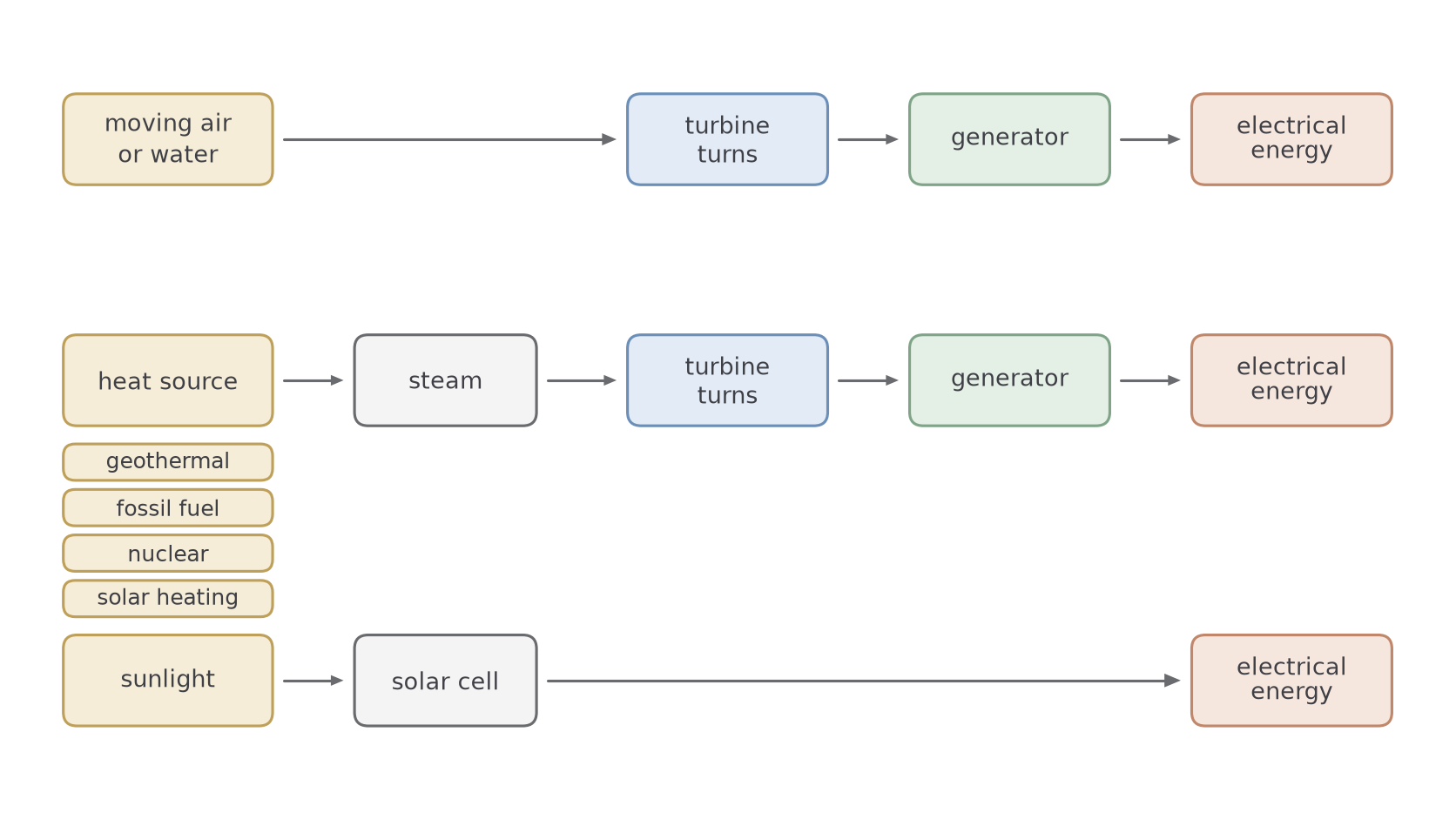
In exam answers, make the transfer chain specific to the resource. "It makes electricity" is too vague. A stronger answer names the starting energy store or pathway and then follows the sequence to the generator.
Wind, water and geothermal
Wind turbines use the kinetic energy of moving air. The moving air pushes the turbine blades, so energy is transferred to the kinetic energy of the rotating blades and shaft. The turning shaft drives a generator, which produces electrical energy.
For water, the useful starting energy depends on the situation. Water stored high behind a dam has gravitational potential energy. When it falls through pipes, that energy is transferred to the kinetic energy of the moving water. Flowing rivers, tidal streams and waves already involve moving water, so their useful resource is the kinetic energy of the water. A tidal barrage works more like a dam: it traps water at high tide, and that water's gravitational potential energy is used as it flows back out. In each case, the moving water turns a turbine connected to a generator.
Geothermal resources use energy transferred from hot rocks underground. Water can be heated by these rocks to make hot water or steam. Hot water can make steam directly or heat a separate working fluid until it vaporises. The expanding vapour drives a turbine connected to a generator; warm water alone is not a source of electricity without a suitable energy-conversion system.
| Resource | Main transfer route |
|---|---|
| Wind | kinetic energy of moving air → kinetic energy of turbine → electrical energy from generator |
| Water | gravitational potential energy of high water or kinetic energy of moving water → kinetic energy of turbine → electrical energy from generator |
| Geothermal | thermal energy from hot rocks → steam or hot water movement → kinetic energy of turbine → electrical energy from generator |
The key similarity is that all three are renewable resources. The key difference is availability. Wind and many water resources depend on weather, season and location. Geothermal generation is more reliable where suitable hot rocks are close enough to use, but those sites are not available everywhere.
Solar heating and solar cells
The specification names two solar routes, and they must not be muddled.
Solar heating systems use radiation from the Sun to increase the internal energy of water or another fluid. In a domestic system, this may simply heat water for use in a building. For electricity generation, concentrated solar heating produces sufficiently hot fluid to generate steam or another vapour. Its expansion drives a turbine and generator. An ordinary domestic hot-water panel does not itself generate electricity; the diagram represents the additional power-generation stages schematically.
Solar cells, also called photovoltaic cells, work differently. They transfer energy from sunlight directly to electrical energy. There is no boiler, no steam and no turbine in the cell itself.
[DIAGRAM: asset_name: Electricity generation and energy resources - diagram 02; asset_slug: p41_electricity_generation_and_energy_resources__diagram_02; recommended_method: image_gen; description: White 16:9 NovaLearn pale-palette diagram with grey outlines and dark-grey labels. Side-by-side solar heating and photovoltaic panels, with the collector, hot fluid or steam, turbine, generator and direct electrical output shown separately.]
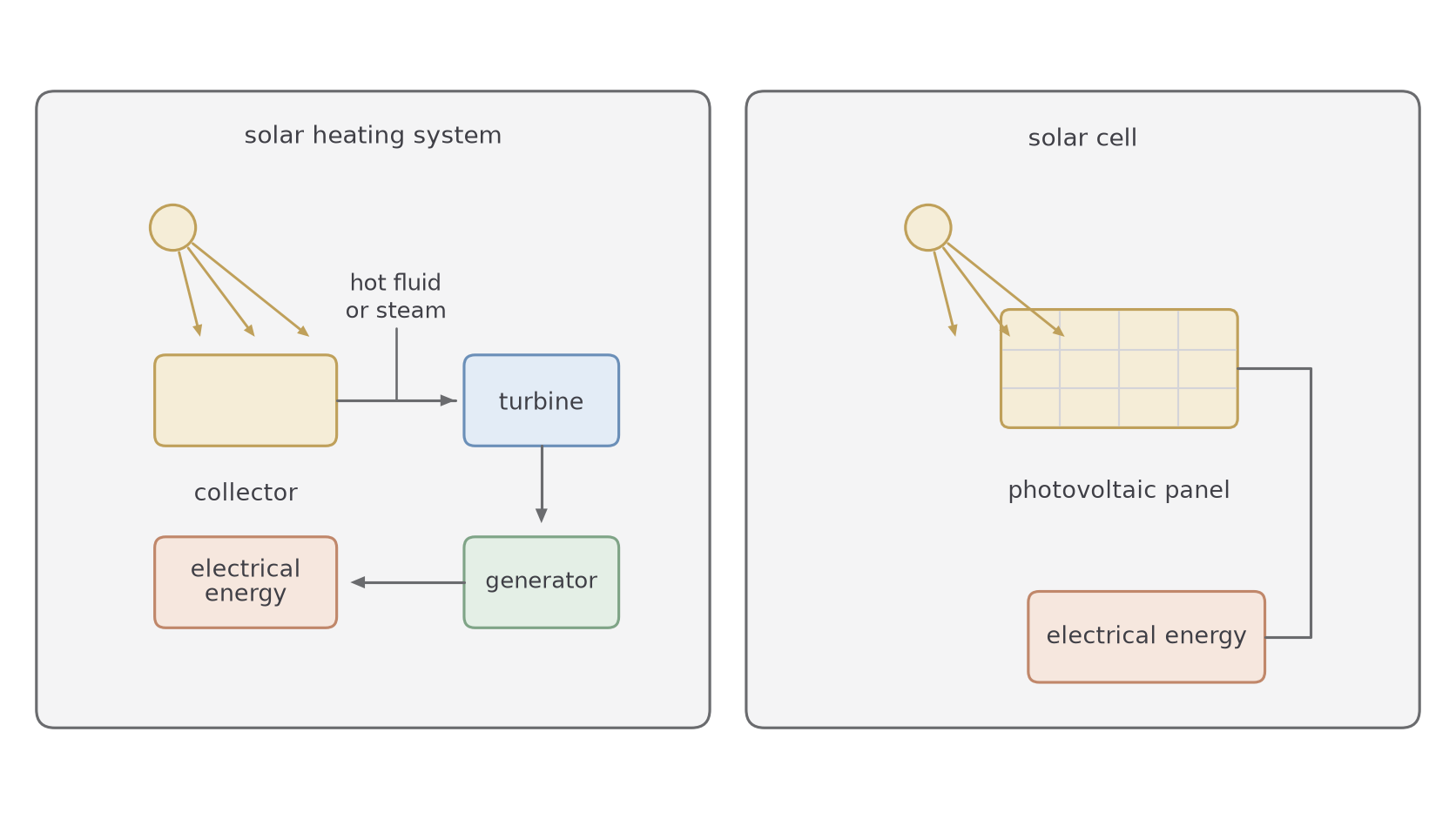
Both solar methods have the advantage of using a renewable resource and needing no fuel to be burned during operation. Their main disadvantage is that output depends on sunlight, so it changes with night, cloud, season and location. Large-scale solar generation also needs a large area, and may need storage or other generators to help meet demand when sunlight is low.
Continue this lesson.
You’re previewing NovaLearn without an account. Create a free account to read the rest.
Create free account