4.6-4.8 - Conduction, convection and radiation
Thermal energy is transferred whenever there is a temperature difference. At International GCSE level, the three routes you must describe are conduction, convection and radiation. The skill is not only naming them, but explaining the particle or radiation process and choosing the right mechanism for an everyday situation.
Three routes for thermal energy transfer
Conduction, convection and radiation can all transfer thermal energy, but they do it in different ways.
Conduction transfers thermal energy through a material or between materials in contact. It is especially important in solids, where particles vibrate about fixed positions and pass energy to neighbouring particles.
Convection transfers thermal energy by the movement of a fluid. A fluid means a liquid or a gas. The warmer part of the fluid moves and carries energy with it, so convection cannot happen in a solid.
Radiation transfers thermal energy by electromagnetic waves, mainly infrared radiation at everyday temperatures. Radiation does not need particles, so it can travel through a vacuum. Conduction and convection both need particles, so radiation is the only one of the three routes that can transfer energy across a vacuum.
| Situation | Main transfer route | Why |
|---|---|---|
| A metal spoon warms up when one end is in hot water | conduction | energy passes through the solid metal |
| Warm air rises above a heater | convection | moving air carries energy around the room |
| The Sun warms your skin | radiation | energy travels through space by electromagnetic waves |
Real situations often involve more than one route. A cup of hot tea loses energy by conduction through the cup, convection in the surrounding air, and radiation from its surface. In exam answers, name the route the question is asking about and give the matching mechanism.
Conduction in solids
In a solid, the particles are close together and held in fixed positions. They cannot flow through the material, but they can vibrate. When one end of a solid is heated, particles near that end gain energy and vibrate more strongly.
These particles collide with neighbouring particles and make them vibrate more. The energy is passed along the solid from the hotter region to the cooler region. This is why the far end of a metal spoon can become hot even though only one end is in hot water.
[DIAGRAM: asset_name: Conduction in a heated solid; asset_slug: p36_conduction_convection_and_radiation__diagram_01; recommended_method: image_gen; description: Minimal NovaLearn conduction diagram: a rounded pale-clay solid bar with fixed particle centres, larger vibrations at the hot left end and smaller vibrations at the cool right end, one energy-transfer arrow to the right, and a rounded pale-blue metal inset with a 5-by-3 ion lattice and four internal mobile electrons with motion arrows.]
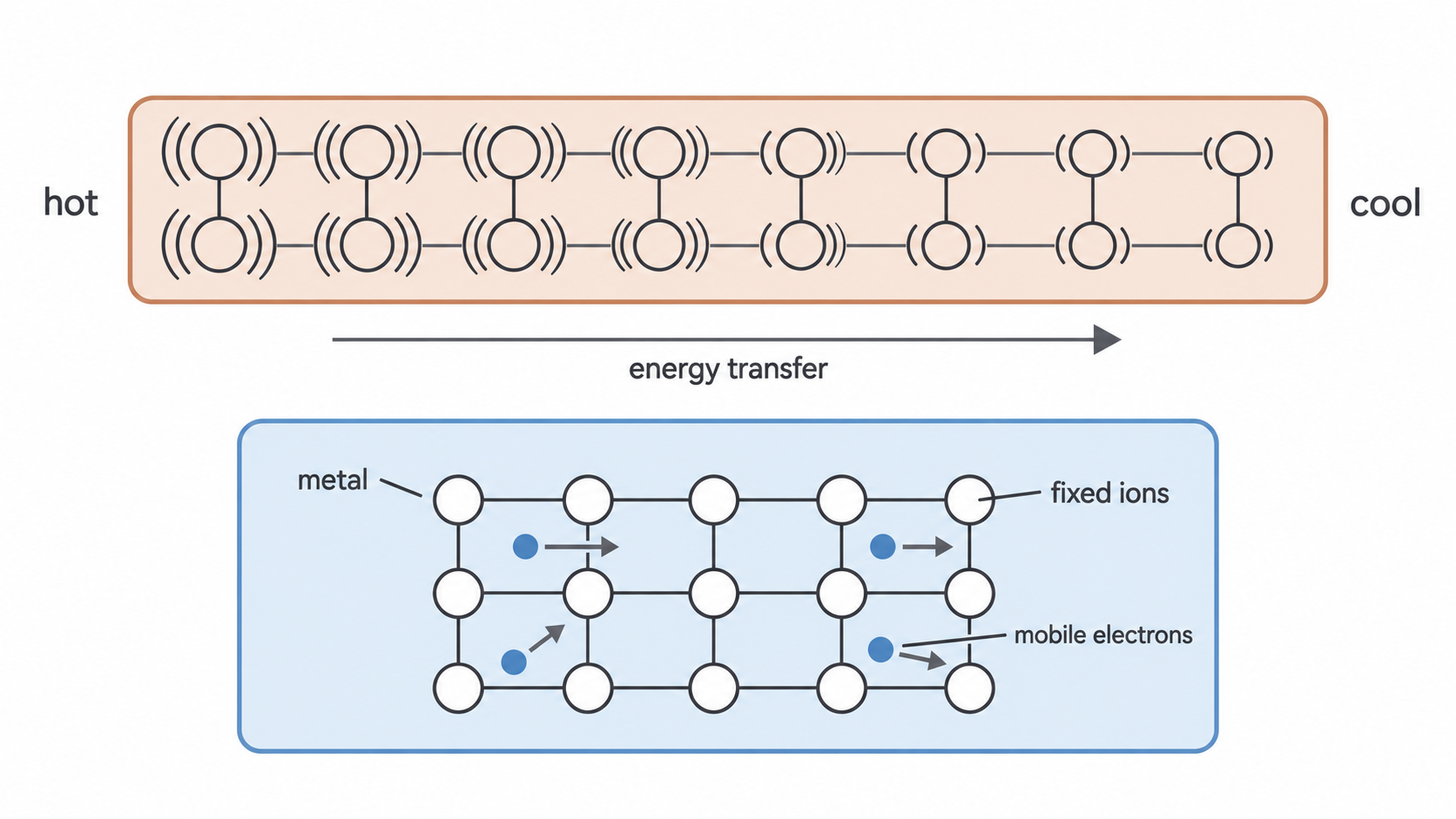
Metals are usually good thermal conductors. As well as vibrating particles, metals contain mobile electrons that can move through the solid and transfer energy quickly. Materials such as plastic, wood and trapped air are poor thermal conductors, so they transfer energy by conduction much more slowly.
Do not write that "heat particles move through the solid". In conduction through a solid, the material itself stays in place; energy is passed from particle to particle.
Convection in fluids
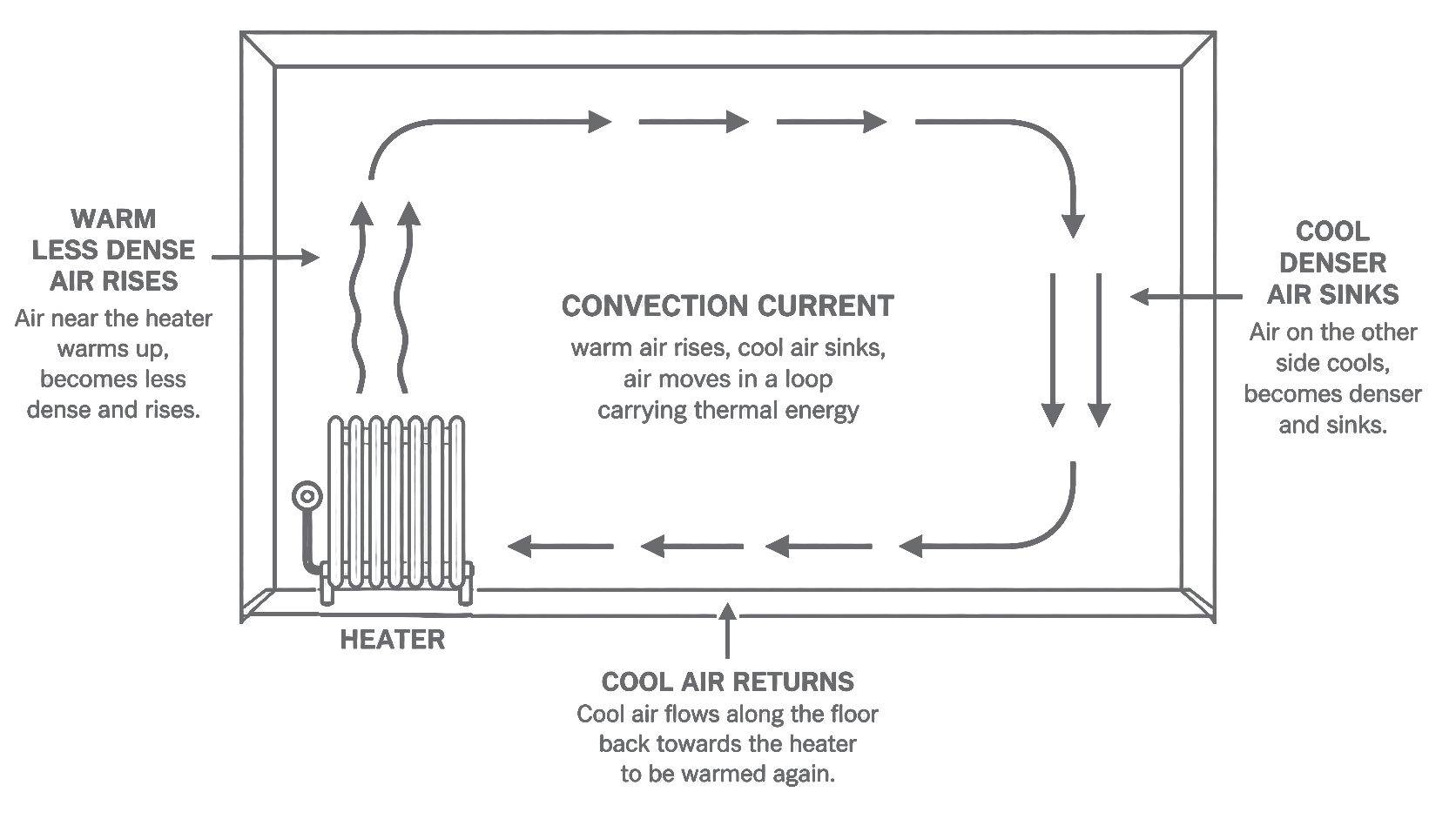
Convection happens in liquids and gases because these fluids can move. When a region of fluid is heated, its particles move faster and spread slightly further apart, so that region of fluid expands. The same mass now takes up more volume, so that region becomes less dense than the cooler fluid around it.
The warmer, less dense fluid rises. Cooler, denser fluid sinks and moves in to replace it. The cooler fluid is then heated, becomes less dense and rises too, while the warm fluid that rose cools away from the heat source, becomes denser and sinks again. This repeated circulation is a convection current.
[DIAGRAM: asset_name: Convection current above a heater; asset_slug: p36_conduction_convection_and_radiation__diagram_02; recommended_method: image_gen; description: Monochrome room-scale convection diagram showing a heater near the floor, warm less dense air rising, cooler denser air sinking on the opposite side, and a labelled convection current loop.]
Convection explains several everyday phenomena:
- A radiator or heater warms air beside it. The warm air rises, cooler air moves towards the heater, and a circulating current spreads energy through the room.
- Water in a pan is heated from below. Warmer water near the base becomes less dense and rises, while cooler water sinks to be heated.
- A sea breeze can form during a sunny day, because the land warms up faster than the sea. Air above the warmer land is heated, becomes less dense and rises, and cooler, denser air from over the sea moves in to replace it, so the breeze blows from the sea towards the land.
Continue this lesson.
You’re previewing NovaLearn without an account. Create a free account to read the rest.
Create free account