6.8-6.10P - Electromagnets and magnetic fields around currents
An electric current does more than move charge around a circuit: it also produces a magnetic field around the conductor. In this lesson you will learn how to describe and draw the field patterns for a straight wire, a flat circular coil and a solenoid, then connect that idea to the construction of an electromagnet. The focus is the field pattern made by a current, not the force on a current-carrying wire or electromagnetic induction.
Current produces a field
A conductor carrying an electric current has a magnetic field around it. The conductor might be a straight piece of wire, a wire loop, or many loops wound into a coil.
Magnetic field
A magnetic field is a region where a magnetic material or another magnet can experience a force.
The field caused by a current exists while the current is flowing. If the current is switched off, the magnetic field due to that current disappears. This is why current-carrying coils can be used to make switchable magnets.
You can think of the current as setting up a pattern around the conductor. A compass placed near the wire would turn because the compass needle is a small magnet. Iron filings can also show a pattern, but in an exam you usually need to describe or draw the field lines.
Magnetic field lines are a model. They show the shape and direction of the field, and closer field lines mean a stronger field. For this lesson, the important skill is drawing the correct pattern for each current-carrying shape.
Straight wire pattern
For a straight current-carrying wire, the magnetic field lines are circles centred on the wire. The easiest drawing is an end-on view, as if the wire is coming out of the page or going into the page.
Use these two current symbols:
| Symbol | Meaning |
|---|---|
• | current coming out of the page, like the tip of an arrow |
× | current going into the page, like the tail feathers of an arrow |
[DIAGRAM: asset_name: Electromagnets and magnetic fields around currents - diagram 01; asset_slug: p51_electromagnets_and_magnetic_fields_around_currents__diagram_01; recommended_method: image_gen; description: White 16:9 NovaLearn pale-palette diagram with grey outlines and dark-grey labels. Concentric sage field circles around an out-of-page current dot, beside a simplified right-hand grip diagram with current along the thumb.]
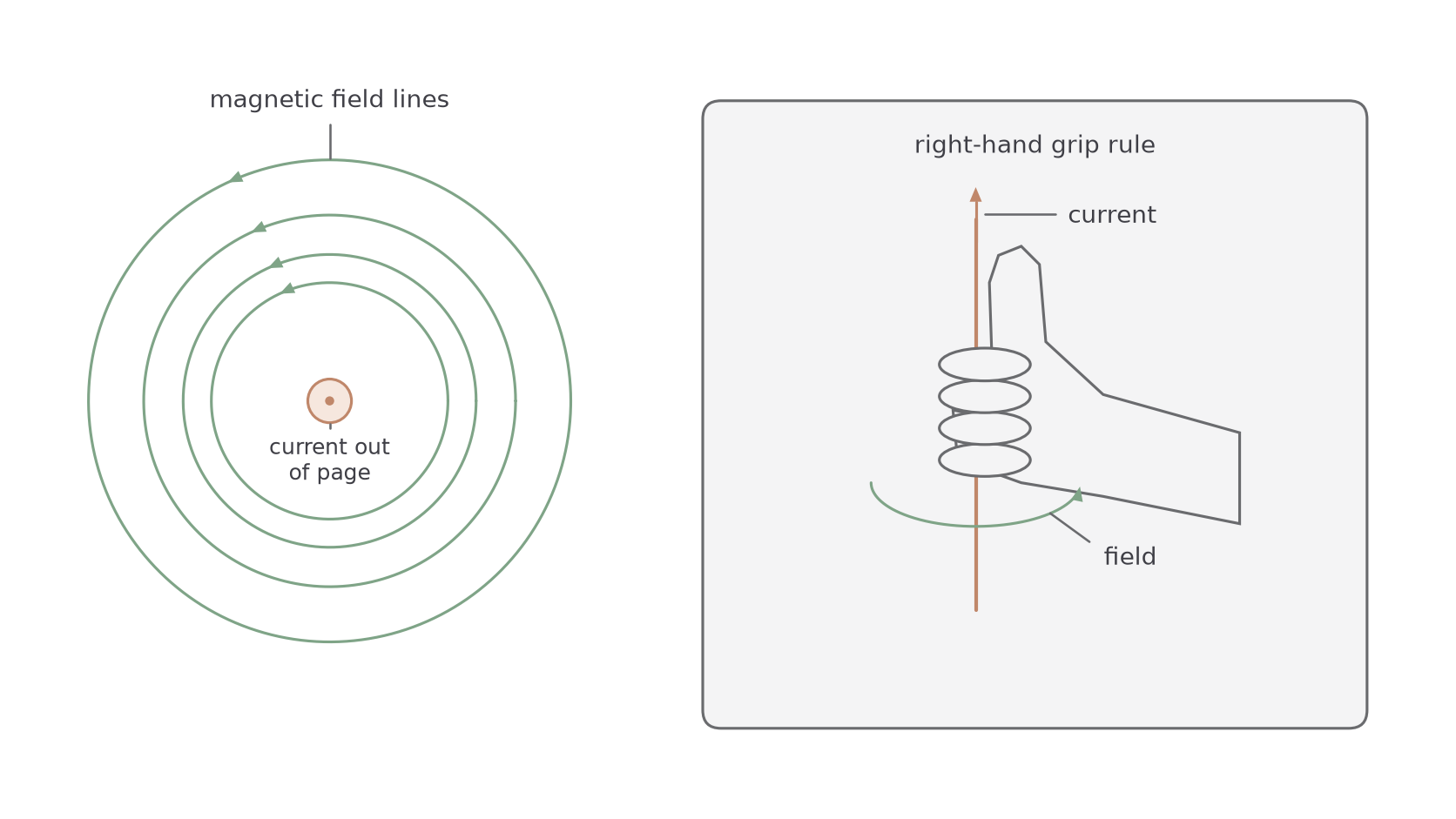
For conventional current coming out of the page, the field direction is anticlockwise. For conventional current going into the page, the field direction is clockwise.
The right-hand grip rule is a quick way to remember this. Point the thumb of your right hand in the direction of conventional current. Your curled fingers show the direction of the circular magnetic field lines.
The field is strongest close to the wire and gets weaker further away. In a careful drawing, show this by making the gaps between neighbouring circles bigger as you move away from the wire.
When drawing the pattern, avoid two common mistakes. Do not draw straight field lines radiating away from the wire, because the field goes around the wire in circles. Do not draw the circles with arrows in mixed directions, because one current direction gives one consistent field direction.
Flat circular coil
A flat circular coil is a loop of wire carrying current. It is still one current-carrying conductor, but bending the wire into a loop changes how the fields from different parts of the wire combine.
[DIAGRAM: asset_name: Electromagnets and magnetic fields around currents - diagram 02; asset_slug: p51_electromagnets_and_magnetic_fields_around_currents__diagram_02; recommended_method: image_gen; description: White 16:9 NovaLearn pale-palette diagram with a clay circular current coil and front-right/back-left current heads. A straight central sage field line and four smooth closed sage loops, two on each side, are exactly symmetric; field goes up through the coil and returns outside. Short dark-grey labels identify the coil and field through centre.]
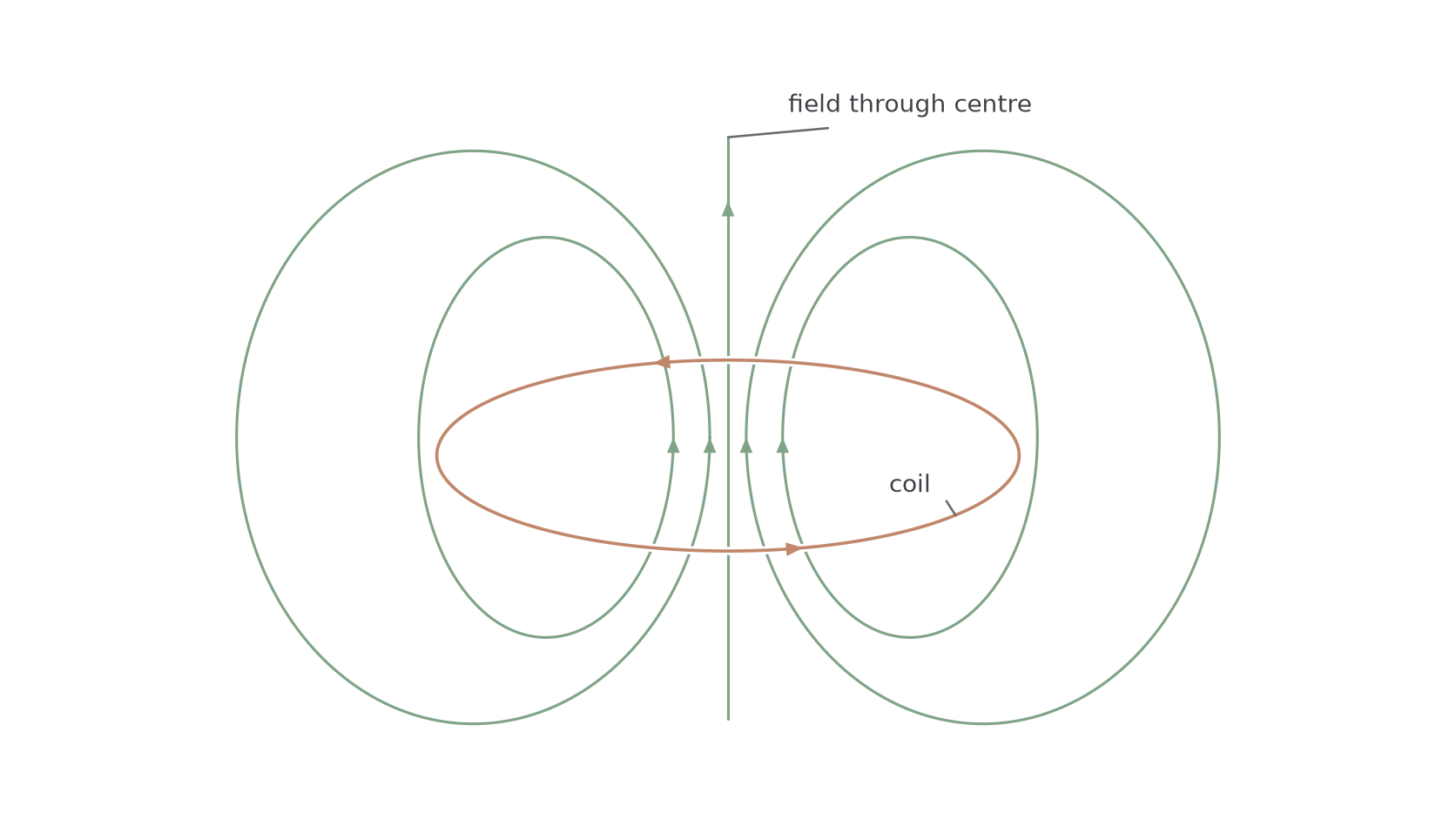
Through the middle of the coil, the field lines pass through the opening of the loop. Outside the coil, the field lines curve back around. The whole pattern is a set of closed loops, not separate start-and-stop lines.
Close to each side of the loop, the field lines circle around the wire, just as they do around a straight wire. In the centre, the fields from opposite sides of the loop point the same way, so they add together.
Continue this lesson.
You’re previewing NovaLearn without an account. Create a free account to read the rest.
Create free account