3.8-3.9 - Doppler effect, reflection and refraction of waves
Waves can change what an observer detects when the source and observer move relative to each other. Waves can also change direction when they meet a boundary or enter a new medium. In this lesson, the focus is qualitative: explaining what changes, why it changes, and which wave behaviour is being described.
The Doppler effect
The Doppler effect is a change in the observed frequency caused by relative motion between a wave source and an observer. In this lesson, picture the source moving towards or away from a stationary observer. For a moving source, the wavefront spacing in the medium also changes in front of and behind the source.
Doppler Effect
The Doppler effect is a change in the observed frequency of a wave caused by relative motion between the source of the wave and the observer.
A familiar sound example is a siren passing you. As it moves towards you, the pitch you hear is higher. As it moves away from you, the pitch you hear is lower. Pitch is how your ear interprets sound frequency, so this is evidence that the observed frequency has changed.
The word observed is important. The source is still producing waves at the same steady frequency (its own frequency does not change), but the observer receives the crests or compressions at a different rate.
Wavefront spacing and frequency
Imagine a source producing wavefronts at regular time intervals while it moves to the right. Each wavefront spreads out from the place where it was produced. Because the source keeps moving, the next wavefront starts from a slightly different position.
[DIAGRAM: asset_name: Doppler effect, reflection and refraction of waves - diagram 01; asset_slug: p25_doppler_effect_reflection_and_refraction_of_waves__diagram_01; recommended_method: image_gen; description: NovaLearn pale-palette Doppler model of a source moving right at half the wave speed, five circular fronts centred on equally spaced previous emission positions, wider rear spacing and narrower forward spacing with exact wavelength brackets and observer labels.]
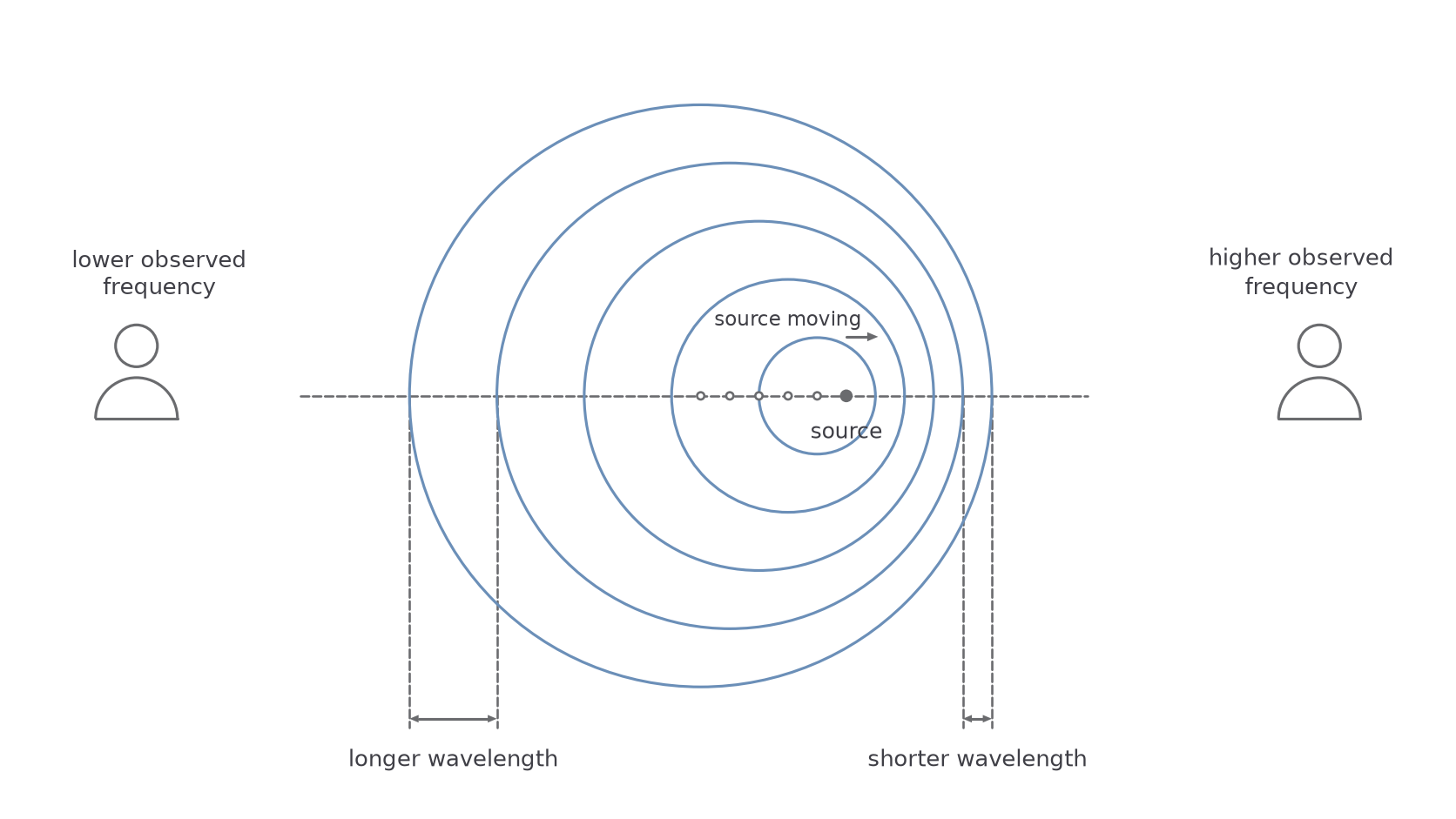
In front of the moving source, each new wavefront starts closer to the observer than the one before, so the wavefronts are closer together. The waves still travel at the same speed, so an observer in front receives more wavefronts each second: the observed frequency is higher and the observed wavelength is shorter.
Behind the moving source, the wavefronts are more spread out. An observer behind receives fewer wavefronts each second, so the observed frequency is lower and the observed wavelength is longer.
Relative motion can change how often wavefronts reach an observer. If only the observer moves through a medium, the frequency they receive changes even though the wavelength in that medium need not change. The Doppler effect also occurs for electromagnetic waves. At this level, you do not need a Doppler equation; you need the cause-and-effect chain.
When the source moves away
For a source moving away from a stationary observer, the Doppler effect reverses. The source produces each new wavefront farther from the observer than the previous one. The wavefronts that reach the observer are more spread out.
More spread-out wavefronts mean a longer observed wavelength. Because fewer wavefronts pass the observer each second, the observed frequency is lower. For sound, the pitch heard by the observer is lower.
A strong explanation should link three ideas in order:
- the source moves towards or away from a stationary observer
- the spacing of the wavefronts reaching the observer changes
- the observed wavelength and frequency change
Continue this lesson.
You’re previewing NovaLearn without an account. Create a free account to read the rest.
Create free account