3.20-3.22 - Total internal reflection, critical angle and optical fibres
Light does not always pass out of a material when it reaches a boundary. If it is travelling from a material with a higher refractive index into one with a lower refractive index, and it meets the boundary at a large enough angle, it can be reflected completely back inside. This lesson builds that idea into the critical angle equation, then applies it to optical fibres and prisms.
When refraction stops
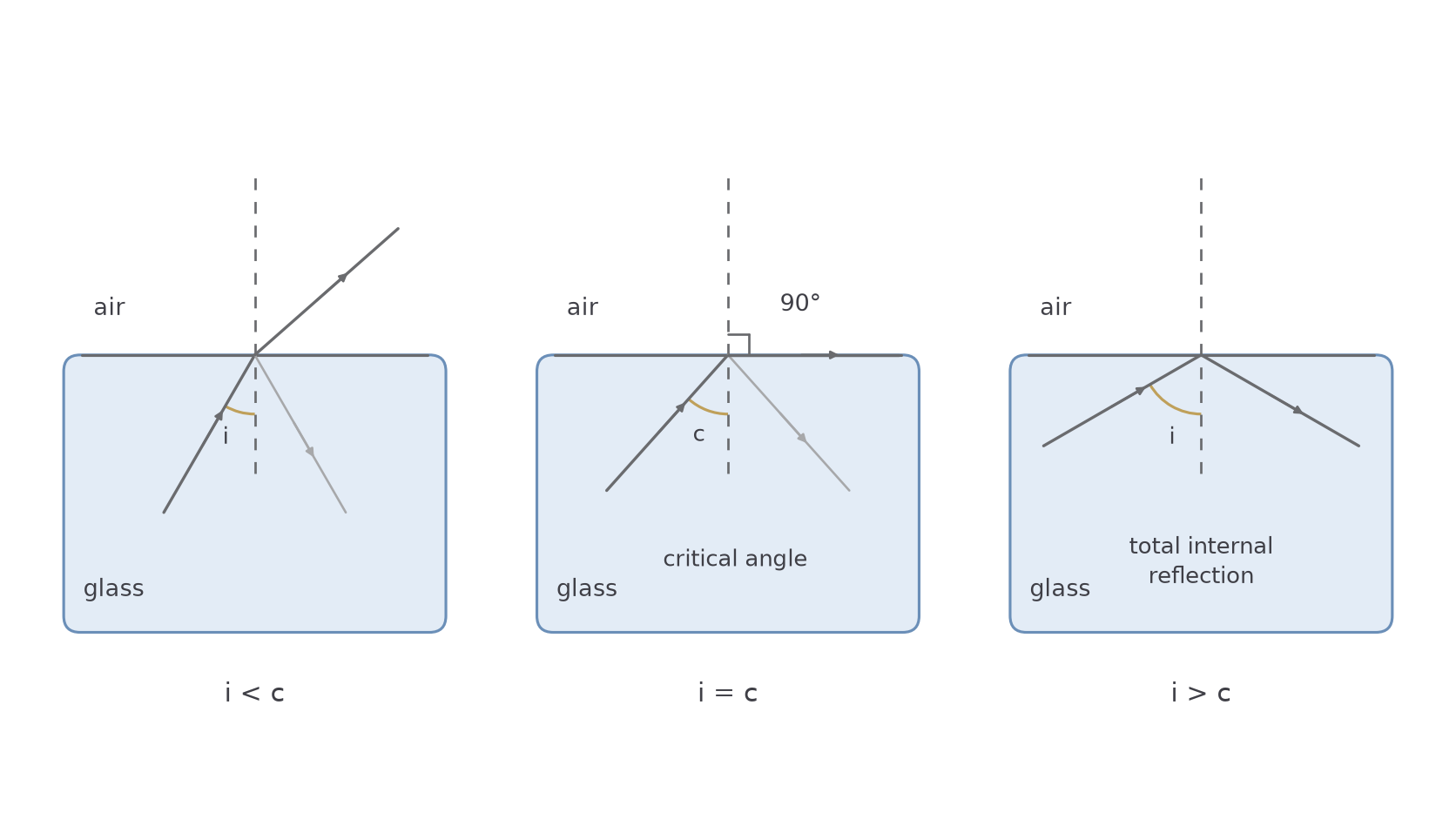
When a ray of light travels from glass or plastic into air, it is moving from a higher refractive index material into a lower refractive index material. At the boundary, the ray normally partly reflects and partly refracts. The refracted ray bends away from the normal.
As the angle of incidence inside the higher refractive index material increases, the angle of refraction increases too. Eventually the refracted ray is just along the boundary. If the angle of incidence is increased further, there is no refracted ray leaving the material. All the light is reflected back inside: this is total internal reflection.
Total internal reflection
Total internal reflection is the complete reflection of a ray of light at a boundary, back into the original material, when the ray is travelling from a higher refractive index material to a lower refractive index material and the angle of incidence is greater than the critical angle.
The two conditions are both needed. Light must be trying to leave the higher refractive index material, and its angle of incidence must be greater than the critical angle. A ray travelling from air into glass cannot undergo total internal reflection at the air-glass boundary: entering glass, it bends towards the normal, so its angle of refraction is always smaller than its angle of incidence and can never reach .
[DIAGRAM: critical_angle_sequence: Total internal reflection, critical angle and optical fibres - diagram 01; asset_slug: p30_total_internal_reflection_critical_angle_and_optical_fibres__diagram_01; recommended_method: image_gen; description: Minimal NovaLearn three-panel glass-air ray diagram with rounded pale-blue glass regions, dashed normals, incidence below, at and above the critical angle, partial reflections in the first two cases, a 90-degree refracted ray at the critical angle, and total internal reflection in the final case.]
Critical angle equation
The critical angle, , is the angle of incidence in the higher refractive index material that makes the angle of refraction equal to . In other words, at the critical angle the refracted ray travels along the boundary. In the middle panel of the diagram above (), the critical angle is the angle between the incident ray and the normal inside the glass; the angle in the air, between the normal and the ray along the boundary, is the angle of refraction.
Angles in ray diagrams are measured from the normal, not from the surface. This matters because the critical angle is also measured from the normal inside the material.
Critical angle and refractive index
For a material-air boundary:
so
You need to recall this equation: it is not given in the exam.
Here is the refractive index of the material compared with air. Because most transparent solids and liquids have , the value of is less than 1, which is possible for .
Worked example: a glass block has refractive index . Find its critical angle at a glass-air boundary.
First substitute into the formula:
Then use inverse sine:
So any ray inside this glass that hits the glass-air boundary at an angle greater than about to the normal will undergo total internal reflection.
Because , a higher refractive index gives a smaller and so a smaller critical angle. For example, a material with has , so , smaller than the of the glass above.
Continue this lesson.
You’re previewing NovaLearn without an account. Create a free account to read the rest.
Create free account