5.20-5.22 - Gas pressure laws
Gas pressure laws describe what happens to the pressure of a fixed amount of gas when either its volume or its Kelvin temperature changes. The two relationships in this lesson have different conditions, so the first skill is choosing which quantity is being kept constant. Once the condition is clear, the calculation is usually a proportionality question in disguise.
Conditions and gas pressure
A gas exerts pressure because its molecules move randomly and collide with the walls of their container. Each collision exerts a force on the wall; many collisions over an area produce pressure.
In gas-law questions, the words "fixed amount" or "fixed mass" matter. They mean no gas is added and no gas escapes, so the number of molecules stays the same. If gas leaks out, pressure could change because there are fewer molecules, not just because the volume or temperature changed.
For this lesson, the two comparisons are:
| Relationship being considered | Condition kept constant | Main pattern |
|---|---|---|
| pressure and volume | temperature | larger volume gives lower pressure |
| pressure and Kelvin temperature | volume | higher Kelvin temperature gives higher pressure |
The condition tells you which gas law to use. If the question says the container is rigid, its volume is constant. If it says the gas is compressed slowly while temperature is kept the same, use the constant-temperature pressure-volume relationship. The word slowly matters: compressing a gas quickly warms it, while a slow change gives the gas time to pass that energy to its surroundings and stay at the same temperature.
Pressure and volume
For a fixed amount of gas at constant temperature, pressure and volume have an inverse relationship. If the volume is decreased, the pressure increases. If the volume is increased, the pressure decreases.
The particle explanation is about collision frequency. At constant temperature, the average speed of the molecules is unchanged. When the same molecules are squeezed into a smaller volume, there are more wall impacts each second per unit area, so the mean force per unit area and pressure increase.
[DIAGRAM: asset_name: Gas pressure laws - diagram 01; asset_slug: p48_gas_pressure_laws__diagram_01; recommended_method: matplotlib; description: White 16:9 NovaLearn pale-palette diagram with grey outlines and dark-grey labels. Blue inverse pressure-volume curve with exact V,p and 2V,p/2 guide points and clear constant-temperature labels.]
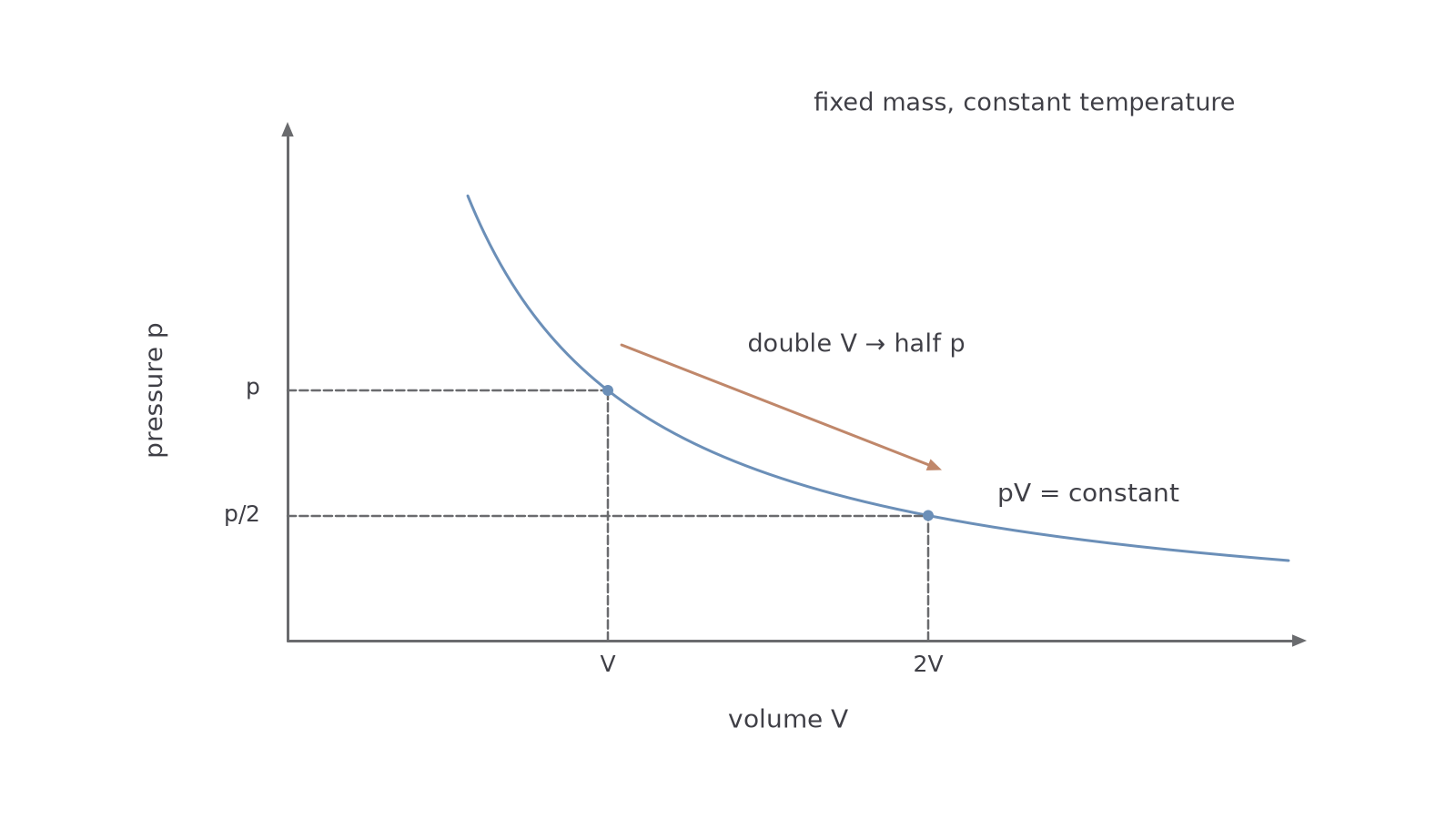
This inverse relationship means the product of pressure and volume stays constant. On the graph, doubling the volume from to halves the pressure from to , and equals , which is what the label means.
Pressure-volume law
For a fixed mass of gas at constant temperature:
Use absolute pressure, measured from a vacuum, in these laws; a gauge reading above atmospheric pressure needs atmospheric pressure added if that distinction is given. The pressure units must match each other, and the volume units must match each other. For example, both pressures could be in kPa and both volumes could be in . You do not have to convert to if both volume values use .
Worked example: a gas has a pressure of when its volume is . The temperature is constant. Calculate the pressure when the volume is compressed to .
The volume decreased, so the pressure increased. That direction check is useful: if your answer had been less than , it would not fit the inverse relationship.
Pressure and Kelvin temperature
For a fixed mass of gas at constant volume, pressure is directly proportional to Kelvin temperature. If the Kelvin temperature doubles, the pressure doubles. If the Kelvin temperature halves, the pressure halves.
Continue this lesson.
You’re previewing NovaLearn without an account. Create a free account to read the rest.
Create free account