6.1-6.3 - Magnetic units, magnets and magnetic materials
Magnetism starts with three precise ideas: the electrical units used later in this topic, how magnets interact, and how magnetic materials behave. You do not need field-line patterns or electromagnets yet; those come in later lessons. Here the aim is to make the basic words reliable enough for short Edexcel-style answers.
Electrical units in this topic
The magnetism and electromagnetism section uses some electrical quantities. At this point, Edexcel only expects you to use three unit names and symbols accurately.
| Quantity | Unit name | Unit symbol |
|---|---|---|
| current | ampere | A |
| voltage or potential difference | volt | V |
| power | watt | W |
The unit symbol is part of the answer. means a current of 2 amperes. means a voltage or potential difference of 12 volts. means a power of 60 watts.
Do not swap the symbols around. A current, a voltage and a power are different physical quantities, so each needs its own unit symbol: writing a current as is wrong even though the number is right.
Magnet poles and magnetic substances
A permanent magnet has two poles: a north-seeking pole, usually called the north pole, and a south-seeking pole, usually called the south pole. When two magnets are close together, the force depends on which poles face each other.
[DIAGRAM: asset_name: Magnetic units, magnets and magnetic materials - diagram 01; asset_slug: p49_magnetic_units_magnets_and_magnetic_materials__diagram_01; recommended_method: image_gen; description: White 16:9 NovaLearn pale-palette diagram with grey outlines and dark-grey labels. Three neutral magnetic-force panels show opposite poles attracting, like poles repelling, and a nail and paper clips attracted to a magnet.]
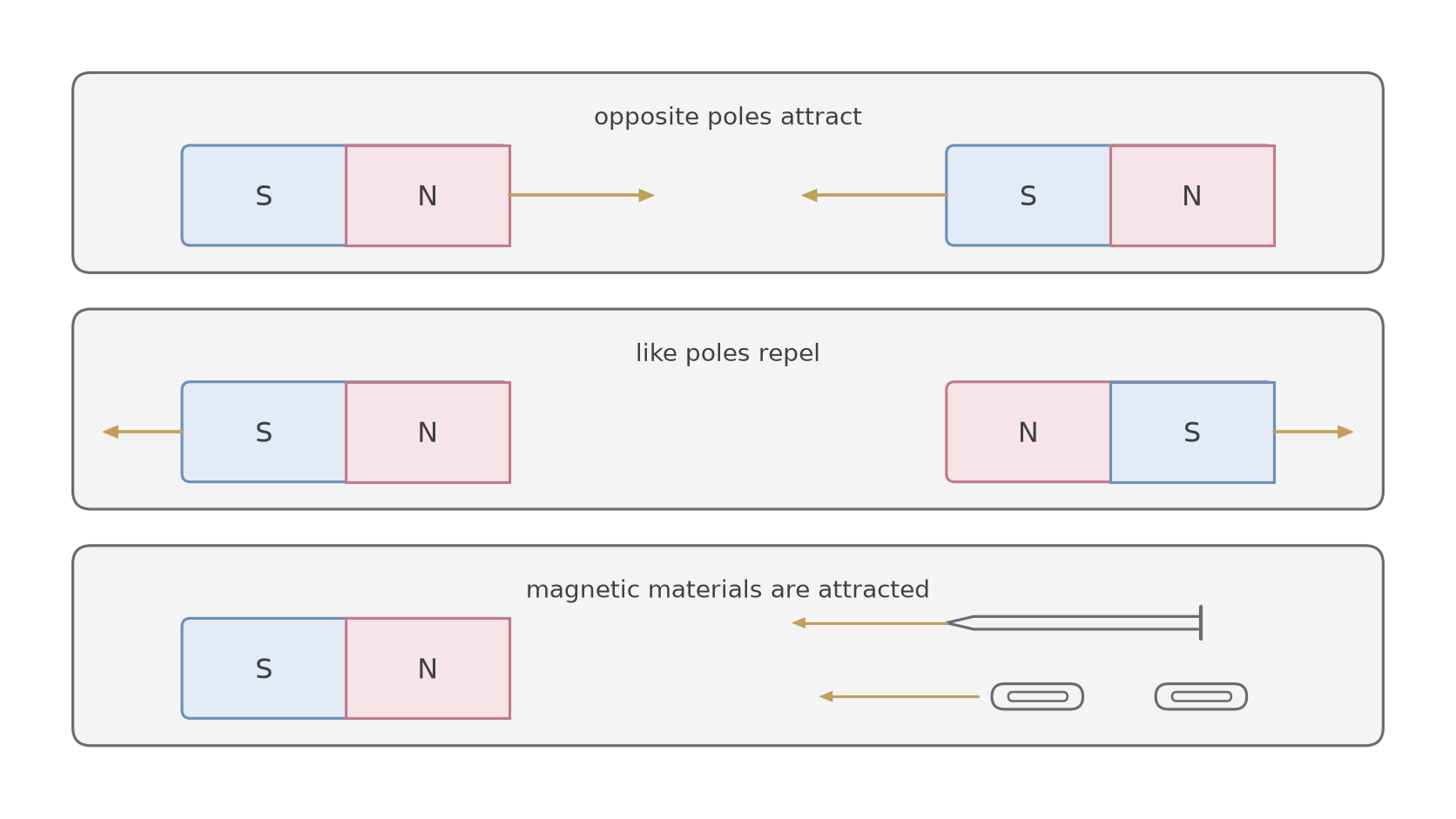
In the diagram, the force arrows point towards each other when opposite poles face each other, and away from each other when like poles face each other. In the bottom panel, the nail and the paper clips are pulled towards the magnet.
The rule is simple but important:
| Situation | What happens |
|---|---|
| north pole near south pole | the magnets attract |
| north pole near north pole | the magnets repel |
| south pole near south pole | the magnets repel |
Magnets also attract magnetic substances. Common magnetic substances include iron, steel, nickel and cobalt. A magnetic substance does not have to be a permanent magnet already; the key observation for this lesson is that a magnet can pull it.
Only a pair of magnets can repel. An unmagnetised magnetic substance is attracted to either pole of a magnet. It is not repelled in the ordinary school-level situation.
Magnets compared with magnetic substances
A magnet is an object that has its own north and south poles. It can attract or repel another magnet depending on the poles that face each other.
A magnetic substance is a material that is attracted by a magnet. Iron and steel are the most useful examples for this lesson. Many everyday objects made from these materials, such as paper clips, nails or some steel screws, are pulled by a magnet.
Not every metal is magnetic. Copper, aluminium and brass are metals, but they are not normally attracted strongly by a bar magnet. So the safe exam wording is "a magnet attracts magnetic substances", not "a magnet attracts all metals".
This distinction helps avoid a common error. If a question says that a bar magnet attracts a nail, that does not prove the nail was already a permanent magnet. It shows the nail is made from a magnetic substance.
Continue this lesson.
You’re previewing NovaLearn without an account. Create a free account to read the rest.
Create free account