7.17-7.20 - Fission and chain reactions
Some nuclear reactions release energy because the nucleus changes. In this lesson, the main example is fission of uranium-235, where a neutron collision makes a heavy nucleus split. The important exam skill is to describe the sequence precisely: one fission can release neutrons, and those neutrons can cause more fissions.
Nuclear reactions as energy sources
A nuclear reaction changes the nucleus of an atom. This is different from a chemical reaction, where atoms are rearranged but the nuclei of the atoms are not changed.
For this specification point, you need to know that several types of nuclear reaction can be sources of energy:
- fission, where a large nucleus splits into smaller nuclei
- fusion, where smaller nuclei join to form a larger nucleus
- radioactive decay, where an unstable nucleus emits radiation as it changes
This lesson focuses on fission and chain reactions. Fusion and the detailed use of fission in reactors are separate topics, so keep the focus here on the basic nuclear process rather than on reactor equipment or stars.
Neutron-induced fission
Uranium-235 is often written as U-235. It is an isotope of uranium with a nucleus that can undergo fission after a collision with a neutron.
Nuclear fission
Nuclear fission is the splitting of a large atomic nucleus into smaller nuclei.
In U-235 fission, a neutron collides with a U-235 nucleus. The neutron is absorbed, forming a highly excited uranium-236 nucleus which splits into two smaller nuclei. Uranium-235 is already radioactive; the absorption triggers this fission event rather than making an otherwise perfectly stable isotope radioactive. These smaller nuclei move away very quickly.
[DIAGRAM: asset_name: Fission and chain reactions - diagram 01; asset_slug: p60_fission_and_chain_reactions__diagram_01; recommended_method: image_gen; description: White 16:9 NovaLearn pale-palette diagram with grey outlines and dark-grey labels. Incoming neutron and U-235 fission with two sage products, three outgoing neutrons and separate outward product-motion arrows.]
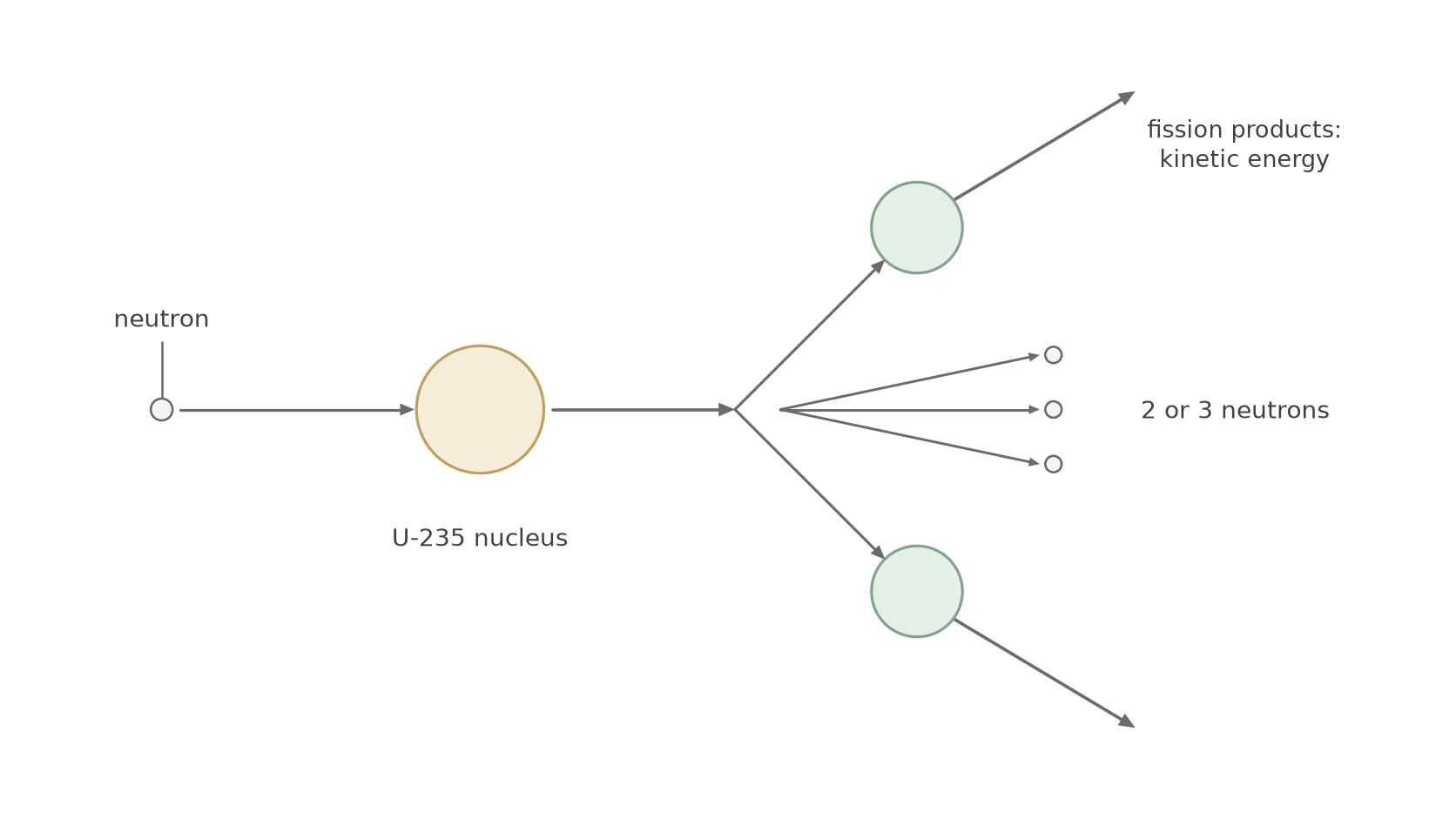
The energy released in this process is mainly transferred as kinetic energy of the fission products. In exam answers, that phrase matters. It is not enough to say vaguely that "energy is made"; the fission products move away with high kinetic energy.
The fast fission products then collide with nearby particles in the material. Those collisions transfer energy to the surroundings, so the material heats up.
Products of fission
The two smaller nuclei produced by U-235 fission are called daughter nuclei. For this course, the key point is that these daughter nuclei are radioactive.
U-235 fission also releases a small number of neutrons. A school-level diagram often shows two or three neutrons being released, but the safest exam wording is a small number of neutrons unless the question gives a particular diagram or value.
So the essential products of one U-235 fission are:
- two radioactive daughter nuclei
- a small number of neutrons
- energy transferred as kinetic energy of the fission products
The neutrons are especially important because they can go on to collide with other U-235 nuclei. That possibility is what makes a chain reaction possible.
Continue this lesson.
You’re previewing NovaLearn without an account. Create a free account to read the rest.
Create free account