7.21-7.22 - Nuclear reactors and control
A nuclear reactor uses a fission chain reaction, but the reaction must be controlled so that energy is released at a steady rate. For this specification point, the important reactor parts are the moderator, control rods and shielding. The exam skill is to describe the role of each part in terms of neutrons, fission rate and radiation protection.
Reactor core overview
In a fission reactor, the chain reaction happens in the reactor core. Fuel rods contain nuclei that can undergo fission, such as uranium-235. When fission occurs, neutrons are released and some of them can go on to cause further fission.
This lesson does not need the full power-station system. You do not need to describe turbines, generators, cooling towers or electricity transmission here. The required core idea is how the reactor keeps the fission process useful and safe:
- the moderator slows fast neutrons so they are more likely to cause further fission
- the control rods absorb neutrons to control the fission rate
- the shielding absorbs radiation from the reactor core
[DIAGRAM: asset_name: Nuclear reactors and control - diagram 01; asset_slug: p61_nuclear_reactors_and_control__diagram_01; recommended_method: image_gen; description: White 16:9 NovaLearn pale-palette diagram with grey outlines and dark-grey labels. Reactor cross-section with blue moderator, ochre fuel rods, partially inserted clay control rods and thick neutral shielding.]
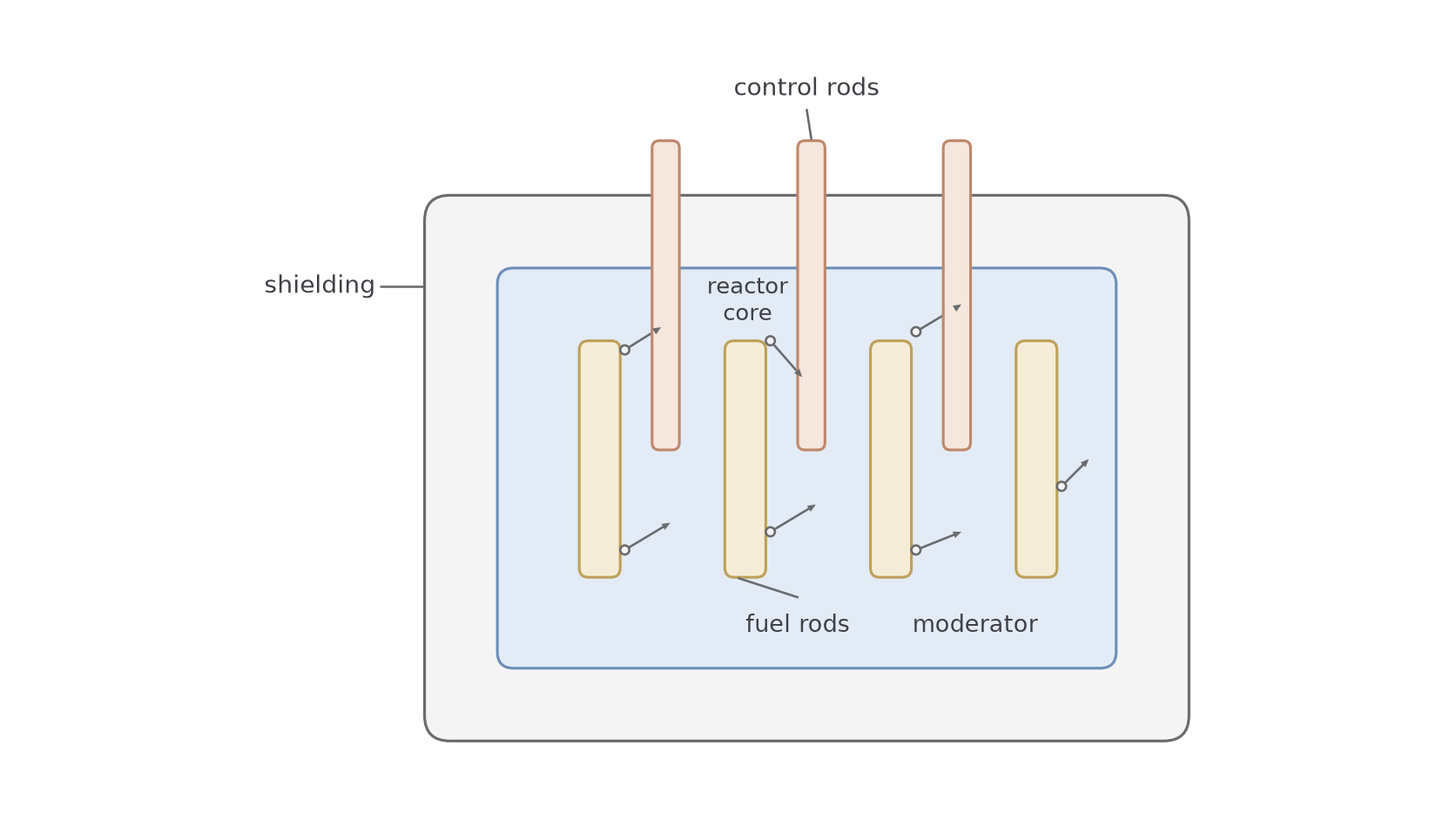
The fuel rods provide the material for fission, but the official focus in this lesson is the role played by the moderator, control rods and shielding.
Moderator slows neutrons
Neutrons released by fission are fast. Fast neutrons are less likely to cause further fission in uranium-235 than slower neutrons.
The moderator is material in the reactor core that slows neutrons down. It does this by collisions with the neutrons. In those collisions, the neutrons lose kinetic energy to the moderator material, so they become slower.
Moderator
A moderator is material in a nuclear reactor that slows down neutrons so they are more likely to cause further fission.
A slower neutron is more likely to be absorbed by a uranium-235 nucleus and cause it to split. This helps maintain the chain reaction in the reactor core. Common examples of moderator materials include graphite and water, but in an exam answer the function is usually more important than naming a material.
[DIAGRAM: asset_name: Nuclear reactors and control - diagram 02; asset_slug: p61_nuclear_reactors_and_control__diagram_02; recommended_method: image_gen; description: White 16:9 NovaLearn pale-palette diagram with grey outlines and dark-grey labels. Fuel fission emits a continuous fast-neutron path into a moderator, then a slower path toward further U-235 fission; a second path ends in a control rod.]
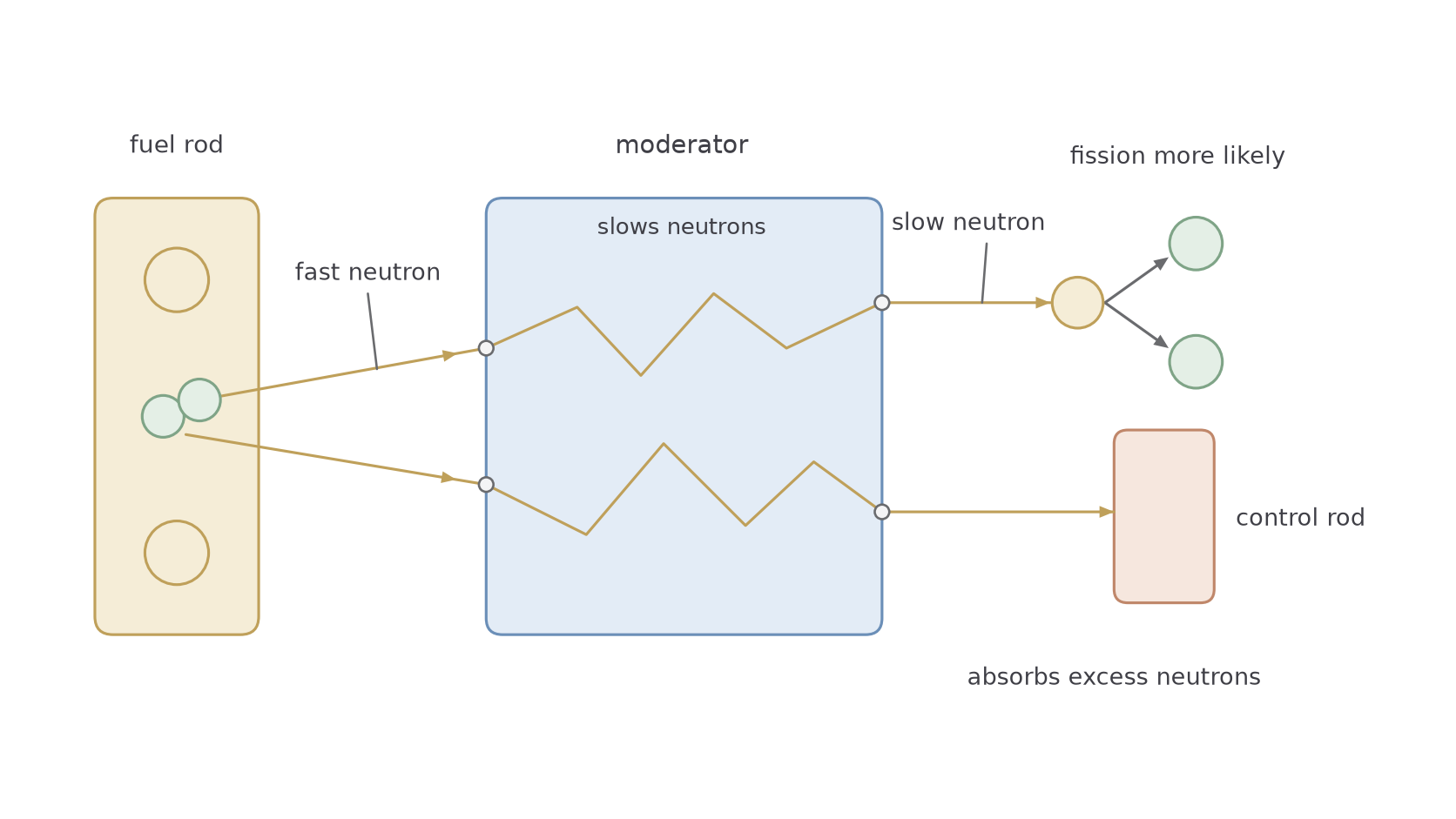
Good exam wording: "The moderator slows down neutrons, making them more likely to cause fission." Avoid saying that the moderator stops neutrons or absorbs the excess neutrons. That is the role of the control rods.
Control rods control rate
Control rods are used to control how many neutrons are available to continue the chain reaction. They are made from materials that absorb neutrons, such as boron or cadmium.
Control rods
Control rods absorb neutrons in a reactor core, reducing the number of neutrons available to cause further fission.
When control rods are lowered further into the reactor core, they absorb more neutrons. Fewer neutrons are then available to collide with fuel nuclei, so fewer fissions occur each second and the rate of reaction decreases.
When control rods are raised further out of the reactor core, they absorb fewer neutrons. More neutrons are available to cause fission, so the rate of reaction can increase. If control rods are inserted deeply enough, they can reduce the chain reaction greatly or shut it down.
Continue this lesson.
You’re previewing NovaLearn without an account. Create a free account to read the rest.
Create free account