5.8P-5.11P - Changes of state and particle model
Heating a substance does not always make its temperature rise. Sometimes the energy transferred by heating changes the way particles are arranged and move, so the substance changes state instead. This lesson uses the particle model to explain solids, liquids and gases, then uses that model to interpret the constant-temperature section of a temperature-time graph.
Heating and energy
When a system is heated, energy is transferred to the particles in that system. When there is net energy input and no compensating work done by the system, its internal energy increases.
Temperature is linked to the average kinetic energy of the particles. If heating makes the particles move faster, the temperature rises.
There is another possible outcome. For a pure substance melting or boiling at constant pressure, the energy transferred by heating may change the arrangement or separation of the particles instead of raising the temperature. This energy works against the attractive forces between the particles, freeing them from fixed positions or pulling them further apart, rather than making them move faster on average. The system still stores more energy, but the thermometer reading can stay constant while the state changes.
So Edexcel's key sentence can be unpacked like this:
| Heating a system can... | What happens to the particles |
|---|---|
| raise its temperature | particles have greater average kinetic energy |
| produce a change of state | particles change arrangement or separation while temperature is constant |
Do not write that energy is "lost" during a change of state. Energy is transferred to the system and changes the energy stored within it.
Particle arrangements
The particle model represents a substance as many tiny particles. The model is useful because solids, liquids and gases have different particle arrangements and different particle motions.
[DIAGRAM: asset_name: Changes of state and particle model - diagram 01; asset_slug: p44_changes_of_state_and_particle_model__diagram_01; recommended_method: image_gen; description: White 16:9 NovaLearn pale-palette diagram with grey outlines and dark-grey labels. Three neutral panels show touching regular solid particles, touching irregular liquid particles and widely spaced gas particles, with appropriate motion arrows.]
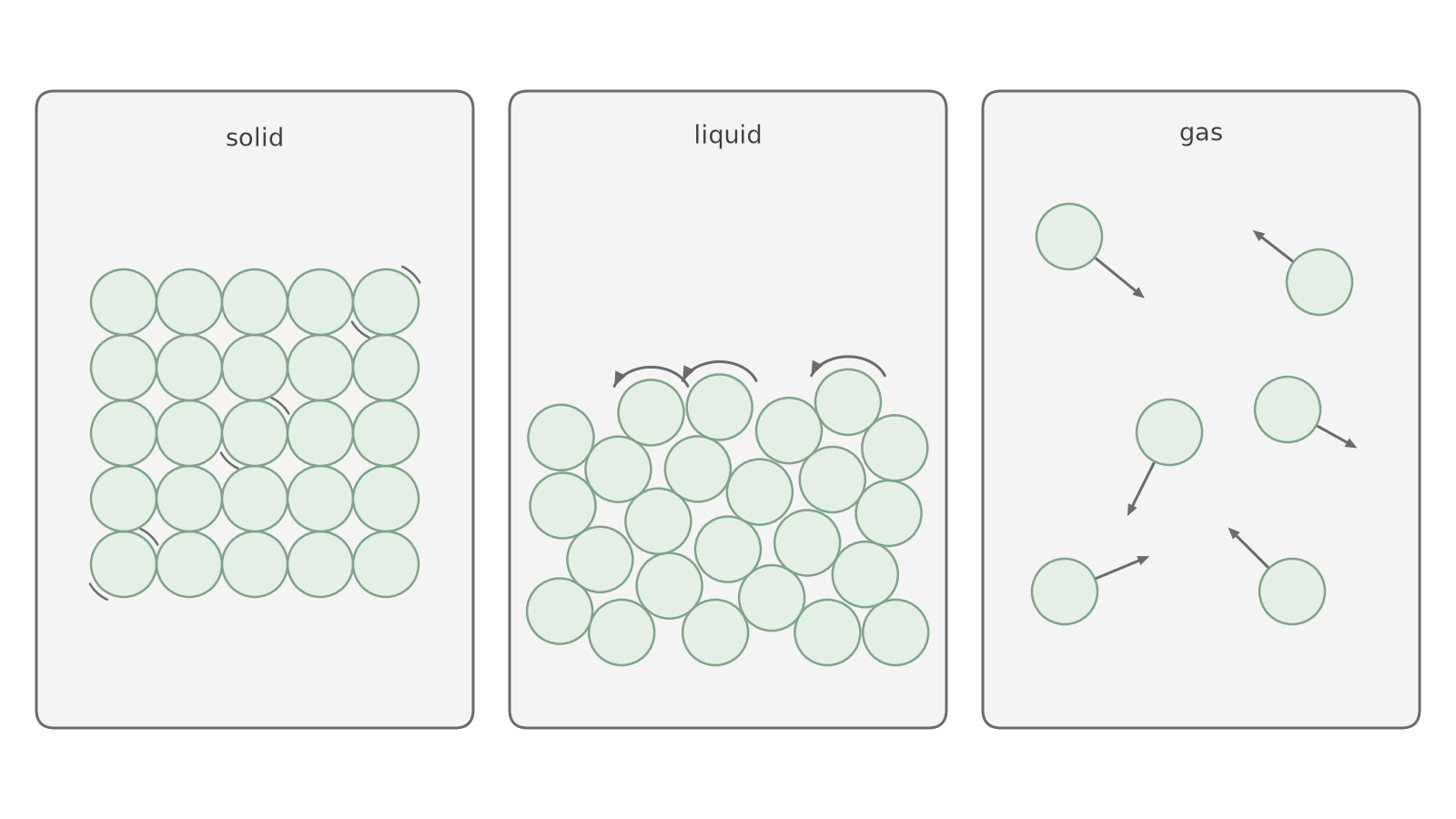
| State | Arrangement of particles | Motion of particles |
|---|---|---|
| solid | very close together in a regular arrangement | vibrate about fixed positions |
| liquid | close together but irregularly arranged | move around each other |
| gas | far apart and randomly arranged | move rapidly and randomly in all directions |
This explains several everyday properties. A solid keeps a fixed shape because its particles are held in fixed positions. A liquid can flow because its particles can move around each other while staying close together. A gas spreads out because its particles are far apart and move freely through the available space.
The particle model is a model, not a photograph. The circles represent particles, not their real sizes. The panels show separate illustrative samples, not one fixed mass disappearing as it changes state; particle number is conserved in an actual closed sample.
Melting
Melting is the change of state from solid to liquid. In a solid, particles are close together in a regular arrangement and vibrate about fixed positions.
As the solid is heated, its particles vibrate more. At the melting point, the energy transferred by heating changes the arrangement of the particles. The particles are no longer held in fixed positions, so they can move around each other.
After melting, the substance is a liquid. Its particles are still close together, but they are irregularly arranged and can slide past each other. That is why a liquid takes the shape of its container but does not spread out to fill all the available space like a gas.
Melting is a physical change. The particles are arranged and moving differently, but the substance has not become a new chemical substance.
Evaporation and boiling
Both evaporation and boiling change a liquid into a gas. In both cases, particles become much more widely separated and move randomly through the space available.
Evaporation happens at the surface of a liquid. Some particles near the surface have enough energy to leave the liquid and become gas particles. This can happen below the boiling point.
Boiling happens throughout the liquid at the boiling point. Gas bubbles form inside the liquid as particles have enough energy to separate from nearby particles and become a gas.
For example, a puddle dries up on a warm day by evaporation, even though the water never gets near 100 °C. Water in a pan boils at about 100 °C, with bubbles forming all through it.
The particle model difference is important:
| Process | Where liquid becomes gas | Particle change |
|---|---|---|
| evaporation | at the surface | some surface particles escape into the gas state |
| boiling | throughout the liquid | gas bubbles form inside the liquid as particles separate |
Continue this lesson.
You’re previewing NovaLearn without an account. Create a free account to read the rest.
Create free account