6.11P-6.14 - Forces on moving charges and the motor effect
Magnetic fields can do more than pull on magnets. They can exert a force on moving charged particles, and a current-carrying wire is full of moving charged particles. This lesson shows how that force is predicted, how it changes, and why the same effect is used in simple d.c. motors and loudspeakers.
Moving charges in fields
A charged particle can experience a force when it moves through a magnetic field. The force is present as long as the particle's motion is not parallel to the magnetic field.
Magnetic force on a moving charged particle
A moving charged particle experiences a force in a magnetic field if its motion has a component across the magnetic field rather than only along it.
The key comparison is between across the field and along the field.
If a charged particle moves across the field, the magnetic field can change its direction of motion. No formula for the size of this force is needed here. For direction, the motion of a positive charge has the direction of conventional current; for a negative charge, conventional current is opposite to its motion. The left-hand rule taught below can therefore be applied with the appropriate current direction. Reversing the sign of the charge reverses the force for the same motion and field.
If the charged particle moves parallel to the magnetic field, there is no magnetic force from that field. The particle is moving along the field lines rather than cutting across them.
[DIAGRAM: asset_name: Motor effect in charged particles and wires - diagram 01; asset_slug: p52_motor_effect_and_charged_current_carrying_particles__diagram_01; recommended_method: image_gen; description: White 16:9 NovaLearn pale-palette diagram with grey outlines and dark-grey labels. Two neutral positive-particle panels compare motion across and along a rightward sage field, with grey motion and an ochre into-page force symbol only across the field.]
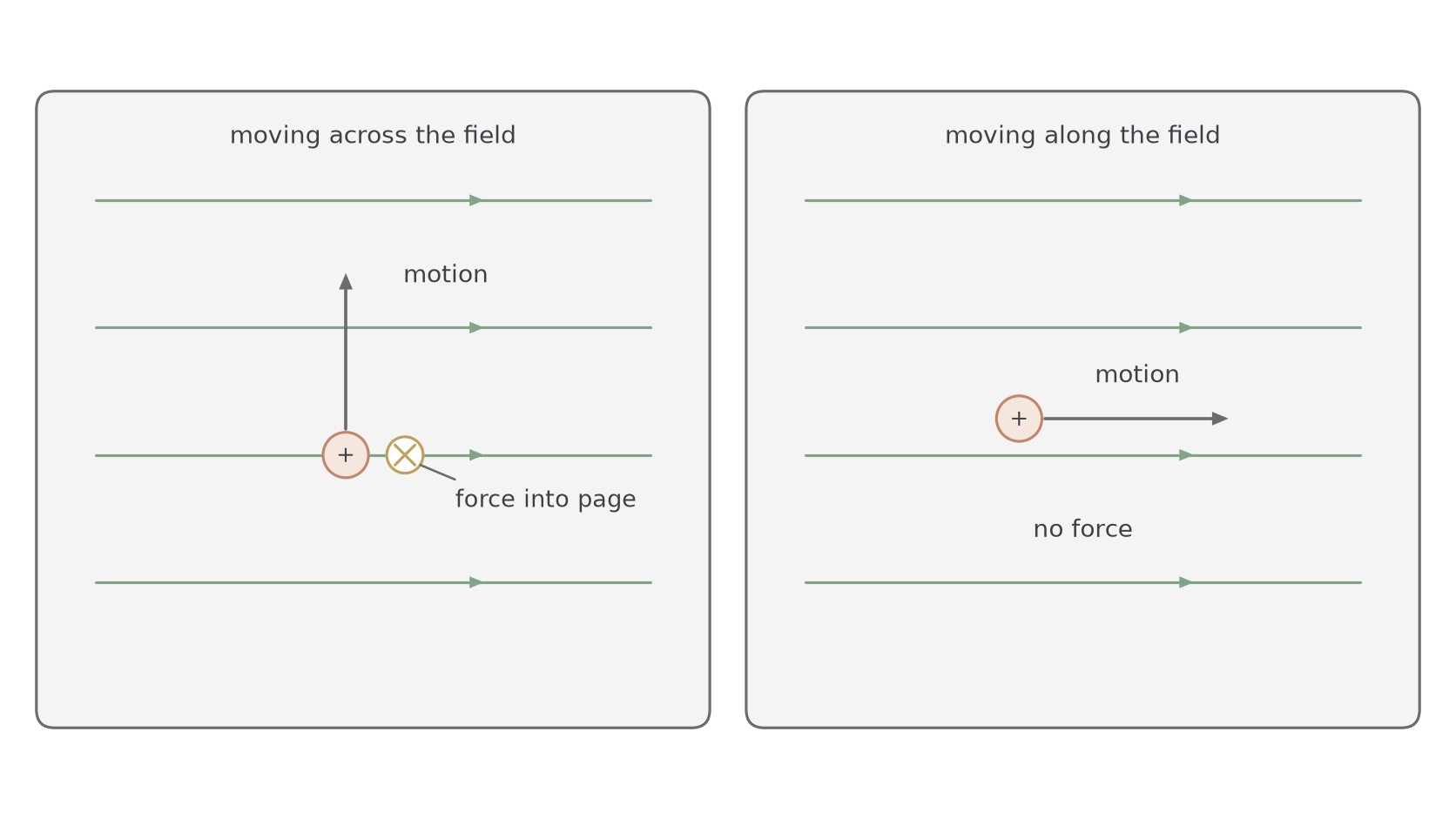
This idea matters because an electric current is a flow of charge. When the moving charges are inside a wire, the wire itself can experience a force.
Force on a current-carrying wire
A current-carrying wire contains moving charged particles. Those moving charges produce a magnetic field around the wire. If the wire is placed in another magnetic field, the two magnetic fields interact and a force can act on the wire.
This is called the motor effect.
Motor effect
The motor effect is the force on a current-carrying conductor placed in a magnetic field.
For the clearest International GCSE case, the wire is perpendicular to the magnetic field. Then the force is at right angles to both:
- the direction of the magnetic field
- the direction of the conventional current
The field direction between two magnetic poles is from north to south. The current direction used in Fleming's left-hand rule is conventional current, from positive to negative around the circuit.
[DIAGRAM: asset_name: Motor effect in charged particles and wires - diagram 02; asset_slug: p52_motor_effect_and_charged_current_carrying_particles__diagram_02; recommended_method: image_gen; description: White 16:9 NovaLearn pale-palette diagram with grey outlines and dark-grey labels. Out-of-page clay current in a wire between rose N and blue S poles, rightward sage field and an upward ochre force arrow.]
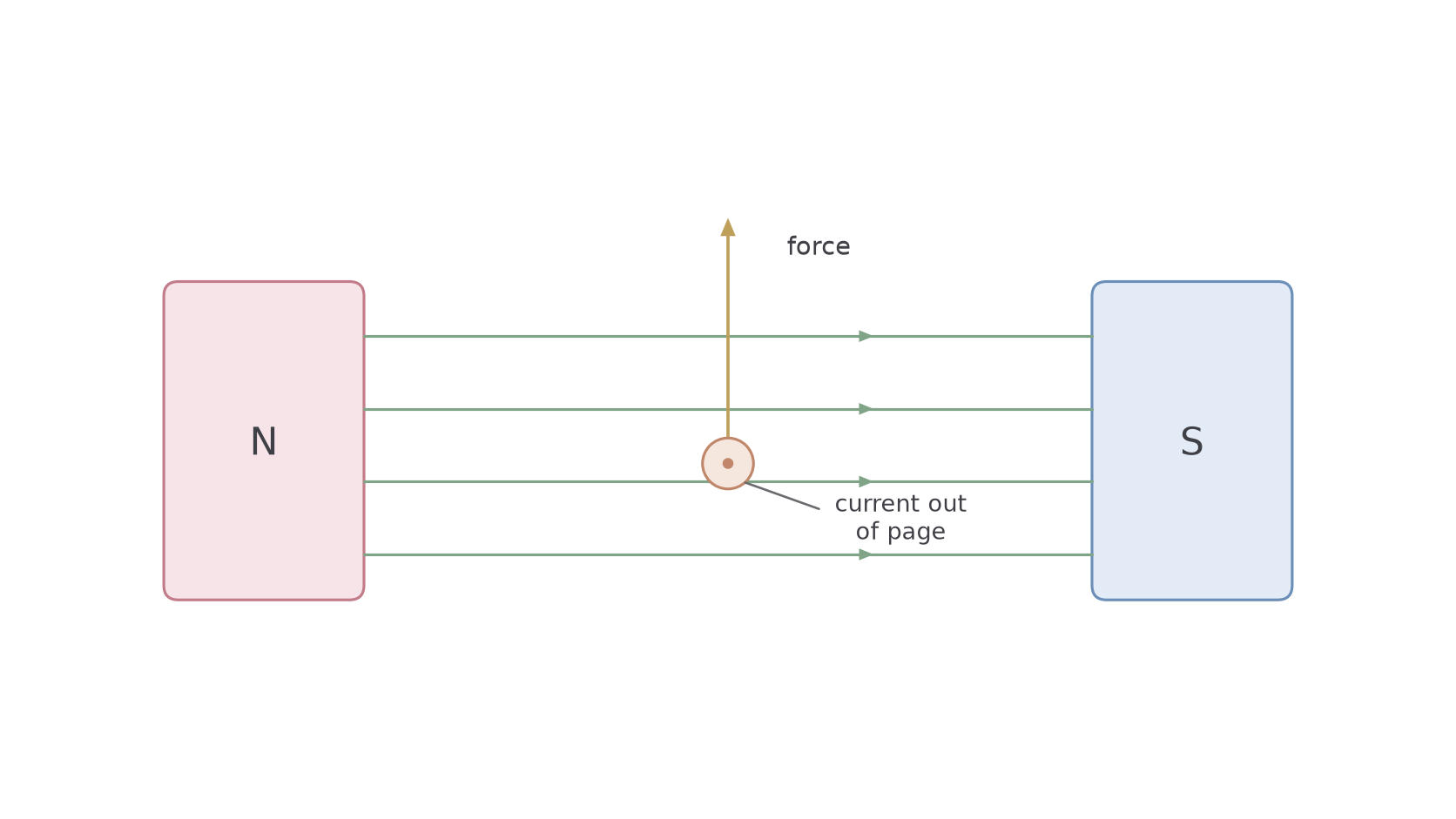
The wire's own magnetic field does not push on itself. The force comes from the interaction between the wire's magnetic field and the external magnetic field.
Using the left-hand rule
Fleming's left-hand rule predicts the direction of the force on a current-carrying wire when the current is perpendicular to the magnetic field.
Hold your left hand so the thumb, first finger and second finger are all at right angles to each other.
| Part of left hand | Direction it represents |
|---|---|
| First finger | magnetic Field, from north to south |
| seCond finger | conventional Current |
| thuMb | force or Motion on the wire |
[DIAGRAM: asset_name: Motor effect in charged particles and wires - diagram 03; asset_slug: p52_motor_effect_and_charged_current_carrying_particles__diagram_03; recommended_method: image_gen; description: White 16:9 NovaLearn pale-palette diagram with grey outlines and dark-grey labels. Clean neutral left-hand outline with thumb force, first-finger field and second-finger current, using ochre, sage and clay respectively.]
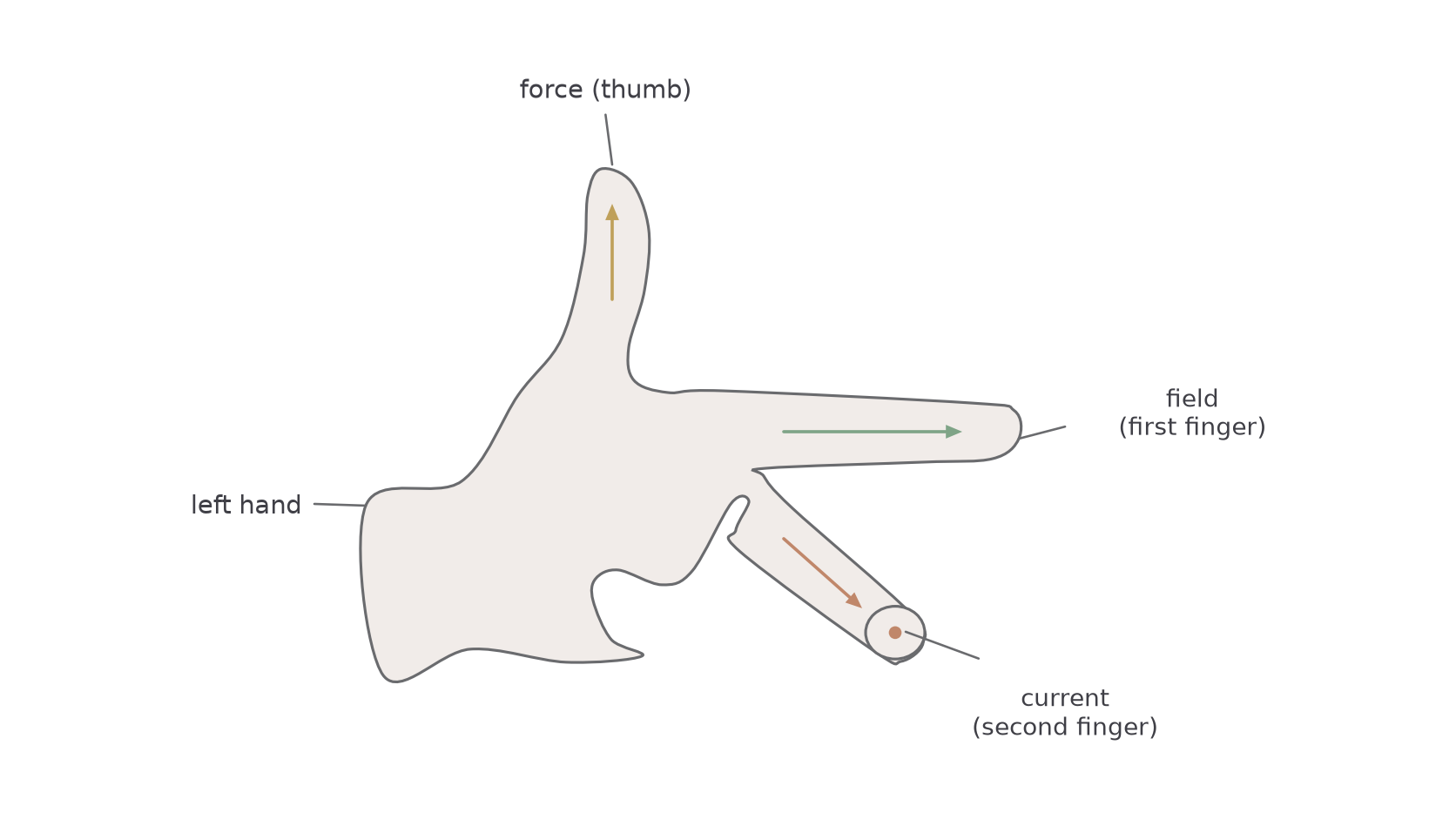
Worked example: a wire is in a magnetic field from left to right. The conventional current goes into the page. Point the first finger to the right for the field, and the second finger into the page for the current. Your thumb points down, so the force on the wire is down.
The rule only works when you line up the field and current directions correctly. A common mistake is to use electron flow instead of conventional current. For Edexcel force-direction questions, use conventional current unless the question explicitly tells you otherwise.
Continue this lesson.
You’re previewing NovaLearn without an account. Create a free account to read the rest.
Create free account