8.17P-8.18P - Expansion of the universe
Light from distant galaxies carries evidence about how the universe is changing. In this lesson, the key observation is that galaxy light is red-shifted, and that the amount of red-shift depends on how far away the galaxy is. The exam skill is to turn that observation into a clear explanation: red-shift shows galaxies are moving away, and the distance pattern is evidence that space itself is expanding.
What red-shift means
Astronomers can split light from a galaxy into a spectrum. A spectrum often contains dark or bright spectral lines, caused by particular atoms. These lines form a pattern that can be compared with a reference spectrum measured in a laboratory.
If the pattern of lines from a galaxy is shifted towards longer wavelengths, the light is red-shifted. The word "red" refers to the red end of the visible spectrum, where wavelengths are longer than at the blue end.
Red-shift
Red-shift is the increase in wavelength of light received from an object compared with the wavelength of the light when it was emitted, so the spectral lines are shifted towards the red end of the spectrum.
Red-shift does not mean the whole galaxy must look visibly red. It means the same spectral-line pattern is received at longer wavelengths than expected.
For this lesson, use this link:
- red-shift means wavelength has increased
- for galaxy light, red-shift is evidence that the galaxy is receding, or moving away
Red-shift and distance
Pearson asks you to describe red-shift in light received from galaxies at different distances from Earth. The important pattern is simple:
more distant galaxies usually show a greater red-shift.
[DIAGRAM: asset_name: Expansion of the universe - diagram 01; asset_slug: p68_expansion_of_the_universe__diagram_01; recommended_method: image_gen; description: White 16:9 NovaLearn pale-palette diagram with grey outlines and dark-grey labels. Common-scale lab, near, distant and farthest galaxy spectra with matching absorption patterns, increasing red-shift and a longer-wavelength arrow.]
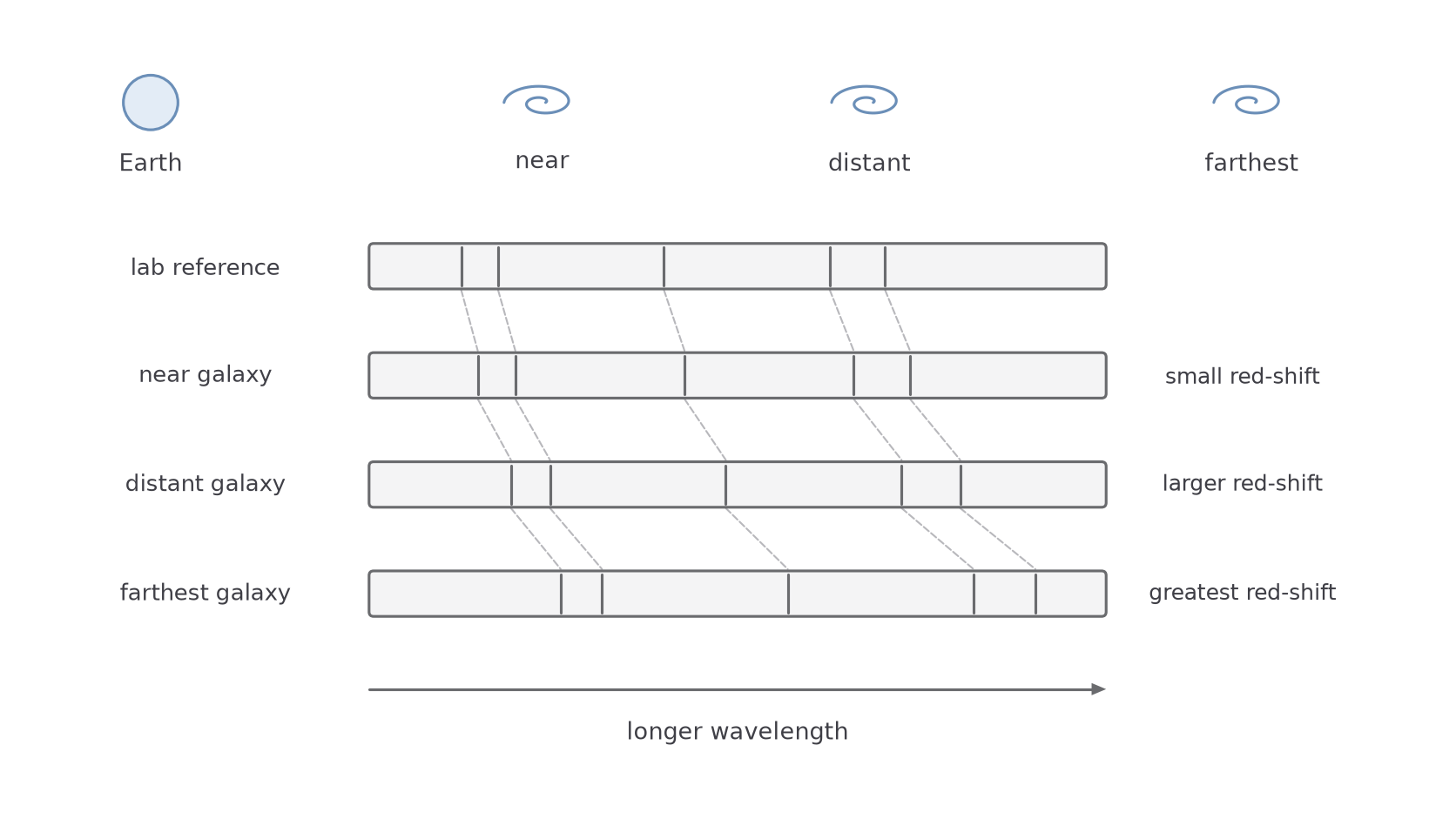
When describing this pattern, be careful to compare the same kind of feature. The lines remain identifiable as the same set, but each wavelength is increased by the same fraction. On a linear wavelength scale, the spacing between lines also stretches; the spectrum is not simply translated by a fixed number of nanometres. In the general expansion trend, a nearer galaxy has a smaller shift and a much more distant galaxy has a larger shift. Nearby galaxies also have local motions, so some can be blue-shifted; the evidence concerns the overall pattern for distant galaxies.
You can describe the observation in one sentence:
"The greater the distance of the galaxy from Earth, the greater the red-shift in the light received from it."
That sentence is not yet the full explanation of expansion. It is the observation that the explanation must use.
Red-shift and recession
A red-shift in galaxy light is interpreted as evidence that the galaxy is moving away from us. Another way to say this is that the galaxy is receding.
The reason is linked to wave behaviour. When a wave source moves away from an observer, each wave crest is emitted from a little farther away than the one before, so the crests arrive more spread out: the observed wavelength is longer and the observed frequency is lower. When light from a receding galaxy reaches us, its wavelengths are longer than they were when emitted. For distant galaxies, this is usually explained as the expansion of space stretching the light as it travels across the universe.
The larger the red-shift, the faster the galaxy is receding. This is why the distance pattern matters:
- nearer galaxies in the general expansion trend show smaller red-shifts, so they are receding more slowly
- distant galaxies show larger red-shifts, so they are receding faster
Avoid saying only "the light is moving away." The light travels towards Earth so that we can detect it. The red-shift tells us about the motion of the galaxy, or about the stretching of light during its journey through expanding space.
Continue this lesson.
You’re previewing NovaLearn without an account. Create a free account to read the rest.
Create free account