4.9-4.10 - Insulation investigation and reducing energy transfer
Thermal energy transfer is useful when you want to cook food, warm a room or heat water. It is unwanted when energy escapes from a house, a cup of hot drink or a machine. In this lesson you will plan and interpret investigations into conduction, convection and radiation, then use the same ideas to explain how insulation reduces unwanted energy transfer.
What to investigate
The practical in this lesson is about investigating thermal energy transfer by conduction, convection and radiation. A good investigation does not simply say "heat moves"; it asks how quickly thermal energy is transferred and which pathway is responsible for most of the transfer.
Thermal energy is transferred from a hotter region or object to a colder region or object. The bigger the temperature difference, the faster the transfer usually is. As the temperatures become closer together, the rate of transfer decreases.
In real equipment, more than one pathway often happens at the same time. A hot metal can transfer energy by conduction through the metal, by convection to nearby air, and by radiation to the surroundings. The practical skill is to design the apparatus so that one pathway is made clear, while the other factors are controlled as far as possible.
For any investigation, identify:
| Variable type | Meaning in this lesson | Example |
|---|---|---|
| independent variable | the factor deliberately changed | the insulating material |
| dependent variable | the factor measured | temperature decrease after a fixed time |
| control variables | factors kept the same | starting temperature, water volume, container, time interval |
When you compare methods of reducing energy transfer, the best insulator is usually the one that gives the smallest temperature change in the same time. For a hot object cooling down, a smaller fall in temperature means less thermal energy has been transferred to the surroundings.
Investigating three pathways
To investigate conduction, heat one end of a metal rod and observe how energy is transferred along it. A simple method is to attach small wax drops or pins along the rod. The wax nearest the flame melts first because thermal energy is conducted along the rod from the hotter end towards the colder end.
If you compare different rods, keep their length and diameter the same, use the same amount of wax, and heat each rod in the same way. The dependent variable could be the time taken for a wax drop to melt at a fixed distance from the flame. A shorter time is evidence of faster energy transfer in this controlled arrangement. Melting time also depends on heat capacity and heat losses, so it is not a direct measurement of thermal conductivity alone. Use clamps, eye protection and a heatproof mat; allow hot rods to cool before handling.
To investigate convection, place a small crystal or dye near the bottom of a beaker of water and heat the water gently on one side. The coloured water shows the movement of the water. The heated water expands and becomes less dense than the cooler water around it, so it rises; cooler, denser water sinks to take its place, and a convection current forms. This investigation is qualitative: the visible movement is the evidence for energy being carried by moving water.
To investigate radiation, place two identical temperature sensors or thermometers at equal distances from the same heat source. One sensor can have a blackened surface and the other a shiny surface. Start at the same temperature and put the sensors to the side of the source, outside its rising hot-air current. Measure the temperature rise over the same time. With matched sensors and other conditions controlled, a larger rise supports greater absorption of infrared radiation. The blackened sensor shows the larger rise, because dull black surfaces are better absorbers of infrared radiation than shiny surfaces.
[DIAGRAM: asset_name: Insulation investigation and reducing energy transfer - diagram 01; asset_slug: p37_insulation_investigation_and_reducing_energy_transfer__diagram_01; recommended_method: image_gen; description: NovaLearn pale-palette conduction, convection and radiation practicals: heated rod and wax drops; crystal directly above the heated side with clay rising and blue sinking currents; one-way infrared arrows from heater to black/shiny sensors and separate same-distance dimension lines.]
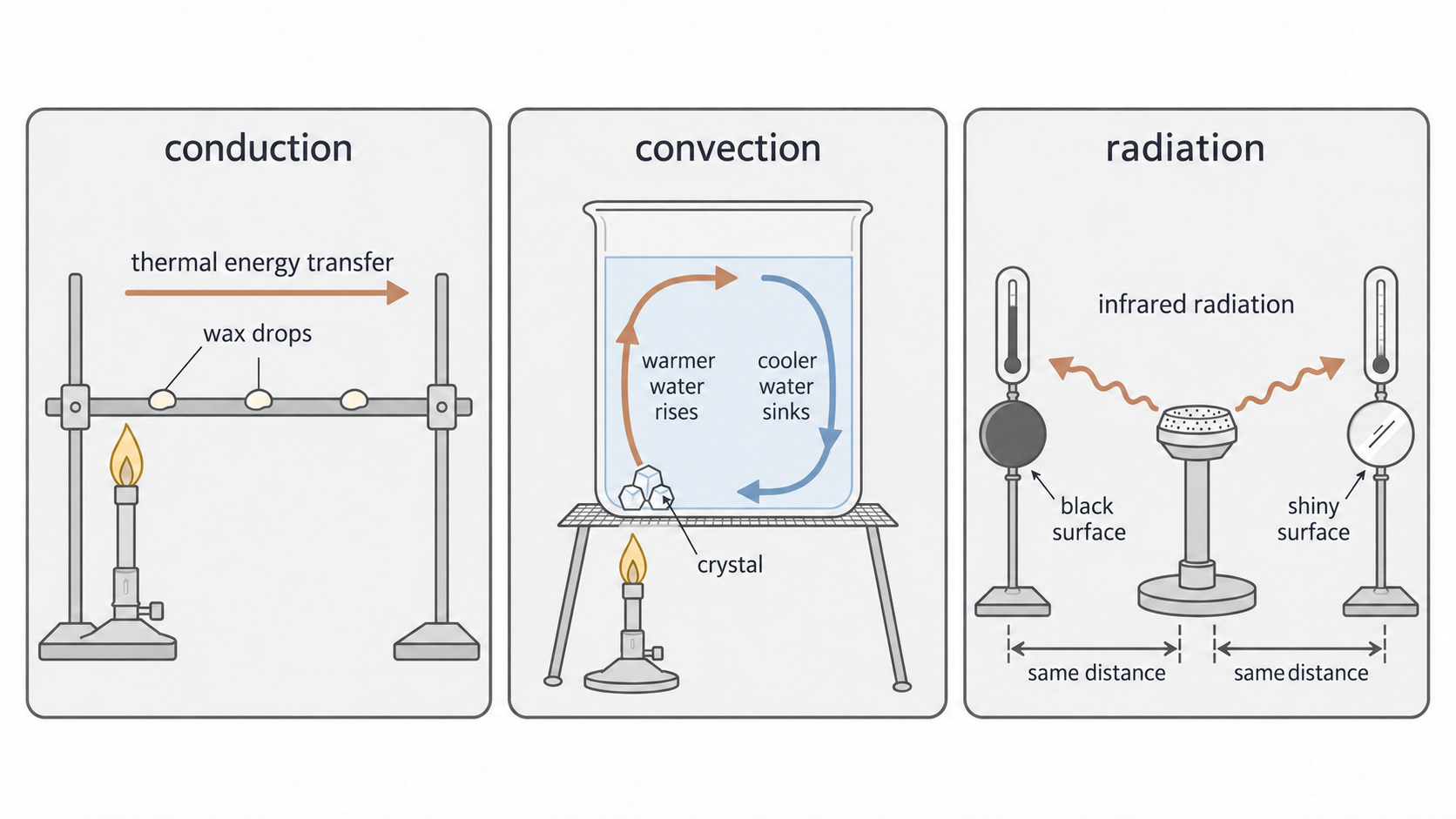
These practicals have the same pattern: make one transfer pathway visible or measurable, keep the comparison fair, and use the evidence to link a temperature change or observation to a transfer mechanism.
Continue this lesson.
You’re previewing NovaLearn without an account. Create a free account to read the rest.
Create free account