6.17P-6.20P - Transformers and power transmission
Transformers are used wherever an alternating voltage needs to be changed to a different size. In this lesson you will learn the structure of a transformer, how the voltage depends on the number of turns on each coil, and why transformers make large-scale electrical energy transmission more efficient. The key calculation idea is simple: in an ideal transformer, changing voltage changes current in the opposite direction so that power is conserved.
Transformer structure
A transformer is made from two coils of insulated wire wound around a soft iron core. The coil connected to the input alternating voltage is the primary coil. The coil connected to the output circuit is the secondary coil.
Transformer
A transformer is a device that changes the size of an alternating voltage using primary and secondary coils linked by a soft iron core.
The primary and secondary coils are not joined by a conducting wire. They are linked by the changing magnetic field in the core. The input must be alternating because an alternating input produces a changing magnetic field. That changing magnetic field is what allows a voltage to be produced on the output side. A steady direct current would produce a steady magnetic field, so no voltage would be induced in the secondary coil.
[DIAGRAM: asset_name: Transformers and power transmission - diagram 01; asset_slug: p54_transformers_and_power_transmission__diagram_01; recommended_method: image_gen; description: White 16:9 NovaLearn pale-palette diagram with grey outlines and dark-grey labels. Neutral hollow soft-iron transformer core with separate continuous primary and secondary windings, an a.c. source and a separate load circuit.]
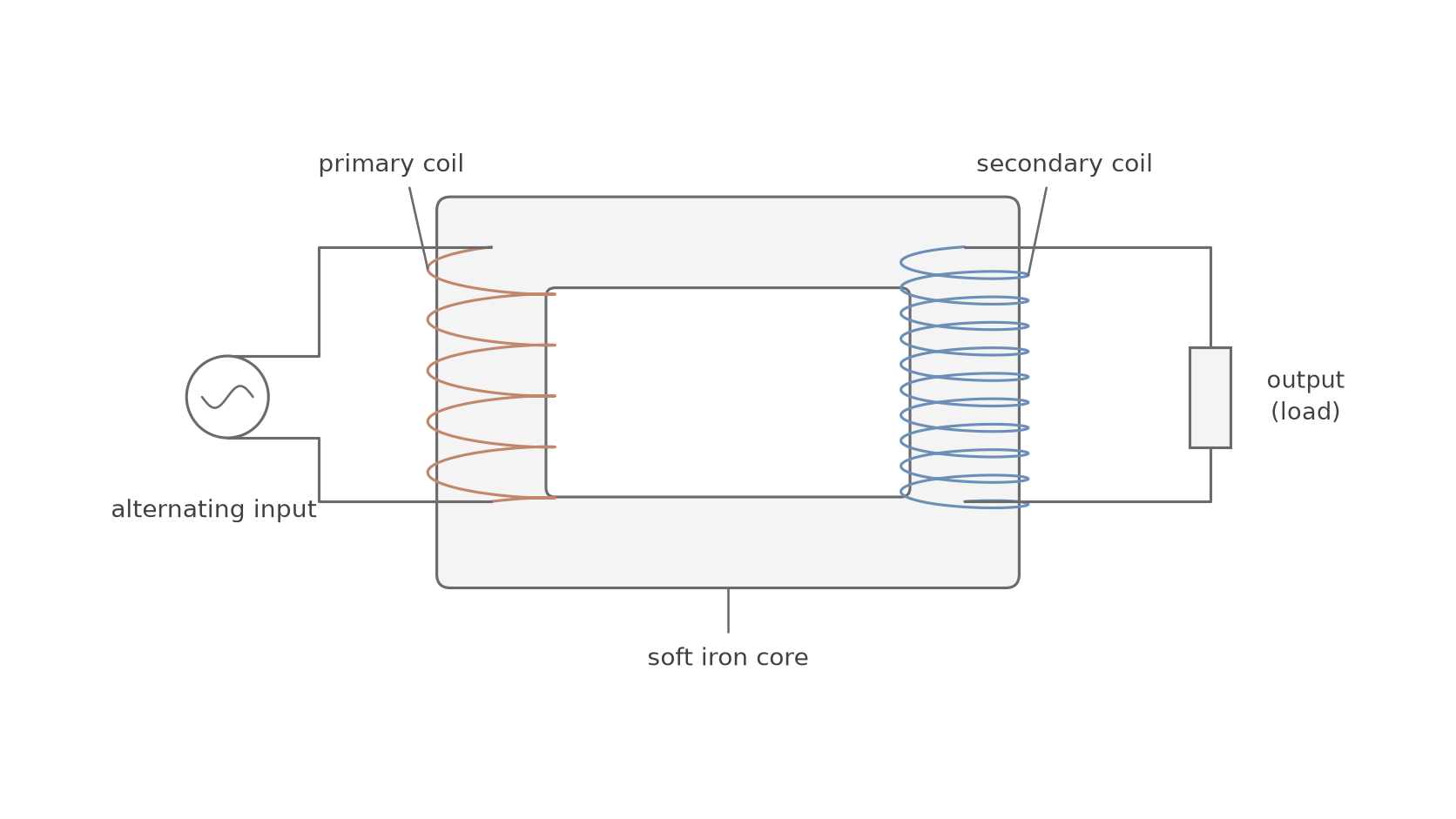
The number of turns means the number of loops of wire in a coil. A transformer changes the size of the alternating voltage when the input and output sides have different numbers of turns.
If the two sides have the same number of turns, the output voltage is the same size as the input voltage for an ideal transformer. If the number of turns is different, the output voltage is different.
Step-up and step-down transformers
The names step-up and step-down describe what happens to the voltage from the primary side to the secondary side.
| Type of transformer | Turns on secondary compared with primary | Effect on voltage |
|---|---|---|
| step-up transformer | more turns on the secondary coil | output voltage is greater than input voltage |
| step-down transformer | fewer turns on the secondary coil | output voltage is less than input voltage |
A step-up transformer does not create extra energy. It increases voltage by using more turns on the secondary side, but for an ideal transformer the current on the output side becomes smaller when the voltage becomes larger.
A step-down transformer reduces voltage by using fewer turns on the secondary side. In an ideal transformer, the output current is larger when the output voltage is smaller.
Worked example: identify the transformer type.
A transformer has 200 turns on the primary coil and 800 turns on the secondary coil. The secondary coil has more turns, so the output voltage is larger than the input voltage. This is a step-up transformer.
Now reverse the turns: 800 primary turns and 200 secondary turns. The secondary coil has fewer turns, so the output voltage is smaller than the input voltage. This is a step-down transformer.
Turns ratio equation
The voltage ratio of a transformer is equal to the turns ratio. Pearson writes this relationship as:
Transformer turns ratio
In this formula, is the primary/input voltage, is the secondary/output voltage, is the number of primary turns and is the number of secondary turns.
The equation can be used in either direction. If you know the two turn numbers and one voltage, you can find the other voltage. The safest method is to write the fraction exactly as primary over secondary, then substitute values carefully.
Worked example: calculate the secondary voltage.
A transformer has a primary voltage of 230 V, 500 primary turns and 50 secondary turns.
So:
The output voltage is 23 V. This is a step-down transformer because the secondary turns and secondary voltage are both smaller.
Worked example: calculate the primary turns.
A transformer changes 12 V to 240 V. The secondary coil has 600 turns.
The primary coil has 30 turns. The voltage has been stepped up, so the secondary coil needs more turns than the primary coil.
Continue this lesson.
You’re previewing NovaLearn without an account. Create a free account to read the rest.
Create free account