4.1-4.3 - Energy units, stores and transfers
Energy is a quantity that lets us describe changes in a system. In this lesson, you will learn the units Edexcel expects for this topic, the eight named energy stores, and the four ways energy can be transferred between stores. The most important idea is conservation of energy: energy can be shifted from store to store, but the total amount is not created or destroyed.
Using energy units
Physics answers need the correct unit as well as the correct idea. In this energy topic, Edexcel expects you to use these units fluently:
| Quantity | Unit name | Unit symbol |
|---|---|---|
| mass | kilogram | kg |
| energy | joule | J |
| distance or height | metre | m |
| speed | metre/second | m/s |
| acceleration | metre/second squared | |
| force | newton | N |
| time | second | s |
| power | watt | W |
A joule is the unit of energy, so transferred energy and energy stored are both measured in joules. A watt is the unit of power, which means rate of energy transfer; you will use this more fully in a later lesson.
The case of the symbol matters. J, N and W are capitals because they are named after people. kg, m and s are lower case. Do not write j for joule or w for watt in a final answer.
Unit symbols also carry meaning. m/s means metres each second, so it is a speed unit. means metres per second per second, so it is an acceleration unit. It is not the same as m/s.
Energy stores
An energy store is a way of describing where energy is held in a system. The Edexcel list has eight stores:
| Energy store | What it is useful for describing |
|---|---|
| chemical | fuels, food, cells and batteries |
| kinetic | moving objects |
| gravitational | objects lifted above a lower position |
| elastic | stretched or compressed springs, bands or other elastic objects |
| thermal | the temperature of objects or surroundings (the hotter an object, the more energy in its thermal store) |
| magnetic | separated magnets or magnetic fields in a system |
| electrostatic | separated electric charges |
| nuclear | atomic nuclei, such as fuel in nuclear reactions |
Some stores are easy to spot from everyday language. A moving ball has energy in its kinetic store. A stretched spring has energy in its elastic store. A hot pan has energy in its thermal store.
Other stores need a little care. A battery is described as having a chemical store, not an electrical store. Energy may be transferred electrically from the battery through a circuit, but "electrically" is the pathway, not the store. In the same way, light and sound are transfer pathways in this specification, not stores.
When you describe a situation, choose the store that belongs to the object or system. For example, a book held on a high shelf has energy in its gravitational store because of its position above the floor. If it falls, energy is transferred away from that gravitational store and into other stores.
Transfer pathways
Energy changes are described by saying which store decreases, which store increases, and how energy is transferred between them. Edexcel names four transfer pathways:
| Transfer pathway | Meaning in a description |
|---|---|
| mechanically | energy is transferred by a force moving something or changing its shape |
| electrically | energy is transferred by moving charge in a circuit |
| by heating | energy is transferred because of a temperature difference |
| by radiation | energy is transferred by waves, including light or sound |
The pathway is the "how". The store is the "where". This is the distinction that keeps exam answers precise.
[DIAGRAM: asset_name: Energy units, stores and transfers - diagram 01; asset_slug: p34_energy_units_stores_and_transfers__diagram_01; recommended_method: image_gen; description: Monochrome 16:9 flow diagram for a battery-powered lamp. Show a battery labelled chemical store in battery, an arrow labelled transferred electrically to a lamp, then arrows from the lamp labelled by light radiation and by heating to the surroundings, with the surroundings labelled thermal store of surroundings. The diagram should avoid labelling electrical, light or sound as energy stores.]
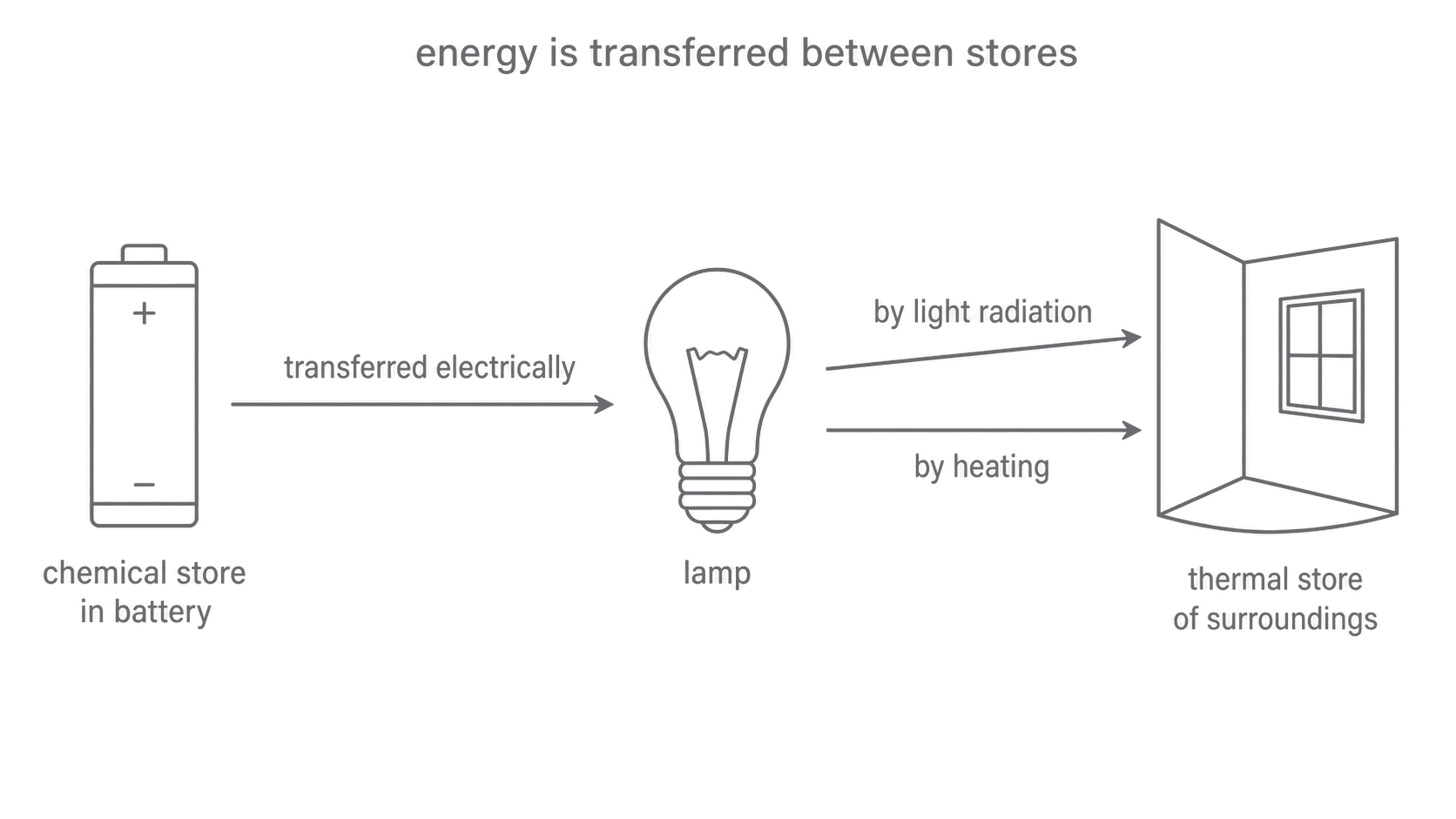
For a battery-powered lamp, a good description is:
Energy decreases in the chemical store of the battery. Energy is transferred electrically through the circuit to the lamp. Energy is then transferred by light radiation and by heating to the thermal store of the surroundings.
Continue this lesson.
You’re previewing NovaLearn without an account. Create a free account to read the rest.
Create free account