7.14-7.16 - Uses, contamination, irradiation and radiation safety
Radioactivity is useful because ionising radiation can pass through materials, be detected from outside the body, and transfer energy to living cells. The same properties make it hazardous if it is not controlled. This lesson focuses on how radioactivity is used, how contamination differs from irradiation, and how the risks from ionising radiation and radioactive waste are reduced.
Uses in industry and medicine
Radioactive sources are useful when radiation can do a job that ordinary light, heat or mechanical contact cannot do easily. In International GCSE questions, describe the use by linking the source, what the radiation does, and what is detected or affected.
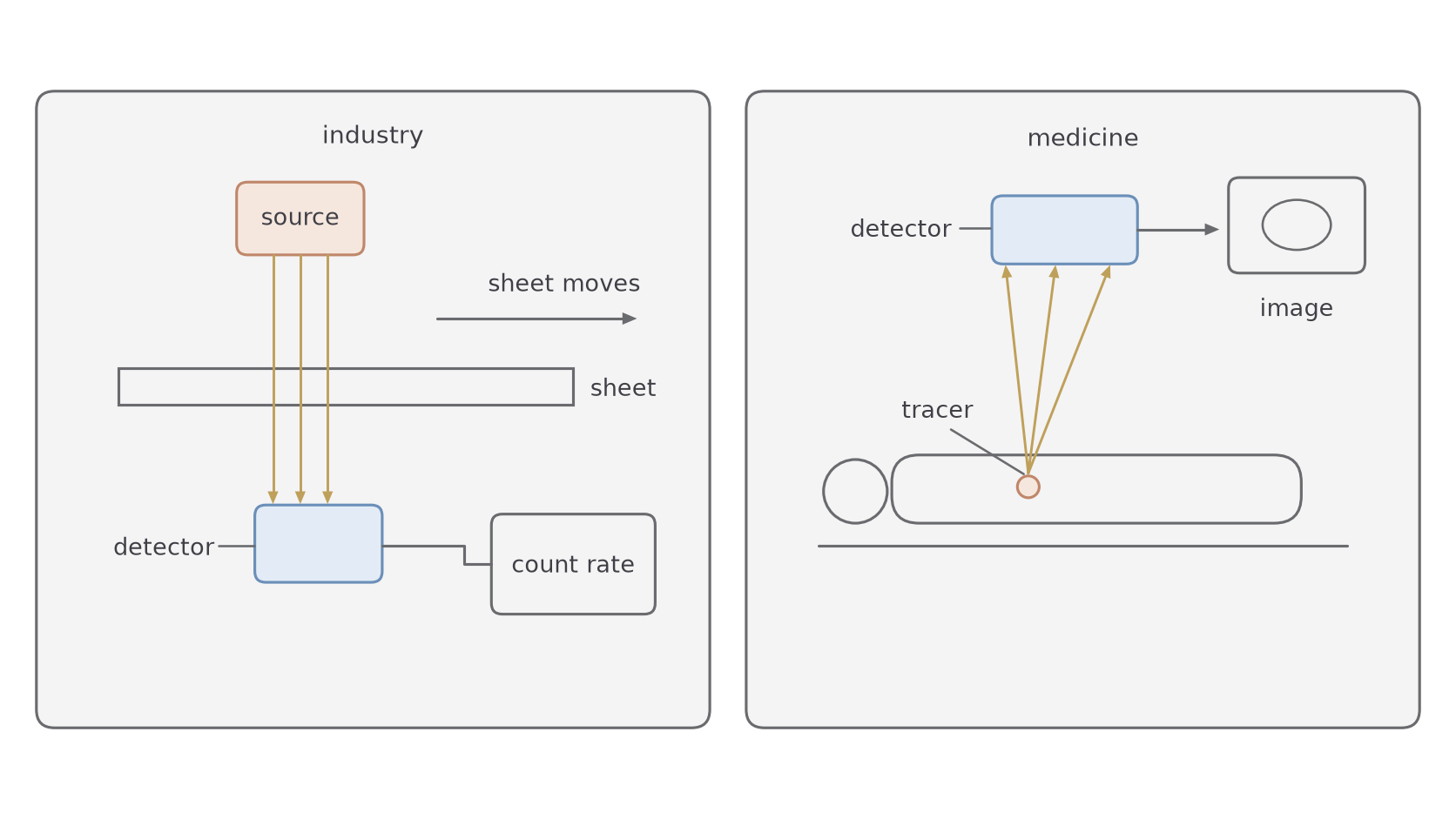
In industry, a radioactive source can be used in a thickness gauge. A source is placed on one side of a moving sheet of paper, plastic or metal foil, and a detector is placed on the other side. If the sheet becomes thicker, less radiation reaches the detector. The count rate can be used to adjust rollers so that the sheet thickness stays close to the required value.
The radiation must be partly absorbed by the sheet. For thin paper, beta is suitable: alpha would be stopped almost completely, while gamma would pass through too readily for a sensitive thickness measurement. A source with a long half-life avoids a rapidly falling count rate being mistaken for thicker paper.
Radioactive tracers can also be used in industry. A small amount of radioactive material is added to a liquid or gas flowing through pipes. Detectors outside the pipe can follow the radiation, so leaks or blockages can be located without digging up or dismantling the whole system.
In medicine, radioactive tracers can help diagnose disease. A small amount of a radioactive substance is put into the body, often by injection, swallowing or inhalation. It collects in a particular organ or tissue and emits radiation that is detected outside the body to build an image or show how that organ is working.
A medical tracer should emit radiation that can escape the body, commonly gamma; gamma is also only weakly ionising, so it does less damage to the cells it passes through. Its half-life must be long enough for delivery and scanning but short enough to limit continuing exposure. For example, a tracer that decays almost entirely before a scan cannot provide a useful image; an unnecessarily long-lived tracer continues irradiating tissue after the measurement.
Radioactivity can also be used in treatment. In radiotherapy, ionising radiation is directed at cancer cells to damage or kill them. The aim is to give a large enough dose to the tumour while limiting the dose to nearby healthy tissue. Radiation can also be used to sterilise medical equipment because it can kill microorganisms without heating the equipment strongly.
[DIAGRAM: asset_name: Uses, contamination, irradiation and radiation safety - diagram 01; asset_slug: p59_uses_contamination_irradiation_and_radiation_safety__diagram_01; recommended_method: image_gen; description: White 16:9 NovaLearn pale-palette diagram with grey outlines and dark-grey labels. Separate industry and medicine panels show radiation through a moving sheet to a detector and a tracer inside a patient emitting toward an external detector and image display.]
Contamination and irradiation
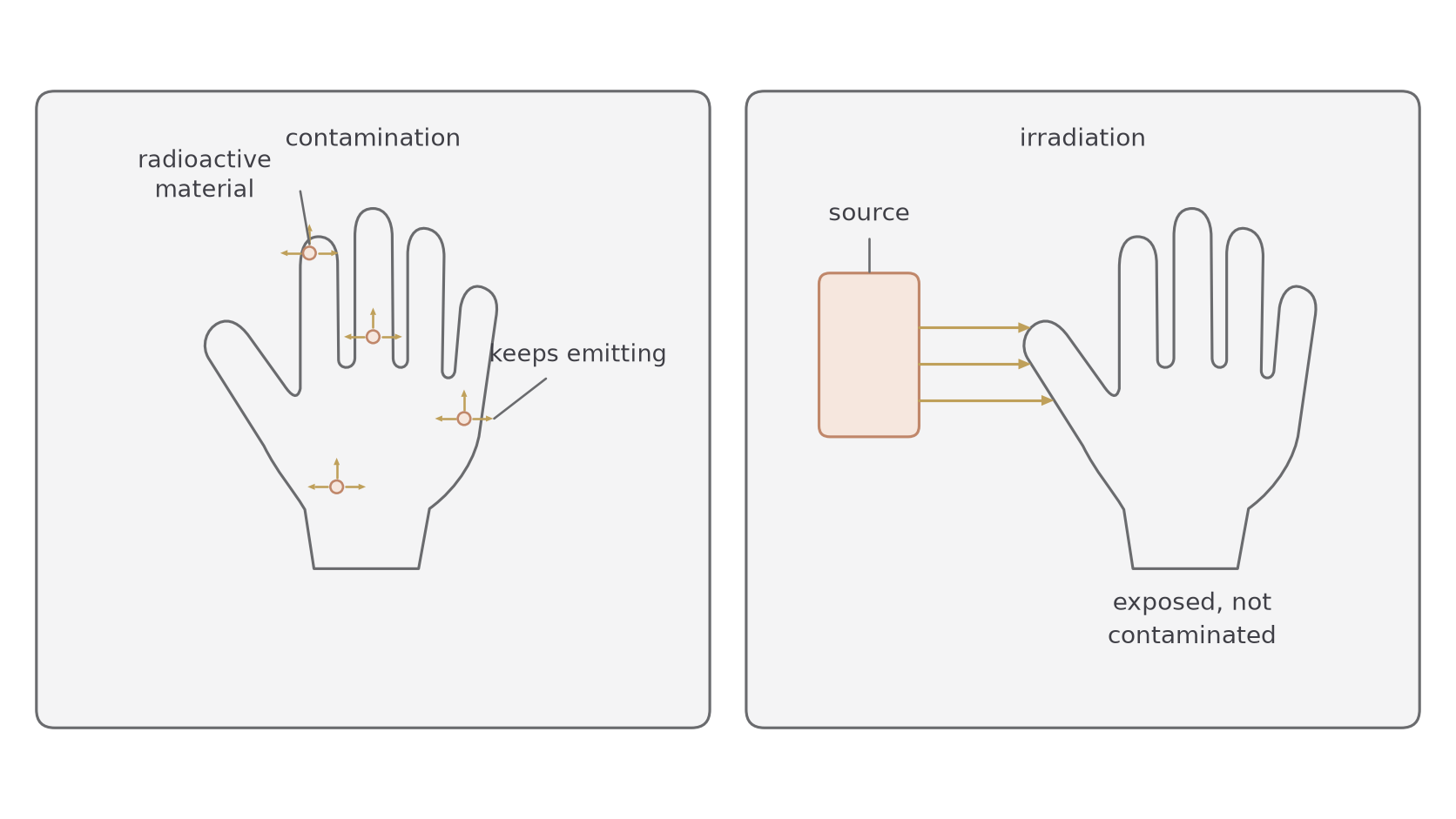
Contamination and irradiation are not the same hazard. The difference is about whether radioactive material is physically present.
Contamination
Radioactive contamination is the unwanted presence of radioactive material on or inside an object, a person or the environment.
If radioactive dust is on someone's clothing, the clothing is contaminated. If a radioactive liquid is swallowed or enters a wound, the person is internally contaminated. The radioactive material can keep emitting radiation until it is removed or until its activity has fallen.
Irradiation means exposure to ionising radiation; the radiation may come from a radioactive source or from a device such as an X-ray tube. The radiation reaches the object or person, but the radioactive material does not have to touch them or stay on them. A person having an X-ray is irradiated but is not made radioactive by the X-ray.
[DIAGRAM: asset_name: Uses, contamination, irradiation and radiation safety - diagram 02; asset_slug: p59_uses_contamination_irradiation_and_radiation_safety__diagram_02; recommended_method: image_gen; description: White 16:9 NovaLearn pale-palette diagram with grey outlines and dark-grey labels. Neutral hand outlines distinguish radioactive contamination with attached material and continued emission from irradiation by an external source.]
The key exam wording is:
| Situation | Is radioactive material present? | Does the object keep emitting after the source is removed? |
|---|---|---|
| contamination | yes, on or inside the object | yes, while the radioactive material remains active and present |
| irradiation | no, only radiation has reached it | no, not just because it was irradiated |
Continue this lesson.
You’re previewing NovaLearn without an account. Create a free account to read the rest.
Create free account