2.25P-2.26P - Electrostatic attraction, repulsion and electron movement
Static electric effects can look mysterious, but the rules are small and exact. Charged objects exert forces on other charged objects, and many electrostatic observations can be explained by electrons moving or shifting. The key exam habit is to name the charge interaction first, then explain how the electron movement produced it.
Charge force rules
There are two types of electric charge: positive and negative. A charged object can exert an electrostatic force on another charged object without touching it.
Electrostatic force
An electrostatic force is a non-contact force between charged objects.
The rule for the direction of the force is:
- unlike charges attract
- like charges repel
"Attract" means each object is pulled towards the other object. "Repel" means each object is pushed away from the other object. The force is mutual, so a force arrow should be shown on both charged objects.
[DIAGRAM: asset_name: Electrostatic attraction, repulsion and electron movement - diagram 01; asset_slug: p21_electrostatic_attraction_repulsion_and_electron_movement__diagram_01; recommended_method: image_gen; description: Monochrome three-panel schematic showing two positive charges repelling, two negative charges repelling, and a positive and negative charge attracting, with mutual force arrows.]
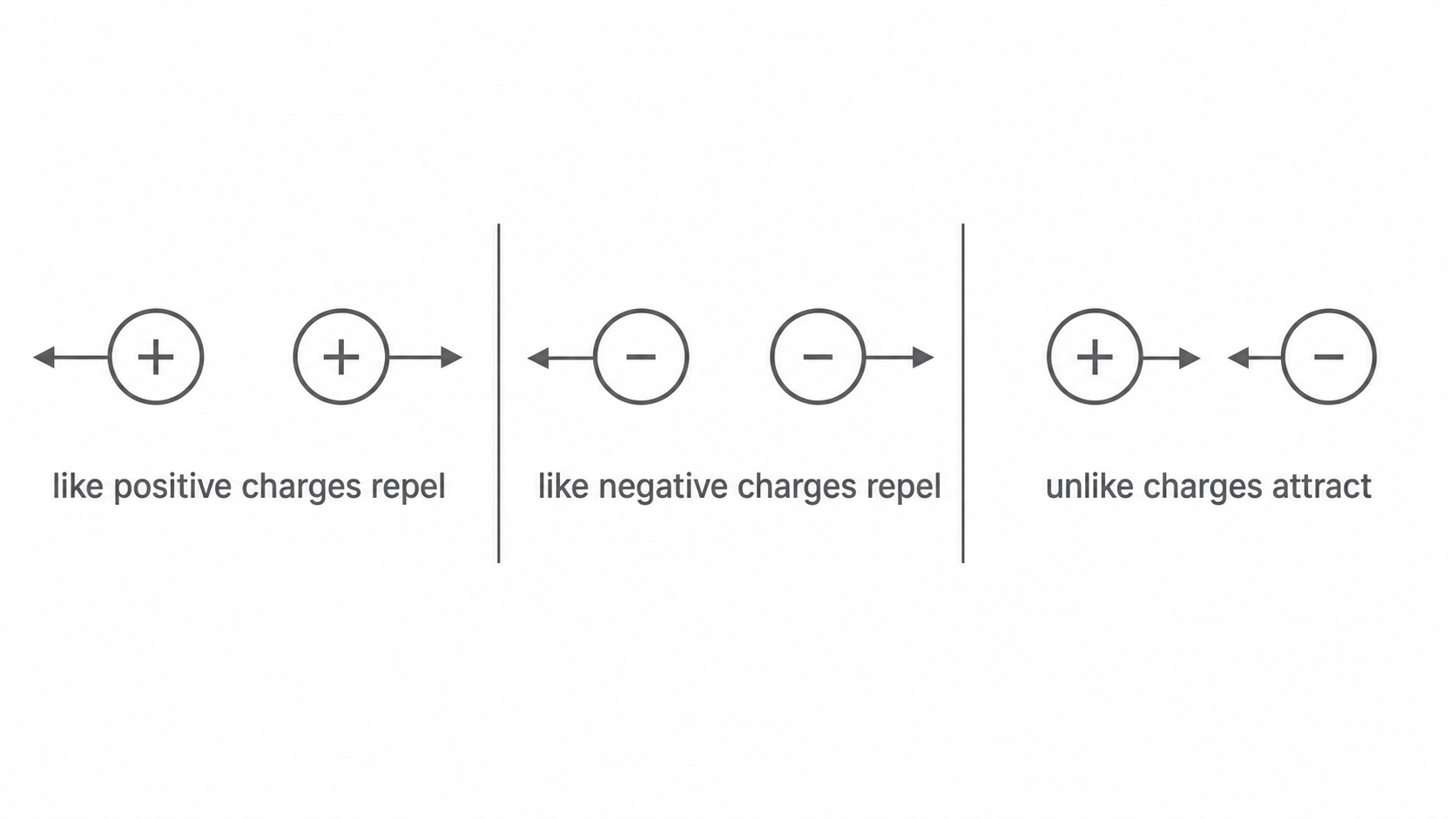
A common exam trap is to treat attraction and repulsion as equally conclusive. Repulsion is strong evidence that both objects are charged and have the same type of charge. Attraction can happen between unlike charges, and a charged object may also attract a neutral object if charges inside the neutral object shift.
Electrons and charge
Atoms contain positive charge in their nuclei and negative electrons around the nuclei. In ordinary solid materials, the positive charge is not the part that moves from one object to another during static charging. The explanation is about electrons.
A neutral object has equal amounts of positive and negative charge overall. If electrons are added to the object, it has more negative charge than positive charge, so it becomes negatively charged. If electrons are removed from the object, it has less negative charge than positive charge, so it becomes positively charged.
| Electron movement | Resulting charge on the object |
|---|---|
| Electrons move onto the object | Negative |
| Electrons move away from the object | Positive |
| An initially neutral object has no overall gain or loss of electrons | Remains neutral overall |
Do not say that positive charge has moved to make the object positive. The positive charge stays in the nuclei, so a positive static charge means electrons have left that object.
[DIAGRAM: asset_name: Electrostatic attraction, repulsion and electron movement - diagram 02; asset_slug: p21_electrostatic_attraction_repulsion_and_electron_movement__diagram_02; recommended_method: image_gen; description: NovaLearn pale-palette three-step rod-to-cloth electron transfer, keeping six positive charges fixed in each object; rod loses three electrons and becomes positive, cloth gains three and becomes negative; protons do not move.]
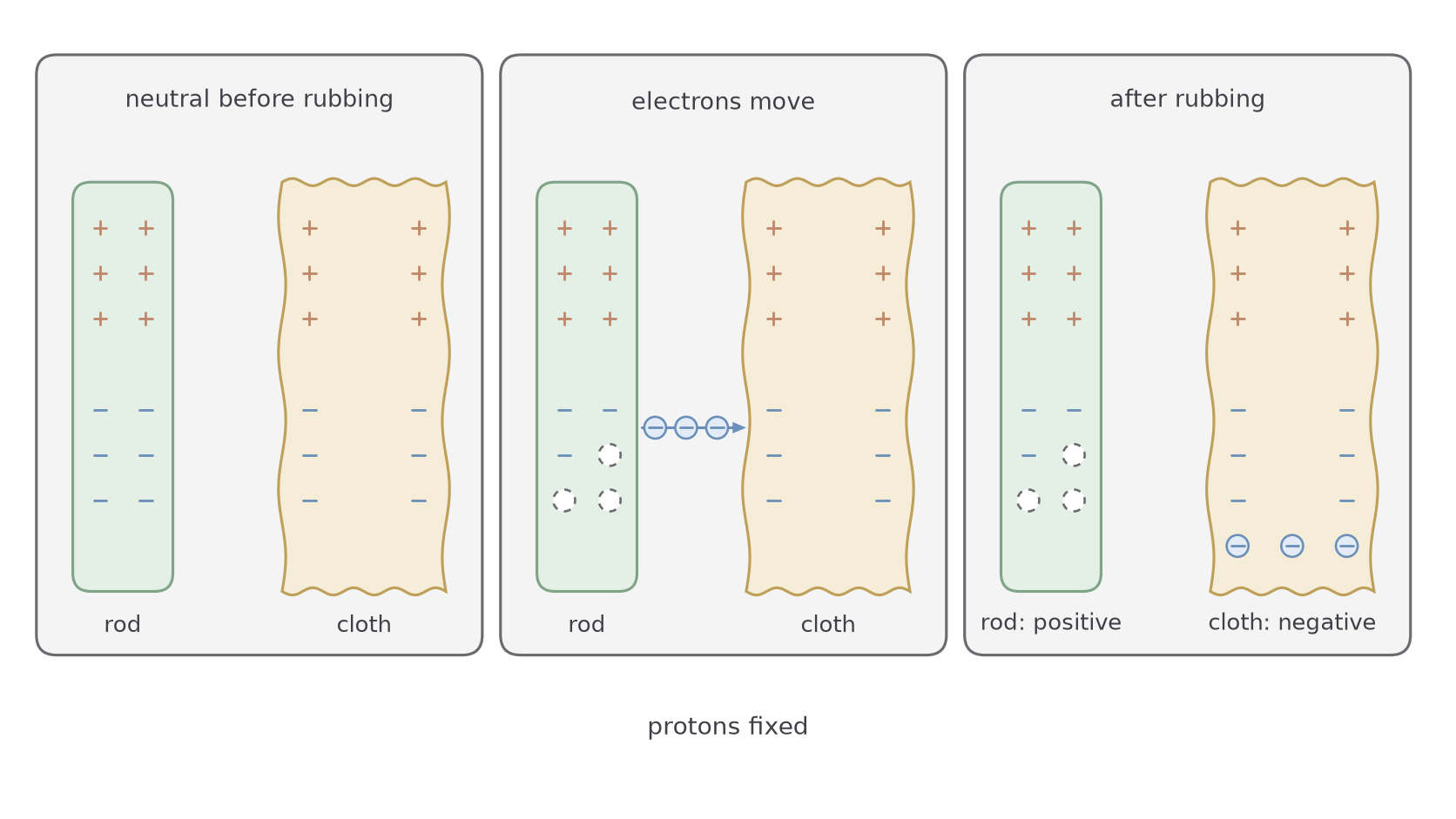
In the example in the diagram, electrons move from the rod to the cloth. The rod has lost electrons, so it becomes positive. The cloth has gained electrons, so it becomes negative.
Continue this lesson.
You’re previewing NovaLearn without an account. Create a free account to read the rest.
Create free account