4.14-4.15 - Kinetic energy and energy calculations
Moving objects have kinetic energy. In this lesson you will calculate kinetic energy from mass and speed, then use conservation of energy to connect kinetic energy with gravitational potential energy and work. The main skill is careful energy bookkeeping: decide where the energy starts, where it ends, and whether any work transfers energy away.
Kinetic energy equation
Kinetic energy is the energy an object has because it is moving. A stationary object has no kinetic energy. A more massive object has more kinetic energy at the same speed, and a faster object has more kinetic energy at the same mass.
Kinetic energy
Kinetic energy is the energy stored by an object because it is moving.
The Pearson equation for kinetic energy is:
Kinetic energy
In words: . This equation is not given in the exam, so learn it.
In this equation, is kinetic energy in joules, J; is mass in kilograms, kg; and is speed in metres per second, m/s. Speed is squared, so means . Only the speed is squared: work out first, then multiply by and by . Squaring as a whole, or leaving out the , gives the wrong answer.
For example, a ball moving at has:
Use speed, not distance or acceleration. If speed is given in , convert it to before using the equation: divide by 3.6, because . If mass is given in grams, divide by 1000 to get kilograms.
Why speed matters so much
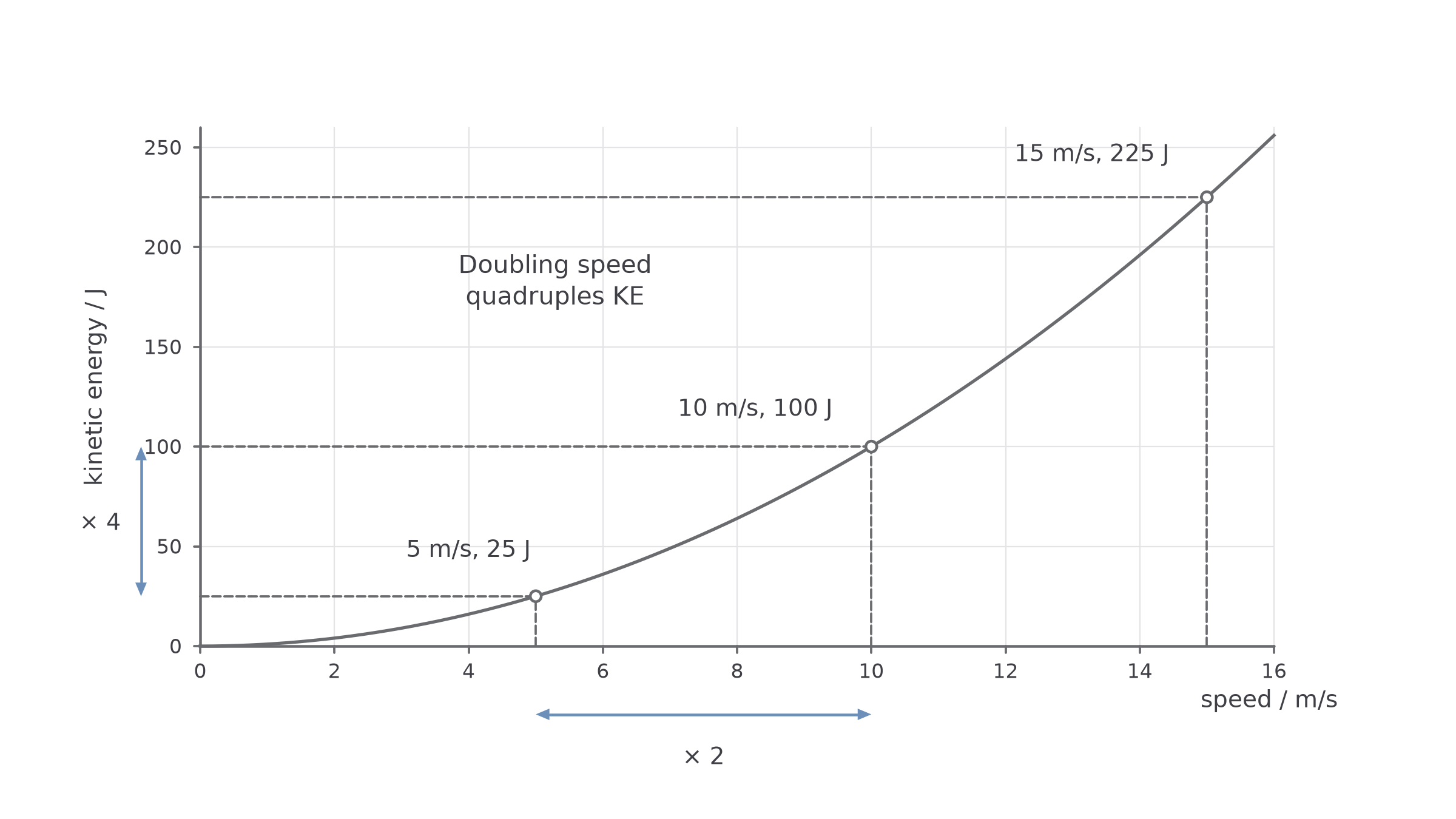
The equation contains , so kinetic energy is not directly proportional to speed. If the mass stays the same, doubling the speed makes the kinetic energy four times bigger because:
[DIAGRAM: asset_name: Kinetic energy and energy calculations - diagram 01; asset_slug: p39_kinetic_energy_and_energy_calculations__diagram_01; recommended_method: matplotlib; description: NovaLearn pale-palette kinetic-energy graph for a 2.0 kg mass, KE = speed squared, with points and dashed guides at (5,25), (10,100) and (15,225), and clear doubling-speed/quadrupling-energy brackets.]
For a trolley:
| Speed in m/s | Kinetic energy in J |
|---|---|
| 5.0 | 25 |
| 10.0 | 100 |
| 15.0 | 225 |
The jump from to doubles the speed, but the kinetic energy changes from to . That is four times larger. Tripling the speed, from to , makes the kinetic energy nine times larger, because : becomes . Mass is not squared, so doubling the mass at the same speed only doubles the kinetic energy.
You may also need to find speed from kinetic energy. Multiply both sides by 2 to get , divide by to get , then take the square root:
For example, if a object has of kinetic energy:
Speed is a scalar, so give the positive value for speed unless a question specifically asks about velocity and direction.
Conservation links energy stores and work
Energy is conserved: it is transferred between stores, but the total amount of energy is not created or destroyed. In this cluster, the useful link is between gravitational potential energy, kinetic energy and work.
If an object falls and air resistance is negligible, energy is transferred from its gravitational store to its kinetic store:
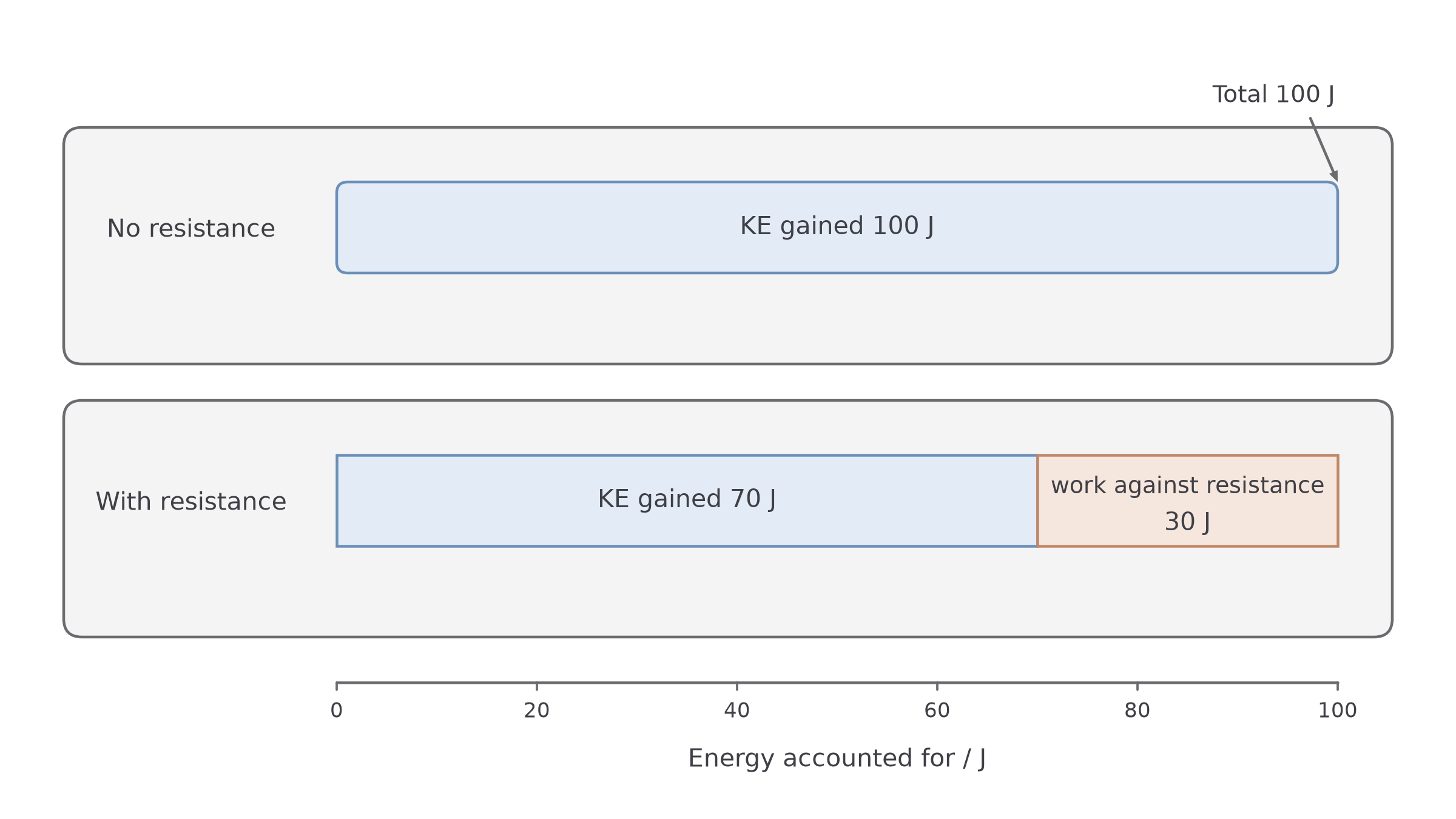
If resistive forces act, not all the lost gravitational potential energy becomes kinetic energy. Some energy is transferred away by work done against resistance, mainly to the thermal stores of the object and the surroundings, with some transferred by sound:
[DIAGRAM: asset_name: Kinetic energy and energy calculations - diagram 02; asset_slug: p39_kinetic_energy_and_energy_calculations__diagram_02; recommended_method: matplotlib; description: NovaLearn pale-palette energy bookkeeping bars on a 0–100 J scale: no-resistance KE gained 100 J, and with-resistance KE gained 70 J plus work done against resistance 30 J, with solid pale blue/clay fills, readable labels and no hatching.]
The same bookkeeping works in reverse. If an object moves upwards, kinetic energy can be transferred into gravitational potential energy. If a braking force or friction slows an object, work is done against the motion and kinetic energy decreases. That energy is transferred mainly to thermal stores, such as those of the brakes and the surroundings.
Continue this lesson.
You’re previewing NovaLearn without an account. Create a free account to read the rest.
Create free account