2.17-2.19 - Current and voltage rules in circuits
Current and voltage follow reliable rules in circuits. In this lesson, current is treated as a flow of charge that cannot disappear at a junction, while voltage is treated as the potential difference across components. The main calculation skill is using the series rules with for two resistive components.
Current at junctions
A junction is a point in a circuit where the path splits or where separate paths join. Current can divide between branches, or branches can combine again, but the total current is conserved at the junction.
Current conservation at a junction
The total current entering a junction is equal to the total current leaving the junction.
This happens because current is the rate of flow of charge. In a steady circuit, charge does not build up at the junction, and it is not created or destroyed there, so the charge arriving each second must equal the charge leaving each second. If reaches a junction and the two outgoing branches carry and , the currents balance:
[DIAGRAM: asset_name: Current and voltage rules in circuits - diagram 01; asset_slug: p18_current_and_voltage_rules_in_circuits__diagram_01; recommended_method: image_gen; description: Monochrome junction diagram showing 0.90 A entering a junction and splitting into 0.30 A and 0.60 A, with arrows and the equation 0.90 A = 0.30 A + 0.60 A.]
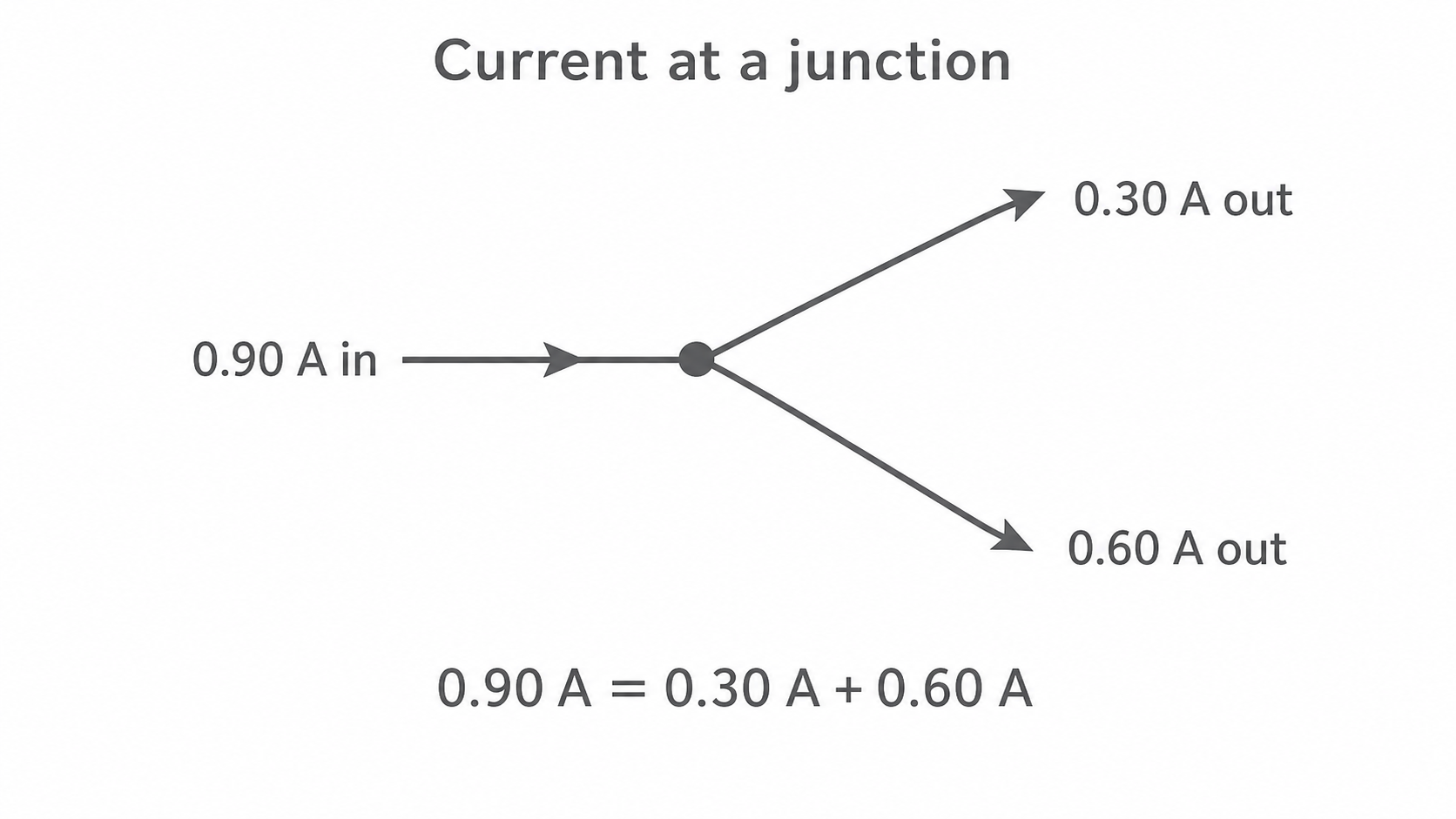
For questions, use the word "total" carefully. To find the current into a junction, add the branch currents leaving it. If one branch current is missing, subtract the known outgoing currents from the incoming current.
Voltage in parallel
Two components are connected in parallel when each component is connected between the same two points in the circuit. Those two points set the voltage across the component.
If two components are connected in parallel, the voltage across each component is the same, even if their resistances are different. If the supply provides across the two rails, each component connected directly across those rails has across it.
[DIAGRAM: asset_name: Current and voltage rules in circuits - diagram 02; asset_slug: p18_current_and_voltage_rules_in_circuits__diagram_02; recommended_method: image_gen; description: Monochrome circuit diagram showing two resistors R1 and R2 in parallel between the same left and right nodes, with a 6 V supply and voltmeters showing 6 V across each branch.]
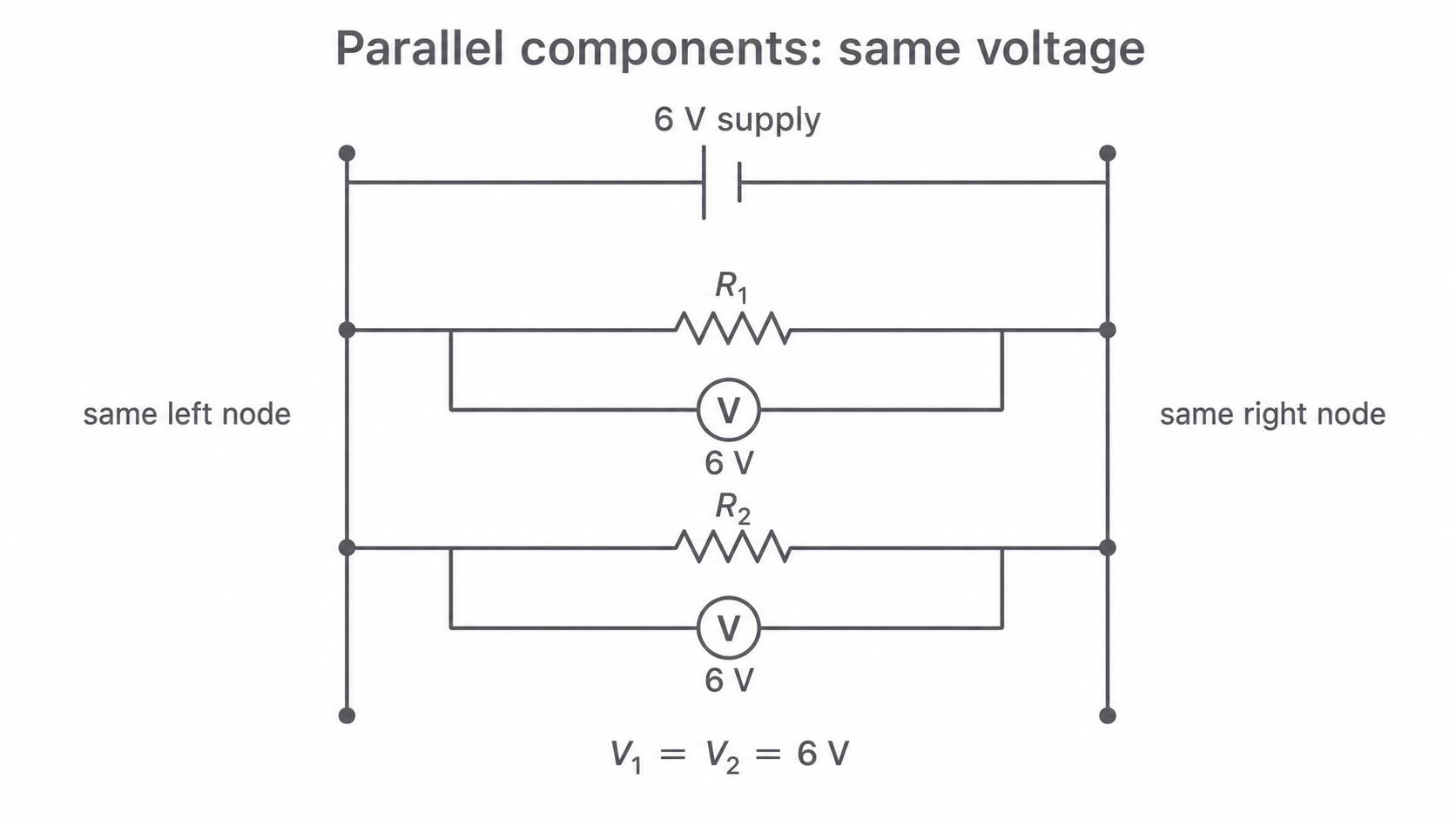
Do not mix up this rule with current at a junction. In a parallel circuit, the current may split between branches depending on their resistances, but the voltage across two components connected between the same two nodes is the same.
Series circuit rules
In a series circuit, there is only one path for current. The same current passes through both resistive components because the charge has no alternative route.
For two resistive components in series, their resistances add:
Two resistors in series
The supply voltage is shared across the components. The voltage across each resistor depends on its resistance and the series current:
and
The separate voltages across the two resistors add to the supply voltage:
The same relationships can be rearranged. For example, if the total series resistance and one component resistance are known, the other component's resistance is found by subtraction. If the voltage across one resistor and the current through it are known, use for that resistor. If the supply voltage and the voltage across one resistor are known, the other resistor's voltage is found by subtraction: .
Continue this lesson.
You’re previewing NovaLearn without an account. Create a free account to read the rest.
Create free account