7.1-7.3 - Radioactivity units, atoms and isotopes
Radioactivity questions often start with careful naming: the unit used, the particles in an atom, and the numbers written beside a chemical symbol. This lesson builds that language slowly, so that later work on radiation types, nuclear equations and half-life has a firm base. The important exam habit is to read the symbol and translate each number into a physical meaning.
Using radioactivity units
The radioactivity section uses several units that you must be able to recognise and use correctly.
| Quantity or measurement | Unit name | Symbol |
|---|---|---|
| activity of a radioactive source | becquerel | Bq |
| length or distance | centimetre | cm |
| time | hour | h |
| time | minute | min |
| time | second | s |
The becquerel is the unit used for activity. At this level, means one nuclear decay per second. A source with a larger activity has more decays each second, but this lesson does not yet compare radiation types or calculate half-lives.
Becquerel
The becquerel, symbol , is the unit of activity for a radioactive source.
Time units are often mixed in questions, so convert them before comparing values:
For length, . In this topic, centimetres are useful when describing small distances, such as absorber thickness or detector position in later practical work. Always write unit symbols exactly: Bq, cm, h, min and s.
Inside an atom
An atom has a tiny central nucleus with electrons around it. The nucleus contains protons and neutrons. The electrons are outside the nucleus.
| Particle | Position in the atom | Charge |
|---|---|---|
| proton | in the nucleus | positive |
| neutron | in the nucleus | no charge |
| electron | outside the nucleus | negative |
[DIAGRAM: asset_name: Radioactivity units, atoms and isotopes - diagram 01; asset_slug: p55_radioactivity_units_atoms_and_isotopes__diagram_01; recommended_method: image_gen; description: White 16:9 NovaLearn pale-palette diagram with grey outlines and dark-grey labels. Carbon-14 atom with 6 protons, 8 neutrons and 6 electrons in 2,4 shells, beside correctly stacked mass number 14 and atomic number 6.]
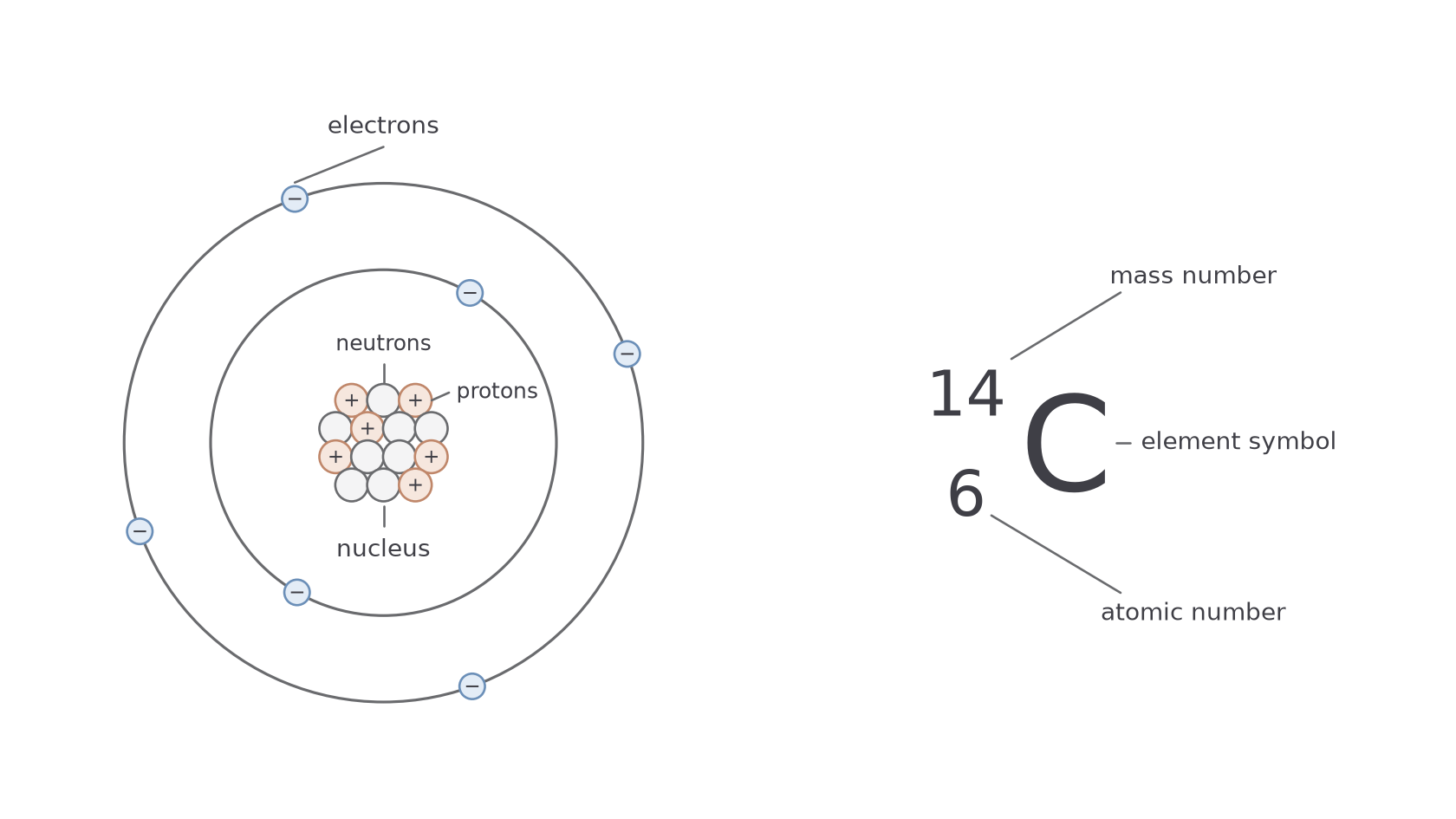
The nucleus is small compared with the whole atom, but it contains nearly all of the atom's mass because protons and neutrons are much more massive than electrons. In radioactivity, most changes involve the nucleus, so you need to be fluent with the words proton, neutron, electron and nucleus.
Do not describe an atom as only a solid ball. Also do not put electrons inside the nucleus: electrons are outside the nucleus.
Reading nuclear symbols
A particular nucleus can be described using a chemical symbol with two numbers beside it. The general form is:
Here, is the chemical symbol for the element, is the mass number, and is the atomic number. For example:
This symbol means a carbon nucleus with mass number 14 and atomic number 6. The C tells you the element is carbon. The lower number, 6, tells you the number of protons in the nucleus. The upper number, 14, tells you the total number of protons and neutrons in the nucleus.
Continue this lesson.
You’re previewing NovaLearn without an account. Create a free account to read the rest.
Create free account