8.13P-8.16P - Big Bang evidence and red-shift equation
The Big Bang theory is not just a story about the start of the universe. It is a model that explains what the universe was like in the past and why astronomers observe particular evidence today. In this lesson, the key evidence is red-shift from galaxies and cosmic microwave background radiation, and the key calculation is the red-shift equation.
Past evolution of the universe
The Big Bang theory describes the universe as having evolved from a very hot, very dense early state. Since then, the universe has expanded and cooled. This is a model of the universe changing over time, not an explosion of material into empty space.
Big Bang theory
The Big Bang theory is the idea that the universe began in a hot, dense state and has expanded and cooled over time.
In the early universe, matter and radiation were packed together at very high temperature. As the universe expanded, it cooled. Later, atoms could form, light could travel freely, and over much longer times stars and galaxies formed.
The main arguments in favour of the Big Bang theory in this course are:
- light from galaxies is red-shifted, which supports the idea that galaxies are moving away and the universe has expanded
- cosmic microwave background radiation is detected from all directions, as expected from radiation left over from a hot early universe
The expanding shapes in the schematic represent change with time, not an edge to the universe or an explosion travelling from one place.
These arguments are powerful because they connect present observations to a past state. If the universe is expanding now, then in the past it was smaller, hotter and denser.
Waves and red-shift
When the distance between a wave source and an observer is changing, the observer detects a different frequency and wavelength from the source's reference values.
If the source is moving away from the observer, the observed waves are spread out. The observed wavelength is longer and the observed frequency is lower.
If the source is moving towards the observer, the observed waves are closer together. The observed wavelength is shorter and the observed frequency is higher.
For light from a galaxy moving away, the increase in wavelength is called red-shift. It does not mean the galaxy must look bright red to the eye. It means that identifiable wavelengths in the light, such as absorption lines, have shifted towards longer wavelength compared with their reference wavelengths measured in a laboratory.
[DIAGRAM: asset_name: Big Bang evidence and red-shift equation - diagram 02; asset_slug: p67_big_bang_evidence_and_red_shift_equation__diagram_02; recommended_method: image_gen; description: White 16:9 NovaLearn pale-palette diagram with grey outlines and dark-grey labels. Aligned lab and galaxy absorption spectra on a common wavelength scale, with matching lines and clay red-shift arrows.]
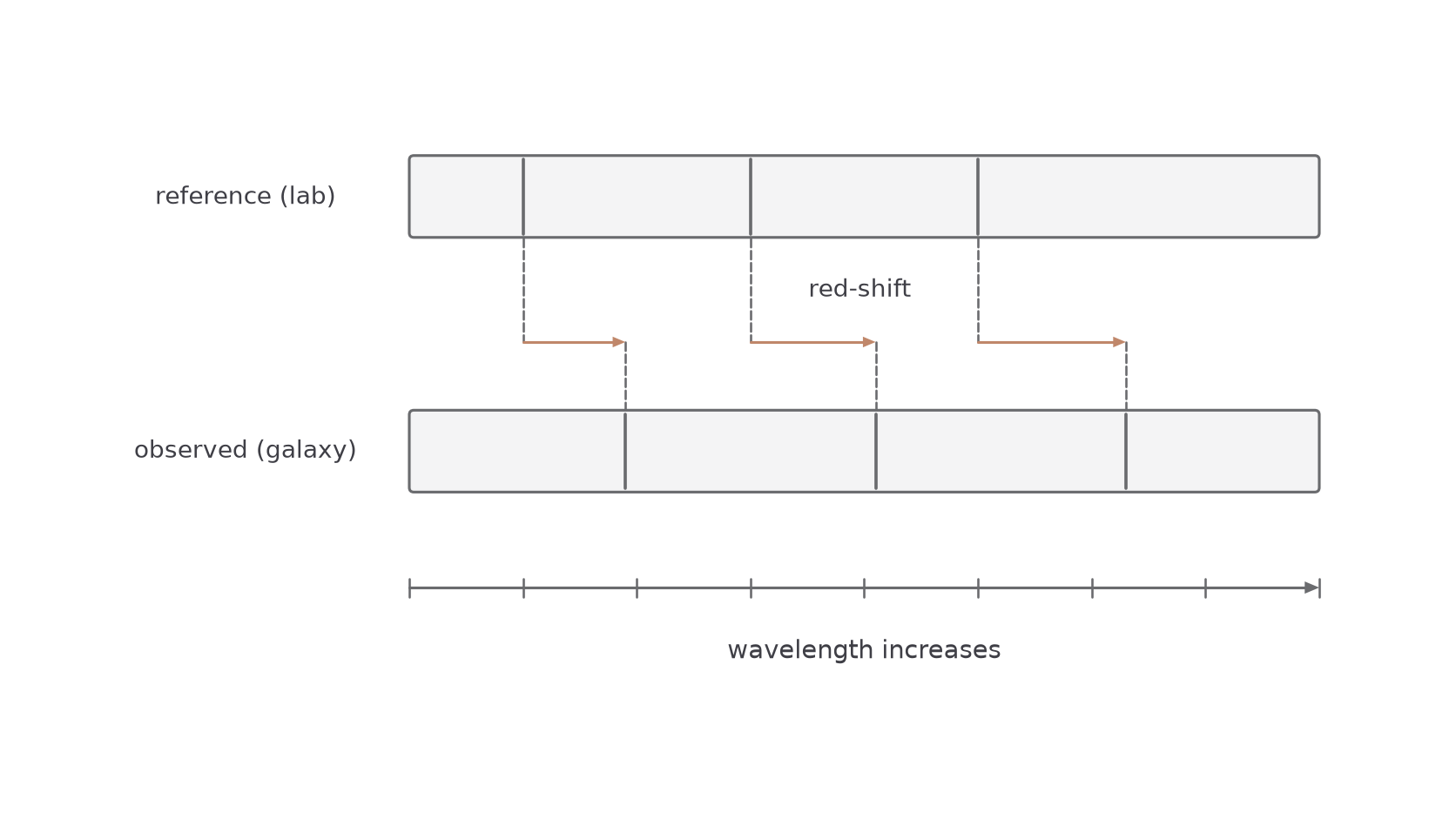
The reference wavelength is the wavelength measured for the same spectral line from a stationary source in a laboratory. The observed wavelength is the wavelength measured from the galaxy. Red-shift is detected by comparing the pattern of lines, not by guessing the apparent colour of the galaxy.
Evidence from red-shift and CMB
Red-shift supports the Big Bang theory because it shows that light from galaxies has been stretched to longer wavelength. This is consistent with galaxies moving away and with the universe having expanded since the light was emitted.
The second required piece of evidence is cosmic microwave background radiation, usually shortened to CMB radiation. This is electromagnetic radiation detected from all directions in space. It is interpreted as radiation left over from the early hot universe, cooled and stretched to microwave wavelengths as the universe expanded.
[DIAGRAM: asset_name: Big Bang evidence and red-shift equation - diagram 01; asset_slug: p67_big_bang_evidence_and_red_shift_equation__diagram_01; recommended_method: image_gen; description: White 16:9 NovaLearn pale-palette diagram with grey outlines and dark-grey labels. Three evidence bands show an early hot dense universe expanding into separated galaxies, stretched travelling light and CMB radiation arriving from every direction.]
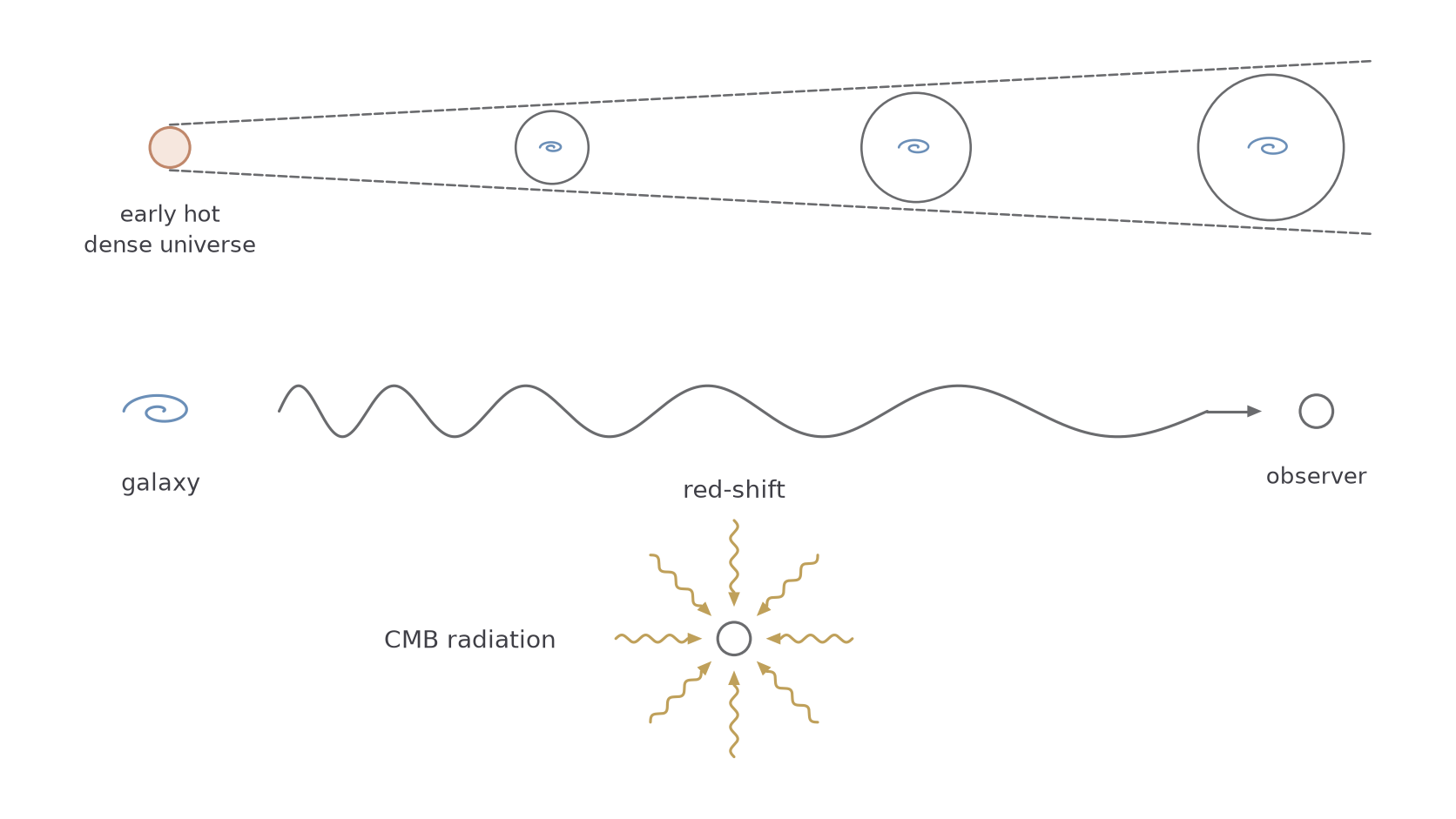
The two observations support the same broad picture:
| Observation today | Why it supports the Big Bang theory |
|---|---|
| galaxy light is red-shifted | the wavelength has increased, consistent with recession and expansion |
| CMB radiation comes from all directions | it is consistent with cooled radiation left over from a hot early universe |
Be careful with wording. Red-shift evidence is about longer wavelength light from galaxies. CMB evidence is about background microwave radiation from all directions. Do not merge them into one vague statement such as "there is radiation in space".
Continue this lesson.
You’re previewing NovaLearn without an account. Create a free account to read the rest.
Create free account