6.4-6.7 - Magnetic field lines, induced magnetism and field patterns
Magnets act through the space around them. We describe this space using magnetic field lines, which show both the shape and direction of the magnetic field. In this lesson, you will use field lines to explain induced magnetism, practical field-pattern investigations, and the arrangement of two magnets that produces a uniform magnetic field.
Magnetic field lines
A magnetic field is the region where a magnetic material or another magnet experiences a force. Field lines are a way to represent that invisible region on a diagram.
Magnetic field line
A magnetic field line is a line drawn to show the direction and pattern of a magnetic field.
The direction of a magnetic field line is the direction in which the north-seeking end of a small plotting compass would point at that position. Outside a bar magnet, field lines are drawn from the north pole to the south pole. This is because the north-seeking end of the compass needle is itself a small north pole: it is repelled by the magnet's north pole and attracted towards its south pole.
[DIAGRAM: asset_name: Magnetic field lines, induced magnetism and field patterns - diagram 01; asset_slug: p50_magnetic_field_lines_induced_magnetism_and_field_patterns__diagram_01; recommended_method: image_gen; description: White 16:9 NovaLearn pale-palette diagram with grey outlines and dark-grey labels. Rose-N/blue-S bar magnet with six smooth noncrossing sage field loops, direction heads and a short stronger-field label near the poles.]
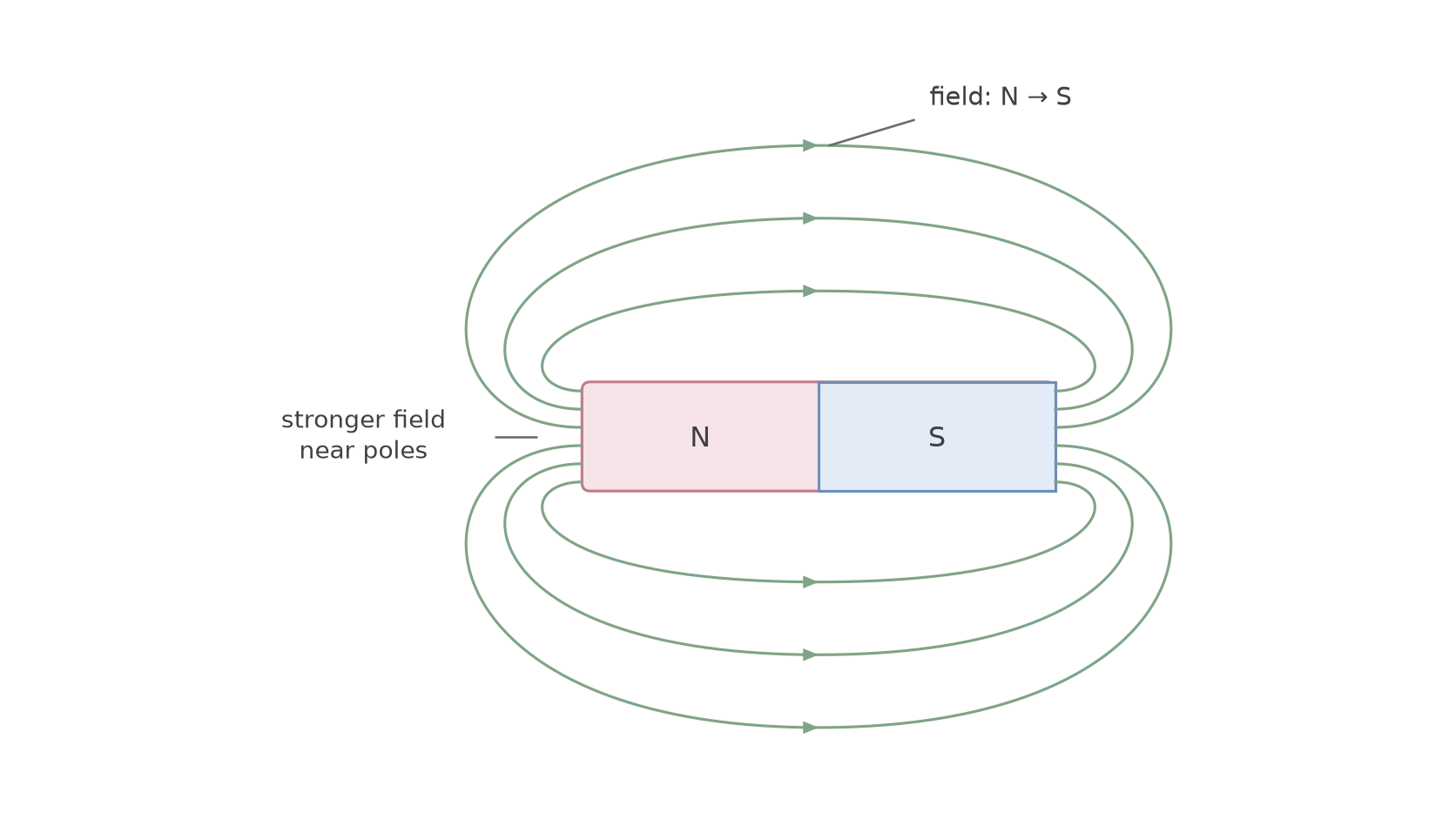
A field line diagram shows three important things:
- direction: arrows show the direction a compass north-seeking end points
- shape: the curved lines show the pattern of the magnetic field
- relative strength: closer field lines show a stronger magnetic field
Field lines do not cross. If two field lines crossed, a compass at the crossing point would have to point in two directions at once, which is not possible.
The field is strongest near the poles of a bar magnet. This is why field lines are drawn closest together near the north and south poles, and farther apart away from the magnet.
Induced magnetism
Some materials become magnetised when they are placed in a magnetic field. This is called induced magnetism. It happens in magnetic materials such as iron, steel, nickel and cobalt, but not in every material.
Induced magnetism
Induced magnetism is magnetism produced in a material because the material is placed in a magnetic field.
Induced magnetism explains why an unmagnetised iron nail is attracted to a magnet. When the nail is near the magnet, the nail becomes a temporary magnet. The end of the nail nearest the magnet becomes the opposite pole, so there is attraction.
For example, if the north pole of a magnet is brought near an iron nail, the near end of the nail is induced to act as a south pole. The opposite poles attract, so the nail moves towards the magnet. If the south pole is brought near instead, the near end of the nail is induced to act as a north pole, so the nail is still attracted. This is why either pole of a magnet attracts an unmagnetised magnetic material.
In iron, a soft magnetic material, the induced magnetism is lost when the magnet is taken away. Steel, a hard magnetic material, keeps some of its induced magnetism.
Iron filings also show induced magnetism. When filings are scattered on paper above a magnet, each small filing becomes temporarily magnetised and lines up with the magnetic field. The filings tend to form chains, especially near the poles where the field is strongest.
Do not confuse induced magnetism with electromagnetic induction. This lesson is only about a material becoming magnetised in a magnetic field, not about generating a voltage.
Single magnet practical
The field pattern around a permanent bar magnet can be investigated using a plotting compass. A plotting compass is a small compass, so its needle turns to line up with the magnetic field at that position.
[DIAGRAM: asset_name: Magnetic field lines, induced magnetism and field patterns - diagram 02; asset_slug: p50_magnetic_field_lines_induced_magnetism_and_field_patterns__diagram_02; recommended_method: image_gen; description: White 16:9 NovaLearn pale-palette diagram with grey outlines and dark-grey labels. Paper-over-magnet practical with three plotting compasses tangent to one dotted field path, marked north needle ends, pencil dots and a short join-dots leader.]
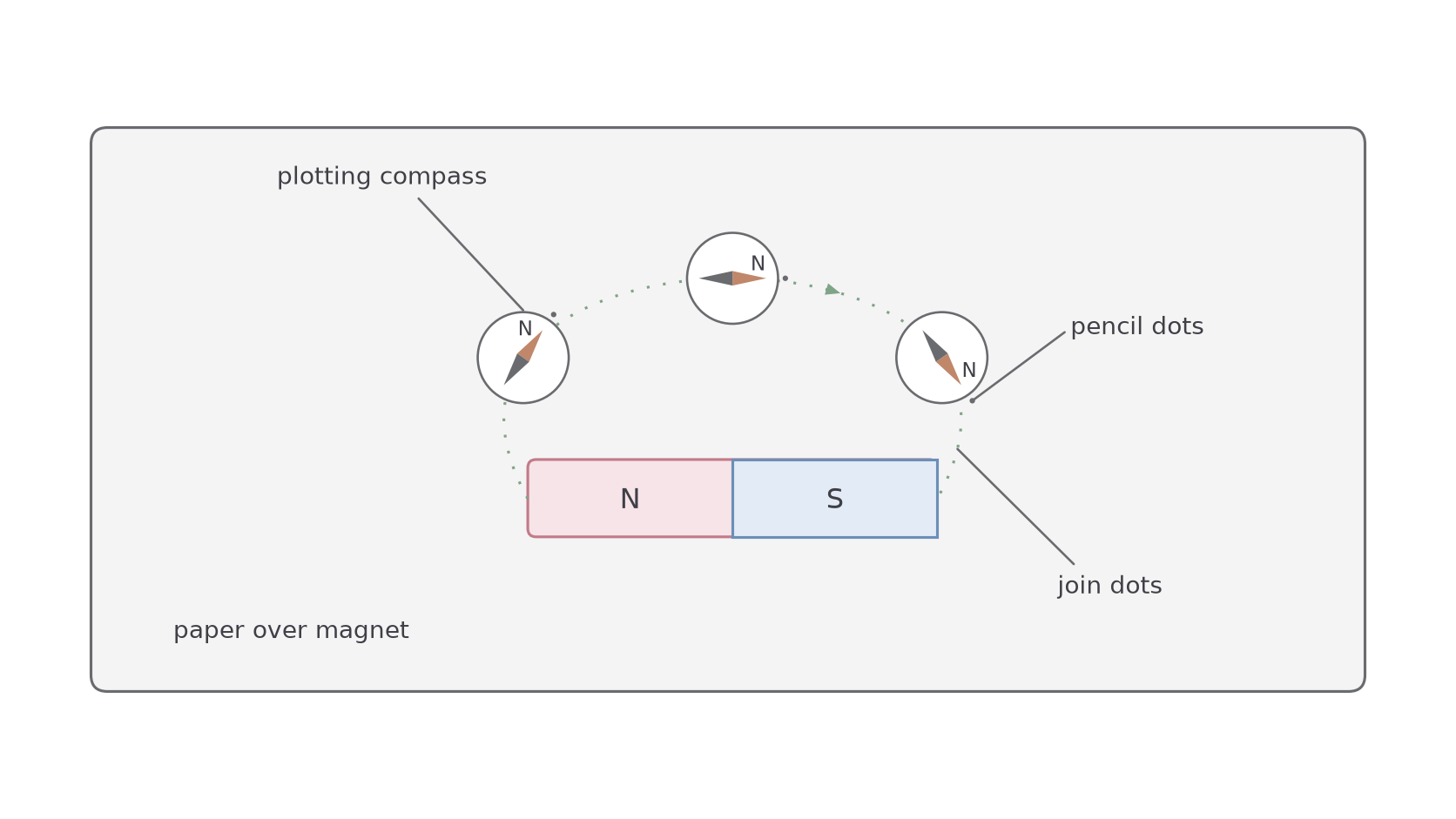
A suitable method is:
- Place the bar magnet on a sheet of paper (or lay the paper over the magnet, as in the diagram) and mark its position, including the north and south poles.
- Place a plotting compass near one pole.
- Mark a small pencil dot just beyond the north-seeking end of the compass needle.
- Move the compass so its centre is at the dot, then mark the next direction.
- Continue moving the compass and marking dots until the path reaches the other pole or leaves the useful area of the paper.
- Join the dots with a smooth curve and add arrows in the direction shown by the compass.
- Repeat from several different starting points to build up the whole field pattern.
Continue this lesson.
You’re previewing NovaLearn without an account. Create a free account to read the rest.
Create free account