3.18-3.19 - Refractive index equation and practical
When light enters glass from air at an angle, it changes direction. The refractive index tells you how strongly the glass refracts the light, using the angles measured from the normal. In this lesson you will calculate refractive index from angles, then use a glass-block practical and graph to find a reliable value.
What refractive index means
The normal is an imaginary line drawn at to the surface where the light ray meets the glass. Angles in refraction are measured from the normal, not from the surface.
Refractive index
The refractive index, , is a number that describes how much light is refracted when it enters a material from air.
For light travelling from air into glass, the incident ray is in air and the refracted ray is inside the glass. The angle of incidence is , and the angle of refraction is .
Refractive index
You must recall this equation: it is not given in the exam, either in this form or rearranged.
The angles are measured in degrees. The sine values are just numbers, so refractive index has no unit. Light slows down when it enters glass, or any other transparent material, from air, so it bends towards the normal: is smaller than , is smaller than , and is always greater than 1. For glass, is usually around 1.5.
Using the equation
The equation is usually used in one of two ways: calculate from measured angles, or calculate one unknown angle when is given.
For example, a ray enters a glass block with:
The refractive index is:
Check that your calculator is in degree mode first. In radian mode, gives 0.851 instead of 0.707, and every answer is wrong.
The answer has no unit. It is sensible for glass because it is close to 1.5.
If and are known, rearrange before using inverse sine:
For and :
Set the calculator to degree mode. Use inverse sine to recover an angle, not the reciprocal of its sine.
A common error is to put and the wrong way round. For light going from air into glass, should be larger than , so should give a value greater than 1.
Glass block method
The practical investigates the refractive index of glass by measuring several pairs of and . The independent variable is the angle of incidence, . The dependent variable is the angle of refraction, , or the calculated value of . Keep the same block material, entry face and light colour/source throughout; changing material or wavelength can change the measured index.
[DIAGRAM: asset_name: Refractive index equation and glass block practical - diagram 01; asset_slug: p29_refractive_index_equation_and_practical__diagram_01; recommended_method: image_gen; description: NovaLearn pale-palette ray-box and rectangular-glass-block setup with sage rays at 50° incidence and 31° refraction, parallel 50° emergence, normal-angle arcs i and r, shared entry point and marking crosses.]
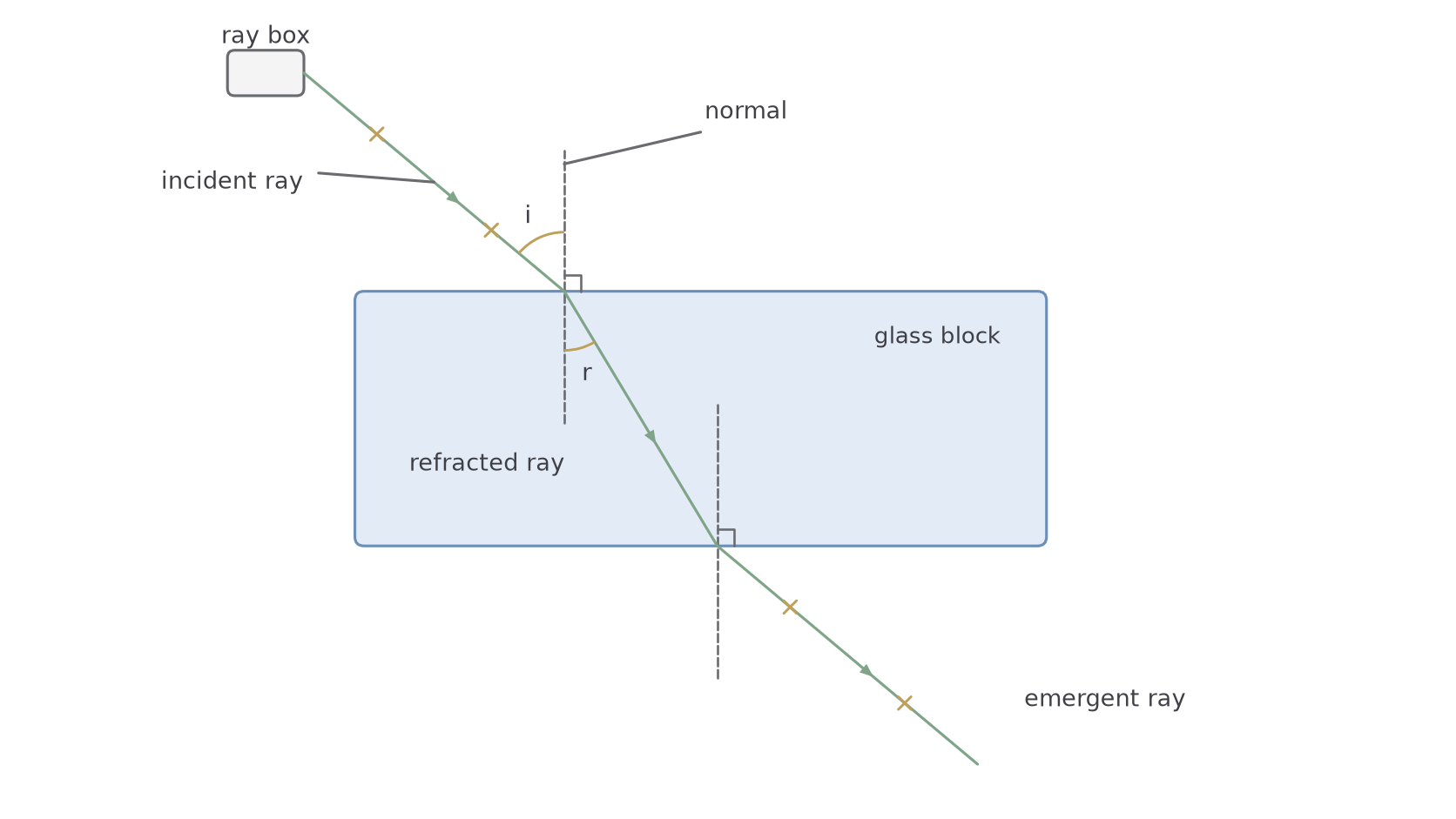
A strong method is:
- Place the glass block on plain white paper and draw around it.
- Mark a point on one face where the ray will enter, then draw a normal at to that face.
- Replace the block exactly on its outline.
- Use a ray box to shine a narrow ray at the entry point at a chosen angle of incidence.
- Mark the incident ray and emergent ray with pencil crosses. Keep crosses far apart so the drawn ray direction is more accurate.
- Remove the block, join the crosses and extend the incident and emergent lines to its traced outline, then join the entry and exit points: this line is the refracted ray inside the block.
- Use a protractor to measure and from the normal.
- Repeat for a range of angles of incidence.
Continue this lesson.
You’re previewing NovaLearn without an account. Create a free account to read the rest.
Create free account