7.4-7.6 - Types of radiation and penetration practical
Radioactive materials contain unstable nuclei. In this lesson, the focus is on the three ionising radiations named in the specification: alpha particles, beta-minus particles and gamma rays. You will compare what each radiation is, how strongly it ionises, how far it penetrates, and how a penetration practical can distinguish between them.
Ionising radiation from nuclei
An unstable nucleus can emit radiation from inside the nucleus. The specification names three types here: alpha, beta-minus and gamma radiation.
These are called ionising radiations because they can remove electrons from atoms or molecules. That leaves charged particles called ions. Ionisation matters because it is the physical change that lets radiation be detected and also explains why ionising radiation can damage living tissue.
Ionising radiation
Ionising radiation is radiation with enough energy to remove electrons from atoms or molecules, forming ions.
Radioactive emission is a random process. You cannot predict exactly when one particular unstable nucleus will emit radiation. With a source containing many unstable nuclei, a detector records a count rate that fluctuates because the emissions happen randomly.
Random does not mean "anything can happen". It means the exact nucleus and exact time are unpredictable. The source still has characteristic radiation types and overall patterns that can be investigated.
Nature of alpha, beta and gamma
The nature of a radiation means what it physically is.
An alpha particle is the same as a helium nucleus. It contains two protons and two neutrons. It has a positive charge (+2, from its two protons) and a relatively large mass compared with the other two radiations in this lesson.
A beta-minus particle is a fast-moving electron emitted from the nucleus. It has a negative charge (−1, the charge of one electron) and a much smaller mass than an alpha particle. It is created in a nuclear change, not released from an electron shell.
A gamma ray is high-frequency electromagnetic radiation (an electromagnetic wave) from the nucleus. It consists of photons with no rest mass and no electric charge.
For this lesson, the useful detail is the identity of each radiation and the practical evidence used to distinguish them. Nuclear equation work and changes to mass number or atomic number come later.
Penetrating and ionising power
Alpha, beta-minus and gamma radiation can be distinguished by their penetrating power and their ability to ionise.
Alpha is the most strongly ionising of the three, but it has the lowest penetrating power. It is stopped by a sheet of paper or a few centimetres of air.
Beta-minus is less ionising than alpha and more penetrating than alpha. It passes through paper, but it is usually stopped by a thin sheet of aluminium.
Gamma is the least ionising of the three in this comparison, but it has the greatest penetrating power. Paper and thin aluminium do not stop it. Thick lead or thick concrete can reduce gamma radiation a lot, although "reduce" is usually a better word than "stop" for gamma.
[DIAGRAM: asset_name: Types of radiation and penetration practical - diagram 01; asset_slug: p56_types_of_radiation_and_penetration_practical__diagram_01; recommended_method: image_gen; description: White 16:9 NovaLearn pale-palette diagram with grey outlines and dark-grey labels. Aligned alpha, beta-minus and gamma rows through identical paper, aluminium and lead columns, with progressively reduced gamma beyond the lead.]
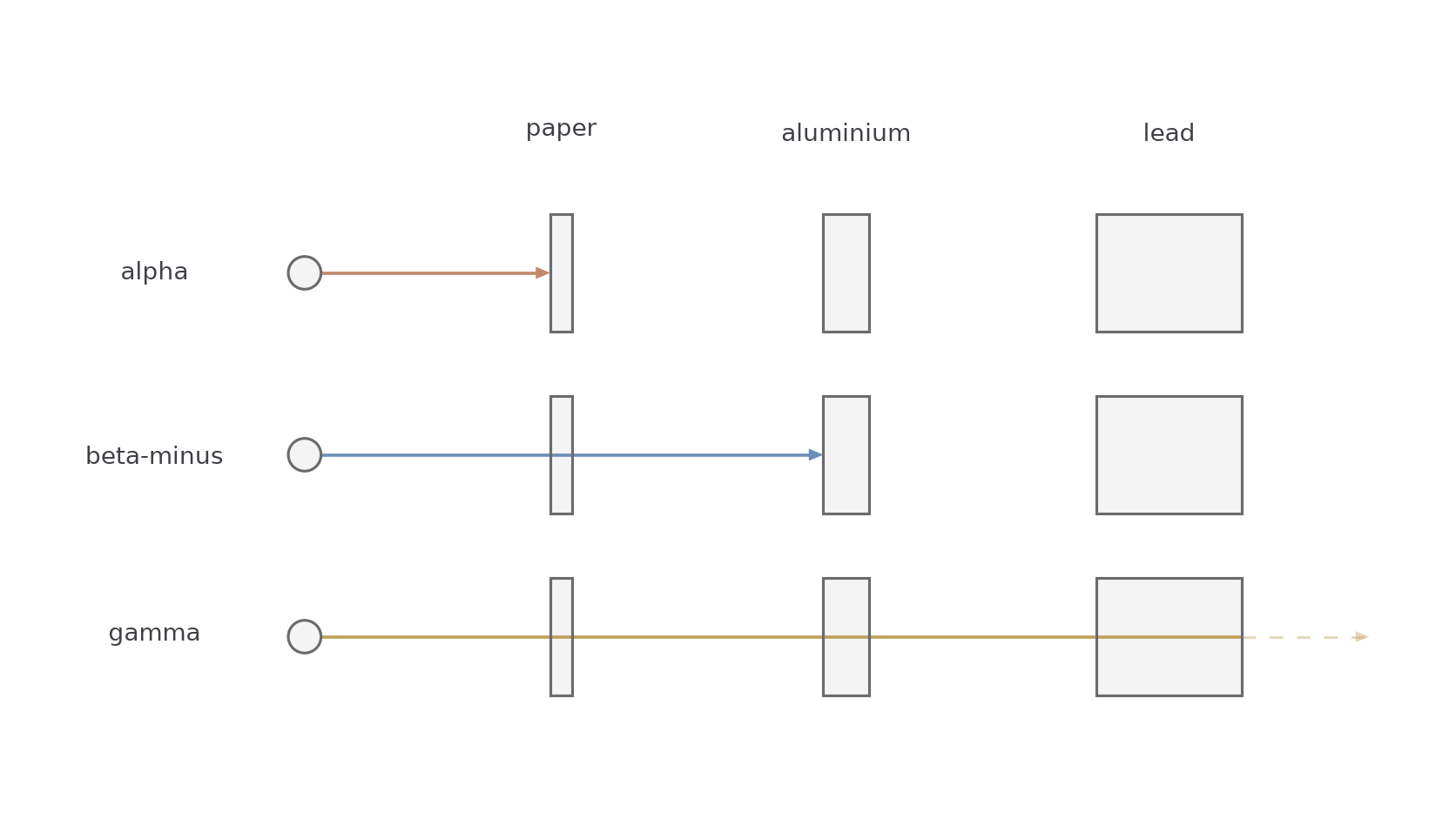
There is a useful pattern: the radiation that ionises most strongly does not penetrate as far. Alpha particles are relatively large and carry a +2 charge, so they interact strongly with the atoms they pass: they ionise many atoms and lose their energy over a short distance. Gamma has no charge and interacts less often, so it can pass through much more material before enough of it is absorbed.
Penetration practical method
The practical investigates the penetration powers of different radiation types. It can be done with suitable radioactive sources under strict local safety rules, or with a simulation that models the same absorber tests.
Continue this lesson.
You’re previewing NovaLearn without an account. Create a free account to read the rest.
Create free account