7.23-7.26 - Fusion and stars
Fusion is one of the nuclear reactions that can release energy. In this lesson, you will compare fusion with fission, describe how fusion releases energy, and explain why stars are able to make fusion happen. The key difficulty is that nuclei contain positively charged protons, so they repel each other unless the conditions are extreme.
Fission and fusion
Both fission and fusion are nuclear reactions. That means the nucleus changes. They are not chemical reactions, because chemical reactions rearrange electrons and bonds without changing the nuclei.
The difference is about what happens to the nuclei:
- fission is the splitting of a large nucleus into smaller nuclei
- fusion is the joining of smaller nuclei to make a larger nucleus
[DIAGRAM: asset_name: Fusion and stars - diagram 01; asset_slug: p62_fusion_and_stars__diagram_01; recommended_method: image_gen; description: White 16:9 NovaLearn pale-palette diagram with grey outlines and dark-grey labels. Neutral comparison panels distinguish one large ochre nucleus splitting into two sage products and neutrons from two small blue nuclei joining into one sage product.]
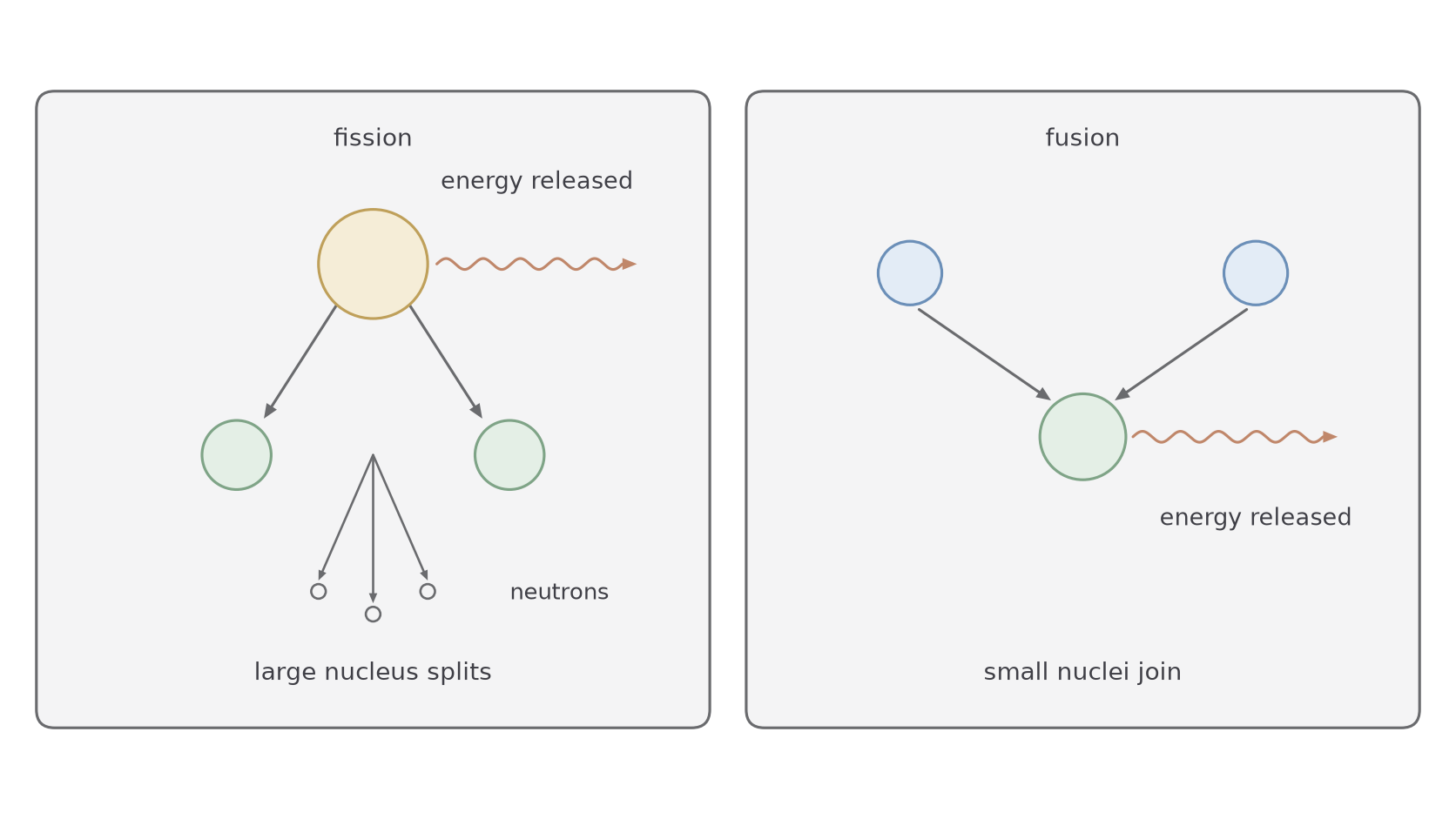
An exam answer must not swap these two words. A quick way to remember them is that fission has a "split" idea, while fusion has a "join together" idea.
Fusion releases energy
In energy-releasing fusion, smaller nuclei come together to form a larger nucleus. The total mass of the products is slightly less than the total mass of the original nuclei. In a simplified reaction with a single product nucleus, this means that nucleus has slightly less mass than the original nuclei together. If other particles are emitted, include them when comparing total masses.
The decrease in mass corresponds to energy released by the nuclear reaction; total mass–energy is conserved. For this lesson, you do not need to calculate the energy from the mass loss; you need the direction of the idea:
- smaller nuclei join
- a larger nucleus is created
- the total mass after the reaction is slightly less than the total mass before
- the lost mass is released as energy
[DIAGRAM: asset_name: Fusion and stars - diagram 02; asset_slug: p62_fusion_and_stars__diagram_02; recommended_method: image_gen; description: White 16:9 NovaLearn pale-palette diagram with grey outlines and dark-grey labels. Two small blue nuclei join into a larger sage nucleus with a clay energy wave, separate mass-before/mass-after and lost-mass/energy labels.]
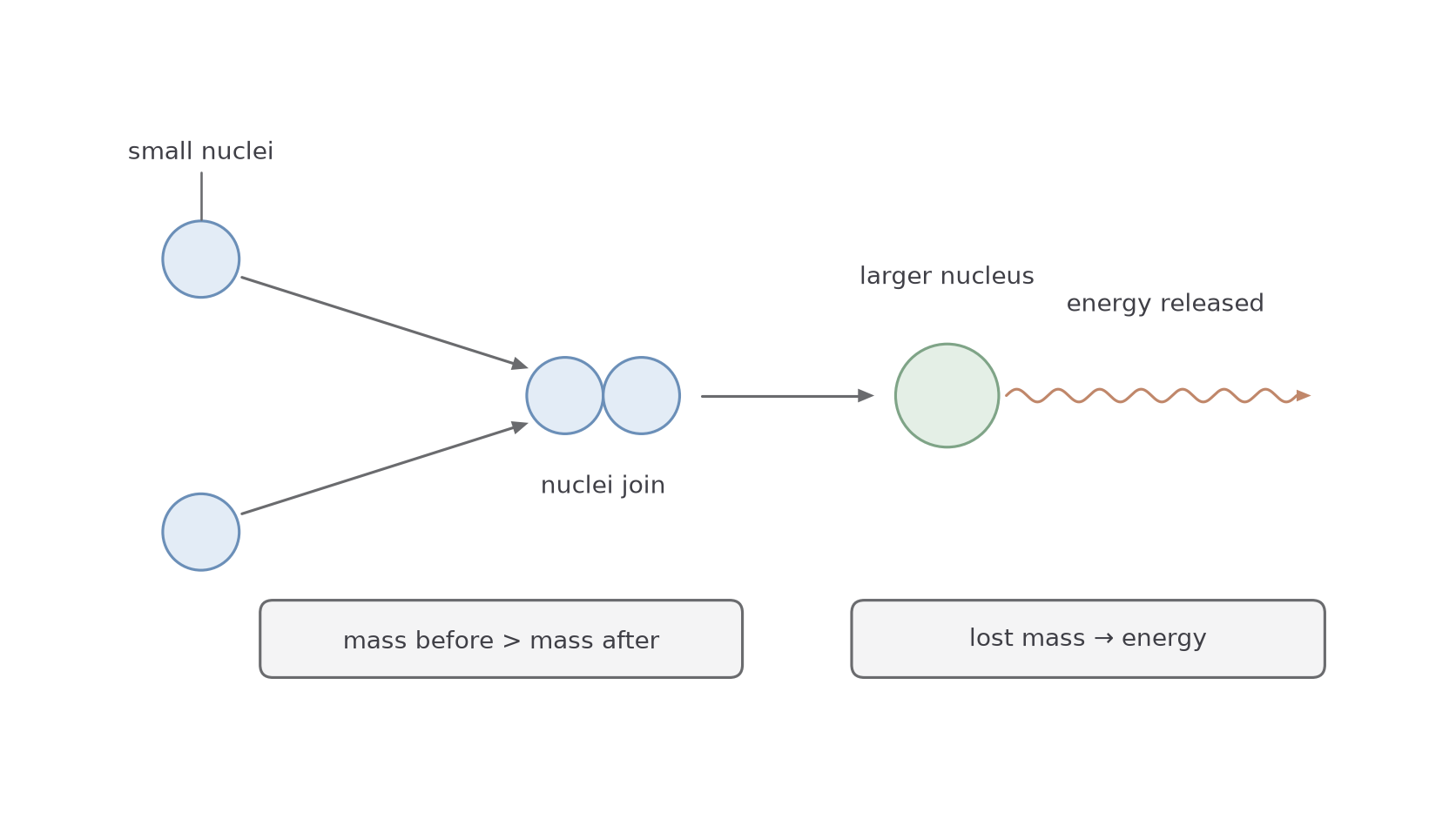
This is why it is more precise to say that fusion releases energy, rather than saying fusion "makes" energy from nothing.
Fusion powers stars
Stars release enormous amounts of energy. The energy source for stars is nuclear fusion in their cores.
In many stars, including the Sun, hydrogen nuclei are fused to form helium nuclei. The detailed reaction chain is not needed here. The specification point is simpler: a star is powered by fusion, not by burning fuel in a chemical reaction and not by fission.
The energy released by fusion keeps the star hot and is eventually emitted into space as radiation. That is why energy from the Sun can reach Earth as light and other electromagnetic radiation.
Continue this lesson.
You’re previewing NovaLearn without an account. Create a free account to read the rest.
Create free account