8.4-8.6 - Gravity, satellites and orbital motion
Orbits are not motion without a force. They happen because an object has sideways motion while gravity continually pulls it towards a larger body. In this lesson you will explain how gravity makes moons, planets, artificial satellites and comets orbit, compare the paths of moons, planets and comets, and use the Edexcel orbital-speed relationship.
Gravity keeps objects orbiting
An object in orbit is moving around another object because a gravitational force acts between them. The gravitational force is always attractive, so it pulls the orbiting object towards the object it is orbiting.
If a satellite had sideways motion but no gravity, it would continue in a straight line. If it had gravity but too little sideways motion, it would fall down towards the planet. In a stable orbit, the satellite is continually falling towards the planet but moving sideways fast enough to keep missing it.
Orbit
An orbit is the curved path followed by an object as it moves around another object under the effect of gravity.
At this level, you do not need to calculate the gravitational force. You need to explain what it does:
- gravitational force causes moons to orbit planets
- gravitational force causes planets to orbit the Sun
- gravitational force causes artificial satellites to orbit Earth
- gravitational force causes comets to orbit the Sun
[DIAGRAM: asset_name: Gravity, satellites and orbital motion - diagram 01; asset_slug: p64_gravity_satellites_and_orbital_motion__diagram_01; recommended_method: image_gen; description: White 16:9 NovaLearn pale-palette diagram with grey outlines and dark-grey labels. Satellite centred exactly on a circular Earth orbit, with grey tangential sideways motion and an ochre gravitational-force arrow directly toward Earth’s centre.]
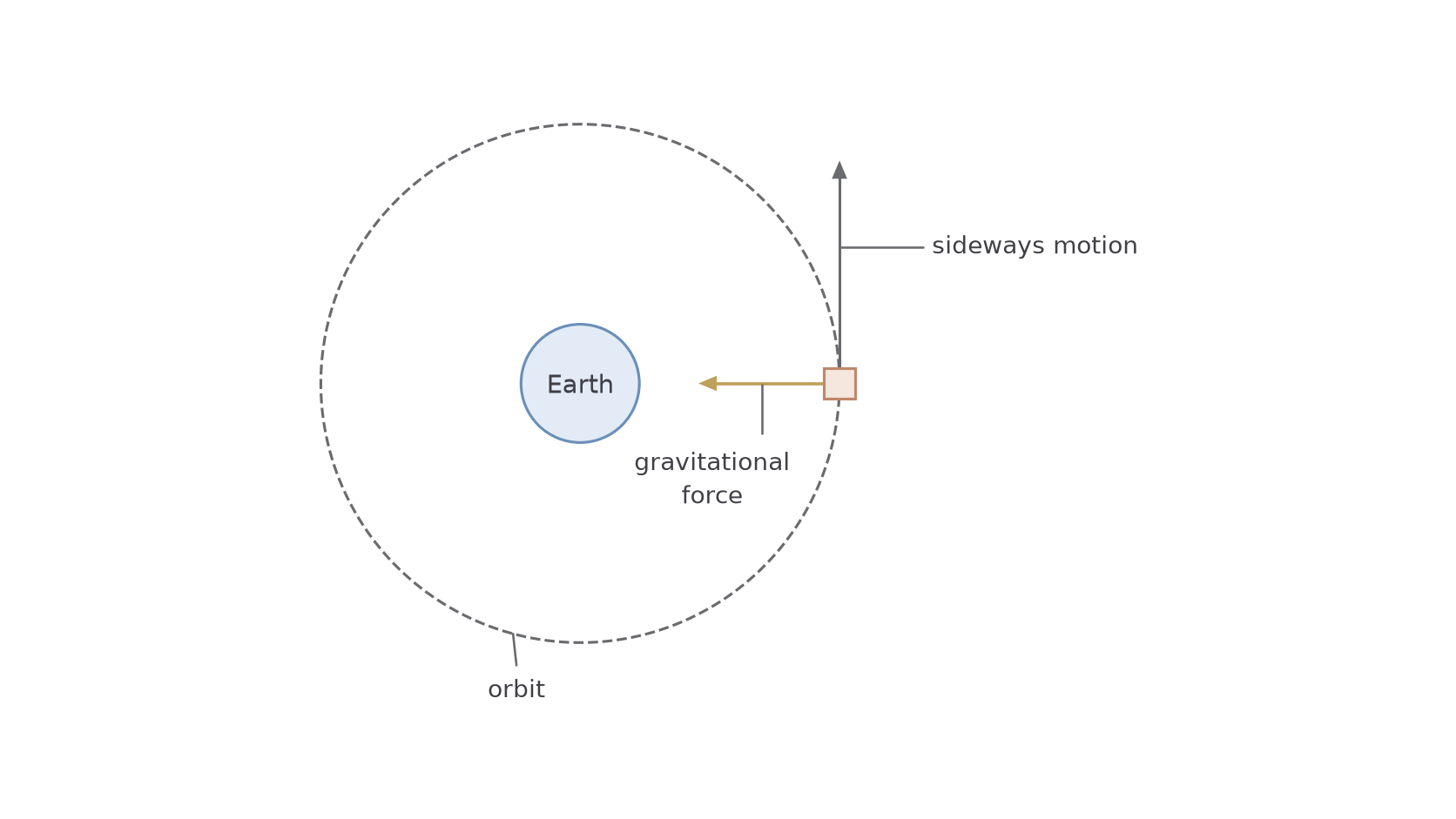
Do not describe gravity as pushing an orbiting object round its path. The force is towards the central body, not forwards along the orbit. The forward or sideways motion comes from the object's existing motion; gravity changes the direction of that motion.
What orbits what
The central object in an orbit is the object being orbited. The orbiting object is usually much less massive, so the simple International GCSE description names the larger body as the centre of the orbit.
| Orbiting object | Object it orbits | Cause of the orbit |
|---|---|---|
| Moon | planet | gravitational force between the moon and planet |
| Planet | Sun | gravitational force between the planet and Sun |
| Artificial satellite | Earth | gravitational force between the satellite and Earth |
| Comet | Sun | gravitational force between the comet and Sun |
A natural moon is not the same as an artificial satellite. A moon is a natural object orbiting a planet. An artificial satellite is a human-made object placed in orbit, such as a communication, weather or navigation satellite.
Comets are also held by gravity. Their paths can take them very far from the Sun and then back close to the Sun, but the Sun's gravitational force is still the cause of the orbit.
Comparing orbit paths
Moons, planets and comets all orbit because of gravity, but their paths are not usually described in the same way.
Planets in the solar system follow paths around the Sun that are close to circular. They are actually ellipses, but for this specification the key comparison is that planet orbits are much less stretched than many comet orbits.
Moons orbit planets. Many moon orbits are also close to circular, although real moon orbits are not perfect circles. When an exam asks for the difference between a moon and a planet orbit, name the central body: a moon orbits a planet, while a planet orbits the Sun.
Comets usually have much more elongated elliptical orbits around the Sun. A comet may spend a long time far from the Sun, then move much closer to the Sun for a smaller part of its orbit. A comet also changes speed considerably: it moves faster near the Sun and slower farther away. A planet in the nearly circular model moves at approximately constant speed. Shape, distance variation and speed variation are all useful comparisons.
The Sun is not at the centre of a comet's orbit: it is near one end of the stretched path. As the comet falls in towards the Sun, the Sun's gravity speeds it up, so it moves fastest when it is closest to the Sun. As it moves away again, gravity slows it down, so it moves slowest when it is farthest away.
[DIAGRAM: asset_name: Gravity, satellites and orbital motion - diagram 02; asset_slug: p64_gravity_satellites_and_orbital_motion__diagram_02; recommended_method: image_gen; description: NovaLearn pale-palette three-panel orbit comparison: moon around a planet, planet around the Sun, and comet on an elongated ellipse with the Sun exactly at one focus. Each orbiting body lies on its path, with one tangential direction arrowhead per orbit.]
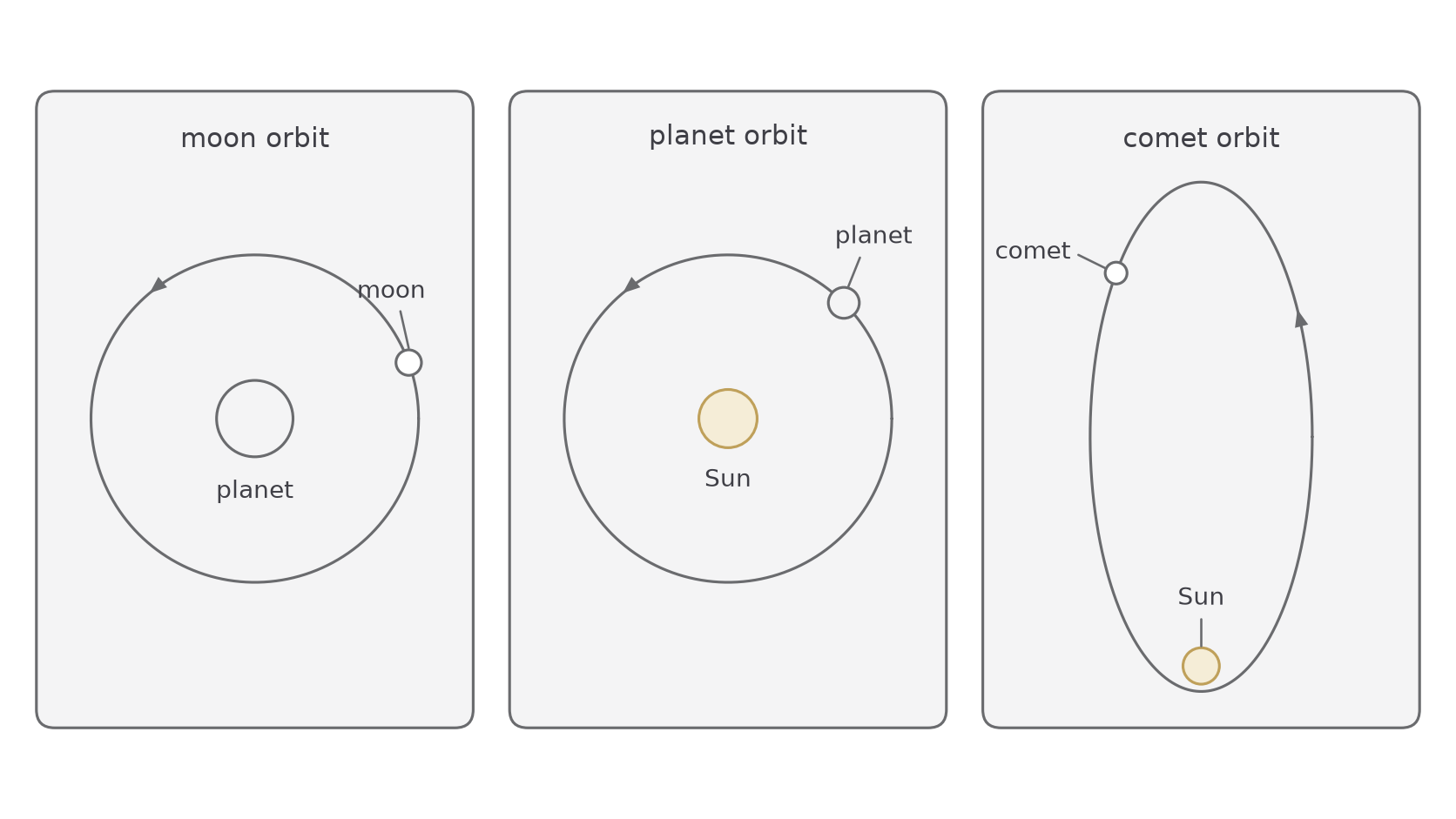
The word "ellipse" means a stretched circle-like shape. A circle is a special case with no stretching. In this lesson, describe planet and moon orbits as nearly circular compared with the more elongated orbits of comets.
Continue this lesson.
You’re previewing NovaLearn without an account. Create a free account to read the rest.
Create free account