Biology 8.1 - 8.3 - Exchange surfaces and diffusion
Explain what organisms exchange with their surroundings, why larger organisms need transport systems, and how the alveoli keep diffusion distances short.
Substances in and out
Every living cell must obtain useful substances and avoid a build-up of wastes. Exchange is movement across a boundary, such as a cell membrane or body surface. Transport moves a substance from one place to another within an organism. A substance may need both: it first crosses an exchange surface and is then transported to cells.
The direction depends on the organism and the process. For example, carbon dioxide usually leaves respiring animal cells, but it enters photosynthesising plant cells.
| Substance | Typical movement | Why it must be moved |
|---|---|---|
| Oxygen | From the environment towards many respiring cells | It is used in aerobic respiration to release energy for cell processes. |
| Carbon dioxide | Away from respiring cells; into photosynthesising cells | It is a waste from respiration in animals, but a raw material for photosynthesis in plants. |
| Water | Into organisms and between their cells; excess water may leave | It is a solvent, takes part in reactions and carries dissolved substances. |
| Dissolved food molecules | From an absorbing surface towards cells | Molecules such as glucose and amino acids are used for respiration, growth and repair. |
| Mineral ions | From the environment into an organism, such as from soil into plant roots | They are needed to make cell materials and maintain healthy growth. |
| Urea | Away from where it is produced and out of mammals | It is a nitrogen-containing waste; allowing it to accumulate would damage cells. |
A single-celled organism may exchange these substances directly through its cell membrane. In a large multicellular organism, most cells do not touch the external environment, so substances also have to travel between the body surface and those cells.
Why size creates a problem
Diffusion
Diffusion is the net movement of particles from a region of higher concentration to a region of lower concentration, caused by their random movement.
Particles move randomly in every direction. If there are more particles on one side of a boundary, more will cross away from that side than cross back, so there is net movement down the concentration difference. Diffusion itself does not require energy from a cell.
For a very small organism, two features make direct diffusion across its outer surface workable:
- it has a large amount of surface compared with its small volume;
- every part of the cell is only a short distance from that surface.
Increasing an organism's size changes both conditions. Its volume, and therefore the amount of living material needing supplies, grows faster than its outer surface area. Cells near the centre are also farther from the surface. The outer surface alone cannot exchange enough material, and diffusion across the whole body would take too long to supply distant cells.
A multicellular organism therefore needs two linked solutions:
- a specialised exchange surface, where substances cross between the organism and its environment;
- a transport system, which carries substances between that exchange surface and cells throughout the organism.
In animals, a circulatory system is a transport system; in plants, xylem and phloem form transport systems. The structures of those systems are not the same, but their shared role is to connect exchange surfaces with distant cells.
Surface area to volume
Surface area is the total area of all the outside faces. Volume is the space inside. A surface area : volume ratio compares the exchange area available with the amount of living material that must be supplied.
For a cube with side length :
Cube surface area and volume
Worked example: a 3 mm cube
A cube-shaped organism has sides of length 3 mm. Calculate its surface area : volume ratio.
- Check units. Every length is already in millimetres, so no conversion is needed.
- Find one face. .
- Find all six faces. Surface area .
- Find the volume. Volume .
- Write and simplify the ratio. after dividing both numbers by 27.
- Interpret it. The cube has of surface for each of volume.
As a sense-check, a 1 mm cube has surface area , volume and ratio . The 3 mm cube has a greater total surface area than the 1 mm cube, but its surface area : volume ratio is smaller: rather than . This is the key size effect.
For a cube measured in millimetres, has units of . School questions usually write the numerical surface area : volume ratio as, for example, , with lengths measured in one consistent unit. Changing the length unit changes those numbers; do not compare ratios calculated in different units.
Alveoli and gas exchange
An alveolus is a tiny air sac in a lung. Its wall forms an exchange surface beside a capillary, a very small blood vessel. Oxygen and carbon dioxide diffuse independently across the thin barrier; they do not have to swap molecule-for-molecule.
- The oxygen concentration is higher in alveolar air than in the blood arriving at the capillary, so oxygen diffuses alveolar air → capillary blood.
- The carbon dioxide concentration is higher in the arriving capillary blood than in alveolar air, so carbon dioxide diffuses capillary blood → alveolar air.
[DIAGRAM: asset_name: Biology 8.1-8.3 - Exchange surfaces and diffusion - diagram 01; asset_slug: biology_8_1_8_3_exchange_surfaces_and_diffusion__diagram_01; recommended_method: image_gen; description: Monochrome alveolus diagram: a cluster labelled as a large surface area, a one-cell-thick alveolar wall beside a one-cell-thick capillary wall and moist lining; oxygen arrows run from alveolar air to capillary blood, carbon dioxide arrows run from capillary blood to alveolar air; show the short diffusion distance and exclude heart, ventilation mechanics, haemoglobin and Fick's law.]
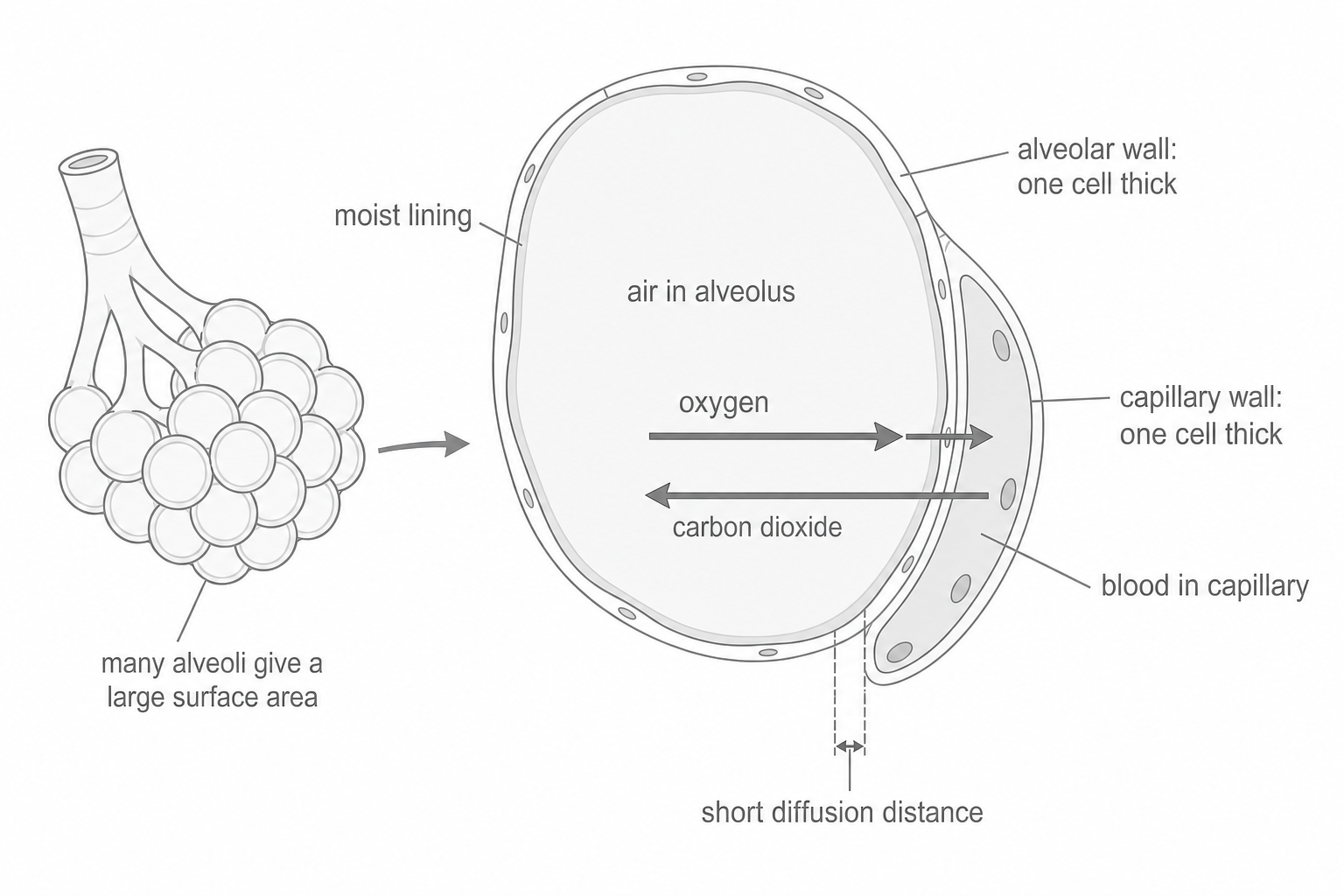
Each visible feature has a physical consequence and a function:
- Many alveoli → very large surface area → more gas particles can cross at the same time. A single large hollow space would provide much less wall area.
- Alveolar wall one cell thick and capillary wall one cell thick → short diffusion distance → gases cross the barrier rapidly. The walls are close together, rather than separated by a large gap.
- Moist lining → oxygen and carbon dioxide dissolve at the exchange surface → they can pass across the cells of the barrier.
- A close capillary network with flowing blood → oxygen is carried away and carbon dioxide is brought to the surface → the concentration differences are maintained.
- Air in the alveoli is refreshed → oxygen is replenished and carbon dioxide is removed → the concentration differences are maintained.
At an alveolus, a large area, a short route and maintained differences between alveolar air and capillary blood allow effective gas exchange by diffusion.