Biology 2.14 - Reflex arcs
Follow a withdrawal reflex from stimulus to muscle contraction, explain why it is rapid and automatic, and predict the effects of an interruption to the pathway.
The reflex arc
A reflex is a rapid, automatic response to a stimulus. Automatic means that the response does not have to wait for a conscious decision. This can reduce exposure to a harmful stimulus, although information can still travel to the brain so that the event becomes consciously felt.
The reflex arc is the pathway followed by the signal during a reflex. The CNS is the brain and spinal cord. A receptor detects a stimulus; an effector is a muscle or gland that produces a response. Here the effector is a muscle. Consider touching a very hot surface:
- The high temperature is the stimulus.
- A temperature or pain receptor in the skin detects the stimulus and initiates an electrical impulse.
- The sensory neurone carries the impulse from the receptor into the CNS, in this example the spinal cord.
- At a synapse, neurotransmitter transfers the signal chemically to a relay neurone within the CNS.
- The electrical impulse travels along the relay neurone to another synapse, where neurotransmitter transfers the signal to a motor neurone.
- The motor neurone carries the impulse out of the CNS to a muscle, the effector.
- The muscle contracts, pulling the hand away: this is the response.
[DIAGRAM: asset_slug: bio_b_reflex_arc; description: Withdrawal route: skin receptor to sensory neurone, relay neurone and two synapses within spinal cord, motor neurone to arm muscle; information can also reach the brain.]
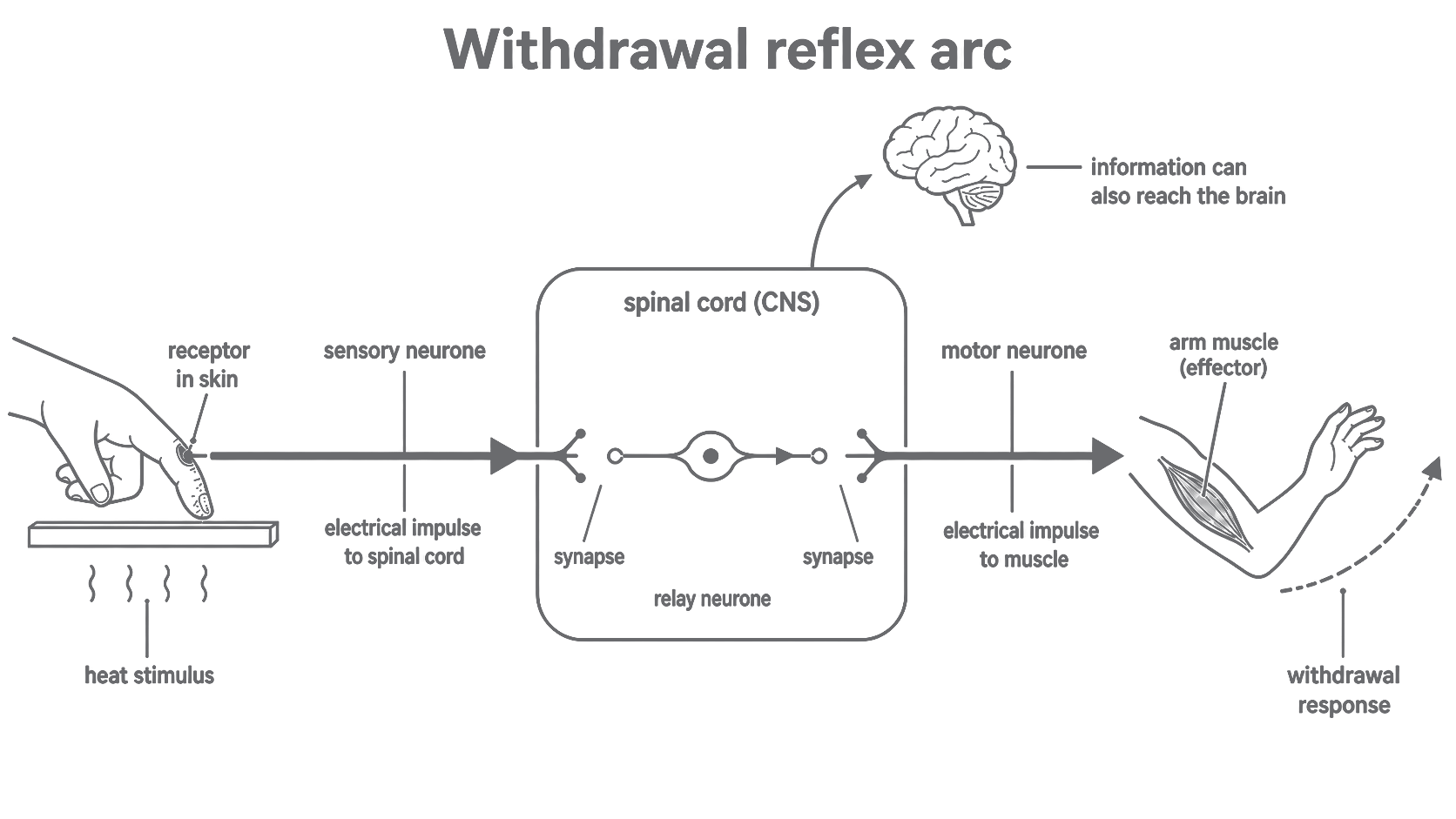
Each neurone has one route-specific function. The sensory neurone links receptor to CNS; the relay neurone links neurones inside the CNS; and the motor neurone links CNS to effector. The synapses between them are part of the route, so a complete explanation must not describe one unbroken electrical current from skin to muscle.
Joining the scales
A complete reflex explanation moves between biological scales without mixing them up. At the organism scale, a stimulus produces a rapid response. At the cell scale, three specialised neurones carry electrical impulses in a fixed route. At each junction between neurones, neurotransmitter carries the message chemically across a synaptic gap.
| Location in the route | What happens there |
|---|---|
| Receptor | Detects a particular stimulus and initiates an electrical impulse in a sensory neurone. |
| Sensory neurone | Carries the impulse from receptor to CNS. |
| Synapse | Neurotransmitter diffuses across the gap and triggers a new impulse in the receiving neurone. |
| Relay neurone | Connects neurones within the CNS. |
| Motor neurone | Carries the impulse from CNS to effector. |
| Effector | Produces the response, such as a muscle contracting. |
A reflex arc is a directed pathway, not a single wire: receptor → sensory neurone → relay neurone in the CNS → motor neurone → effector. The signal is electrical within each neurone and chemical across each synapse.
At each synapse, an arriving impulse causes neurotransmitter release. The molecules diffuse across the gap and bind to receptors on the next neurone, triggering a new impulse. Chemical transfer takes time, so a short pathway with few synapses supports a rapid response. Myelin around long nerve fibres also increases transmission speed.
Predicting what happens if the route is interrupted
If the sensory neurone is interrupted, information from that receptor does not reach the spinal reflex pathway. If the motor neurone is interrupted, the sensory information can still enter the CNS, but the impulse cannot reach that muscle along the damaged motor route. The muscle therefore cannot produce this withdrawal response through that route. Sensation and movement are different stages, so loss of one does not automatically mean the other is lost.
The response is automatic because the spinal pathway can activate the muscle without waiting for conscious choice. Information can still reach the brain for awareness. A conscious decision to pick up a cup also uses receptors, neurones and muscles, but is not therefore a reflex.