Biology 4.4 - 4.5 - Evidence for human evolution
Compare Ardi, Lucy and the 1.6-million-year-old Leakey-team fossils, then interpret changes in stone tools. Connect each observation to an inference and use dated surrounding layers to bracket a tool’s age.
How fossils become evidence
A fossil is preserved evidence of an organism from the past, such as mineralised bone. Fossils contribute to human-evolution evidence only when scientists connect two kinds of information: the fossil's age and its anatomy.
Keep three levels of reasoning separate:
| Level | Example | What it can support |
|---|---|---|
| Observation | A pelvis is short and broad. | A description that other researchers can check. |
| Inference | The pelvis could support the body during upright walking. | An explanation based on comparisons with how skeletons function. |
| Evolutionary pattern | Older and more recent fossils show different combinations of movement, skull and limb features. | A conclusion that human anatomy changed over long periods. |
The structure-function link matters. A pelvis shaped to balance the upper body has consequences for upright movement; a larger cranium provides space for a larger brain; long legs change the efficiency of walking. A label such as "more human-like" is not enough unless the named structure and its consequence are given.
Fossils provide evidence of change, but the record is incomplete. Different hominin species sometimes lived at the same time, so these dated examples should not be treated as a proven direct line of ancestors.
Ardi, Lucy and the Leakey evidence
Pearson names three fossil evidence points. Their value lies in comparing dated structures, not merely memorising three names.
Ardi: 4.4 million years ago
Ardi is a partial skeleton of Ardipithecus ramidus. Her short, broad pelvis supports the inference that she could walk upright on the ground. However, a grasping big toe supports climbing in trees. This combination is evidence that early bipedal movement existed alongside features useful for climbing; Ardi did not have a fully modern human body plan.
Lucy: 3.2 million years ago
Lucy is a partial skeleton of Australopithecus afarensis. Her short, broad pelvis supported the upper body above the legs, while inward-angled thigh bones brought the knees beneath the body. These features support regular bipedal walking. Her braincase remained small. Together, these observations support the conclusion that upright walking evolved before the much larger brain seen in later humans.
Richard Leakey's evidence: 1.6 million years ago
The specification calls this Richard Leakey's discovery of fossils from 1.6 million years ago. Work led by Leakey around Lake Turkana produced important Homo erectus evidence from this time. Fossils show a larger braincase and more human-like body proportions than the earlier examples; the long legs of the well-known Turkana Boy skeleton support efficient upright walking.
Historical note, not additional recall for this lesson: Turkana Boy was first found by Kamoya Kimeu, working with Leakey's team.
[DIAGRAM: asset_name: Biology 4.2-4.5 - Evolution and human evidence - diagram 01; asset_slug: biology_4_2_4_5_evolution_and_human_evidence_diagram_01; recommended_method: image_gen; description: Landscape monochrome fossil-evidence timeline on white, ordered left to right from older to more recent: Ardi at 4.4 million years with a pelvis and grasping-toe detail labelled as evidence for upright walking plus climbing; Lucy at 3.2 million years with pelvis/knee and small braincase labelled as evidence for regular upright walking before a large brain; Leakey-team fossils at 1.6 million years with a larger braincase and long legs labelled as evidence for more human-like body proportions and efficient upright walking. Use #6A6B6E linework and exact readable labels, visible right-pointing chronology arrow, separate evidence panels, no ancestor-to-descendant connecting line, no skin reconstructions, no claim that these three form a direct lineage.]
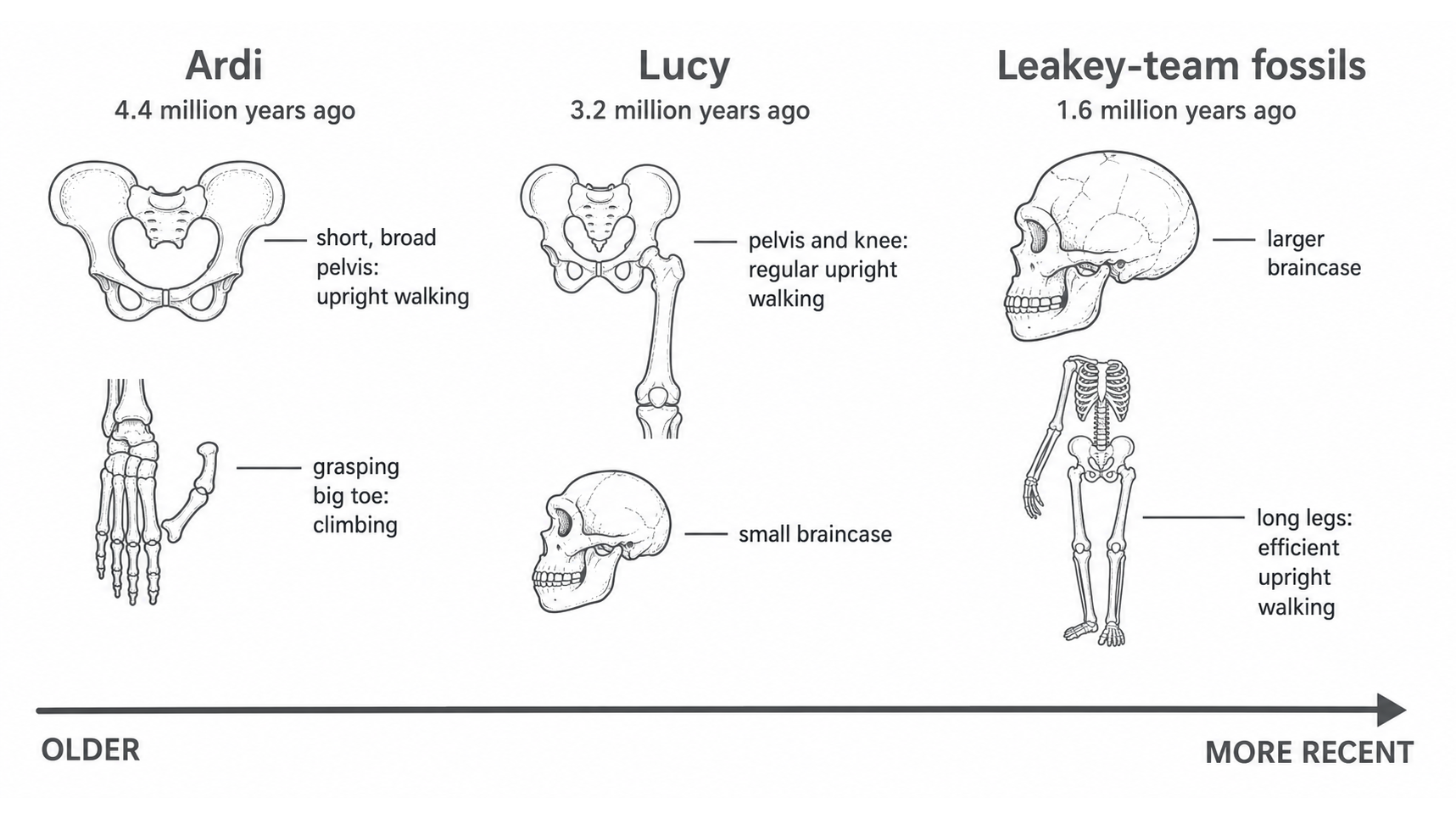
The drawings are simplified illustrations, not measured reconstructions or a size scale. Use the named structural observations and dates as the evidence.
The essential comparison is chronological: evidence for upright walking appears in the older fossils, while the much larger braincase and long-legged body proportions appear in the later evidence. Connect each date to a named structural observation.
Stone tools and evidence from their environment
Stone tools are artefacts: objects made or deliberately modified by humans or other hominins. They preserve evidence of behaviour that bones alone cannot show. Marks where flakes were deliberately struck from a stone can distinguish a tool from an ordinary broken rock.
Across many dated sites, the broad pattern is development from:
- simple hammerstones, cores and sharp flakes;
- deliberately shaped tools such as handaxes with more controlled edges;
- more varied and specialised tools, including points and scrapers made for different tasks.
What can improved tools suggest?
More refined, carefully shaped or specialised tools require greater control and planning to make. Comparing an older simple tool with a more recent refined tool therefore supports this explanation:
more refined tool → greater tool-making skill → evidence suggesting increased intelligence.
In an exam comparison, link the visible tool feature to the skill needed to make it, then to the inference about its makers. A larger brain is also an accepted inference in this kind of Pearson question, but tools do not directly measure brain size or intelligence. Avoid claiming that every later individual was more intelligent than every earlier individual.
Simple tools could remain useful alongside specialised ones. This does not cancel the evidence for an overall development in tool-making skill.
Dating a tool from its surroundings
Most ancient stone tools cannot simply be radiocarbon dated: stone was never living and does not contain the once-living carbon needed for that method. Instead, scientists date the environmental context in which a tool was found.
- Relative dating from rock layers: in an undisturbed sequence, a deeper layer was deposited before a layer above it, so it is usually older.
- Dating nearby material: volcanic ash above or below a tool layer can be dated using radioactive isotopes. Fossils or other datable material in the same undisturbed context can also help.
- Comparison with known-age finds: compare a tool with similar tools or associated fossils whose ages are already established, especially from the same undisturbed layer. This can suggest an age, but similar shape alone does not prove an identical date.
- Bracketing: a dated layer below and another above set an oldest and youngest limit. They do not automatically give the tool an exact age.
Worked example: bracketing the age of a tool layer
An undisturbed site has this order:
| Position | Evidence | Age |
|---|---|---|
| Upper layer | volcanic ash | 1.5 million years ago |
| Middle layer | stone tool | unknown |
| Lower layer | volcanic ash | 1.9 million years ago |
Step 1: identify the older boundary. The lower ash was deposited first and is 1.9 million years old. The tool was deposited after that ash, so it cannot be older than 1.9 million years.
Step 2: identify the younger boundary. The upper ash was deposited after the tool and is 1.5 million years old. The tool cannot be younger than 1.5 million years.
Step 3: state the bracket. The tool layer is between 1.9 and 1.5 million years old. In "years ago", the larger number is the older limit.
The width of this bracket is million years, or years. Subtract the younger age from the older age, then convert millions to years.
Sense-check: 1.6 million years lies inside the bracket, but 2.0 million years is too old and 1.4 million years is too young. The exact age is still unknown because the ash layers, not the tool itself, supplied the two dates.
Know the three fossil dates and their anatomical evidence. Explain how more refined tools suggest greater making skill and increased intelligence, and how surrounding layers or known-age finds help estimate a tool's age. Keep observations separate from the conclusions they support.