Biology 6.7 - 6.10 - Plant transport
Follow water and mineral ions from the soil to the leaves, and sucrose from a source to a sink. Connect root hairs, xylem, phloem and stomata to the different jobs they perform.
Absorbing water and mineral ions
A root is an organ. Near a growing root tip, some cells in its outer layer develop a long, narrow extension into the spaces between soil particles. Each extension belongs to one root hair cell; it is not a root made from many cells.
Root hair cell
A specialised root epidermal cell with a long extension that absorbs water and mineral ions from the soil.
The shape matters because it changes the boundary between the plant and the soil:
| Structural feature | Physical consequence | How this helps absorption |
|---|---|---|
| Long, narrow extension | Large surface area in contact with films of soil water | More membrane is available for water and mineral ions to enter across at the same time |
| Thin cell wall | Short path from the soil solution to the cell membrane | Water and dissolved ions reach the transport membrane quickly |
| Many mitochondria | More aerobic respiration can release energy | Active transport of mineral ions can be sustained when their concentration is lower in the soil than in the cell |
Water and mineral ions do not cross the membrane by the same process. Soil water is usually a more dilute solution than the cell sap. Water moves across the partially permeable cell membrane by osmosis, from the more dilute soil solution towards the more concentrated cell contents. The cell wall is freely permeable; it is the cell membrane that is partially permeable.
Some mineral ions, such as nitrate ions, may be less concentrated in the soil than inside the root hair cell. Moving them into the cell is then against their concentration gradient, so carrier proteins in the membrane use active transport. This process requires energy released by respiration. Osmosis is therefore not a correct explanation for mineral-ion uptake.
Two tissues with different jobs
Once substances enter a plant, diffusion alone would be too slow to supply every distant cell. Groups of specialised cells form the transport tissues xylem and phloem, which run through roots, stems and leaves in vascular bundles.
Xylem: a strong, low-resistance water route
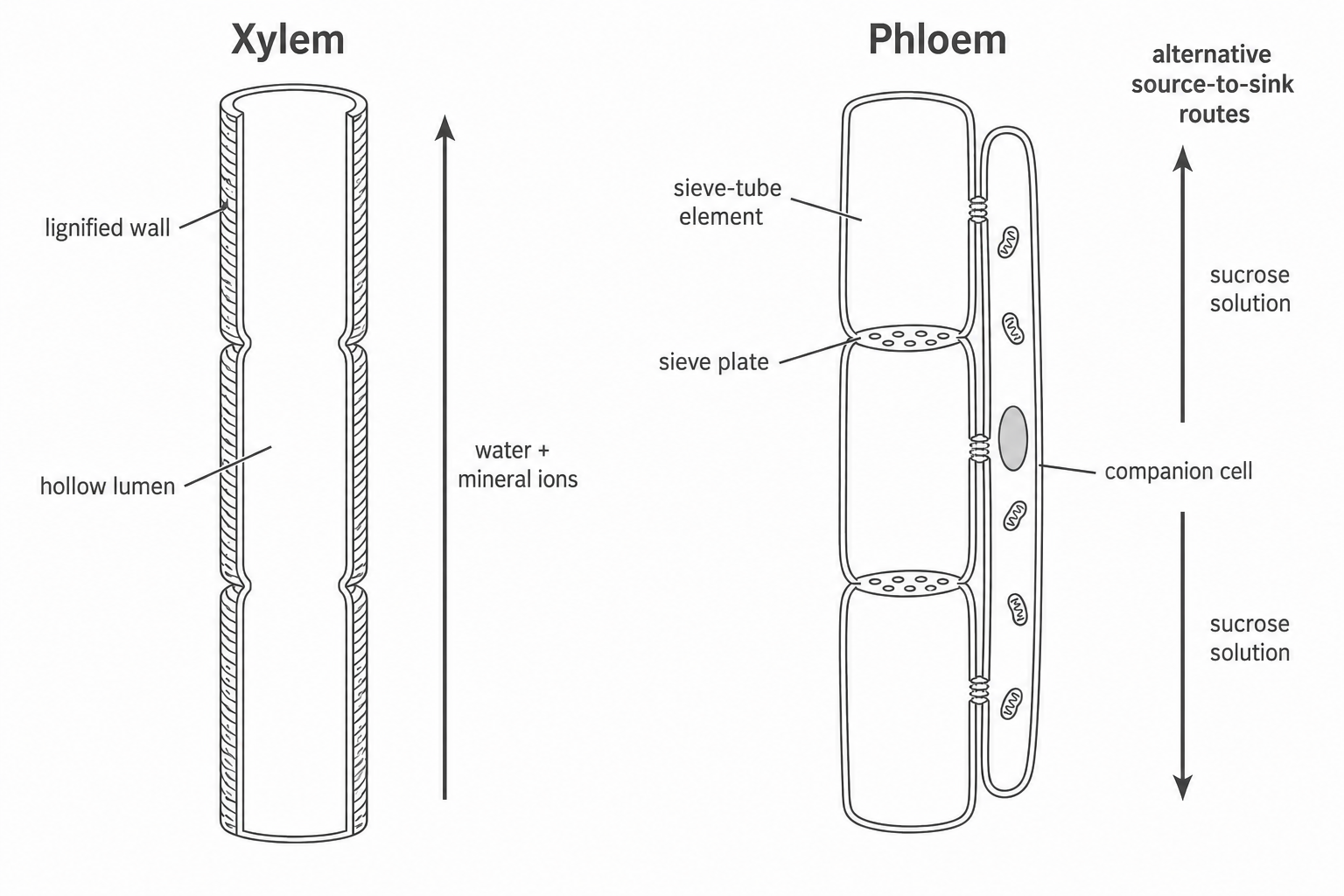
Water-conducting xylem cells die as they mature. Their contents and much of the obstruction at their end walls are lost, so cells joined end to end form a long, hollow lumen. This gives water and dissolved mineral ions a continuous, low-resistance route from roots towards stems and leaves.
Lignin
A strong, waterproof material deposited in xylem cell walls.
Lignin thickens and strengthens the xylem walls. The walls are therefore less likely to collapse while water is being pulled upward, and the tissue also helps support the plant. This is a direct structure-function chain: lignified wall → resists collapse → maintains an open transport route. Because the conducting cells are dead, the xylem vessels themselves do not use respiration to pump the water.
Phloem: living tissue for sucrose transport
Phloem contains living sieve-tube elements joined end to end. Their end walls form perforated sieve plates, so a solution containing sucrose can pass from one element to the next. Closely associated companion cells contain mitochondria and supply energy for active transport involved in loading and unloading sucrose.
The key contrast is not just dead against living. The phloem remains living because moving sucrose from one part of the plant to another requires energy, whereas the hollow, lignified xylem forms a passive route for water and mineral ions.
[DIAGRAM: asset_name: Biology 6.7-6.10 - Plant transport systems - diagram 01; asset_slug: biology_6_7_6_10_plant_transport_systems__diagram_01; recommended_method: image_gen; description: Landscape two-panel monochrome scientific comparison on white: left panel labelled Xylem shows three dead hollow vessel elements joined as one open lumen, thick lignified walls, no nuclei or cytoplasm, and one clear upward arrow labelled water + mineral ions; right panel labelled Phloem shows three living sieve-tube elements joined by two perforated sieve plates, a narrow nucleated companion cell alongside, and separate clear upward and downward arrows labelled sucrose solution and grouped under the label alternative source-to-sink routes. Use only #6A6B6E linework, labels and arrows with light neutral-grey fills, uncrossed leaders and no decorative plant, cross-flow, colour coding or implication that one phloem tube carries both directions simultaneously.]
The transpiration stream and stomata
Two similar terms describe different things.
Transpiration
The loss of water vapour from the aerial parts of a plant, mainly through stomata in the leaves.
The transpiration stream is the movement of water and dissolved mineral ions from the roots, up through xylem, to the leaves. Transpiration is the water loss that helps keep this stream moving.
The mechanism can be followed in order:
- Water enters root hair cells by osmosis and eventually reaches the xylem; absorbed mineral ions also enter the xylem.
- A continuous column of liquid water moves upward through the hollow xylem vessels.
- In a leaf, water moves from the xylem to moist mesophyll cell surfaces and evaporates into the internal air spaces.
- Water vapour diffuses from the leaf air spaces, through open stomata, into the drier outside air.
- Losing water from the leaf creates tension, or a pulling effect, on the water column in the xylem. More water is drawn upward to replace it, carrying dissolved mineral ions with it.
A stoma is a pore in the leaf epidermis; stomata is the plural. Two living guard cells border each pore. By changing shape, guard cells open or close the pore, controlling the route through which carbon dioxide enters and water vapour leaves. The stomatal pore does not pump water: water vapour diffuses through it down a concentration gradient.
The route from a root hair cell to xylem passes through other root tissues. The connecting arrow in the diagram summarises that transfer; the root hair cell is not part of xylem.
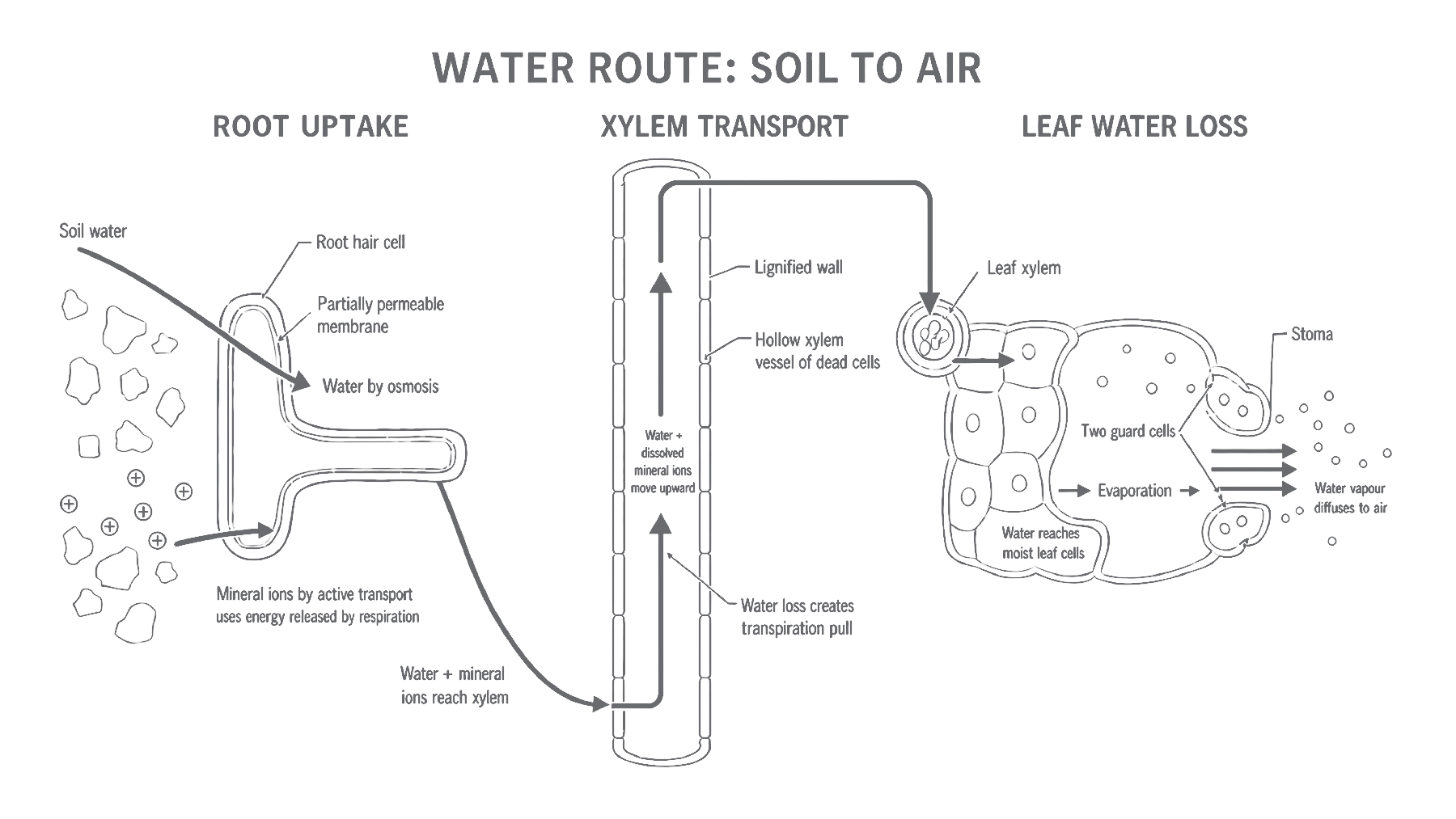
Liquid water reaches moist leaf cells; evaporation and diffusion then move water vapour into the air.
Moving sucrose from source to sink
Photosynthesis in green tissues produces sugars. Plants convert some of this product into sucrose, a soluble sugar that can be carried in phloem sap to another organ.
Translocation
The transport of dissolved sucrose through phloem from a source to a sink.
A source supplies sucrose to the phloem. A photosynthesising leaf is a common source, but a storage organ can become a source when it releases stored carbohydrate. A sink removes sucrose from the phloem because it is using or storing it. Growing shoot tips, roots, fruits, developing seeds and storage organs can all act as sinks.
Translocation follows this route:
- At a source, sucrose is loaded into the living phloem. Active transport involved in loading uses energy supplied by respiration in companion cells.
- The sucrose, dissolved in water, is transported through sieve-tube elements and their perforated sieve plates.
- At a sink, sucrose is unloaded. It may be used in respiration, used to make new biological material for growth, or converted to starch for storage.
Phloem does not have one permanently fixed direction. A leaf may supply sucrose downward to roots and upward to a growing shoot. The direction in a particular route is always from its source to its sink. Across the phloem network, translocation can therefore occur upward or downward, unlike the mainly upward root-to-leaf route of xylem.
Keeping the two routes separate
The plant coordinates both systems, but each tissue has its own cargo, mechanism and destination.
| Question | Water and mineral-ion route | Sucrose route |
|---|---|---|
| Where does the cargo enter or begin? | Water and ions are absorbed from soil by root hair cells | Sucrose is loaded at a source, often a photosynthesising leaf |
| Which tissue carries it long distance? | Xylem | Phloem |
| What is the long-distance direction? | Mainly upward from roots towards leaves | From source to sink, so it may be upward or downward |
| Where is energy used? | Active transport can absorb mineral ions at roots; flow through dead xylem vessels is passive | Living phloem tissue uses energy in loading and unloading sucrose |
| Where does the cargo finish? | Water reaches leaves and much is lost as vapour through stomata; mineral ions enter plant tissues | Sucrose is used or stored at sinks such as growing tissues, roots, fruits or seeds |
Notice the division of labour. Root hairs create the entry surface; xylem supplies water and mineral ions; stomata form a controllable exit for water vapour; and phloem distributes sucrose to where the plant needs it. Calling every transported substance "food" hides these differences and often leads to reversing the tissues.