Biology 1.2 - Specialised cells
Connect the features of sperm, egg and ciliated epithelial cells to their jobs in fertilisation, early development and clearing the airways.
Gametes and fertilisation
A specialised cell has features that make it effective at a particular function. Sperm and egg cells are gametes: their nuclei fuse during fertilisation. Each gamete nucleus is haploid, meaning it contains one set of chromosomes. Fusion of two haploid nuclei produces a fertilised cell with two sets, one from each parent.
Sperm cell
A sperm cell is specialised to reach an egg and deliver its haploid nucleus.
- The tail beats to propel the sperm through liquid towards the egg.
- The middle region contains many mitochondria. Aerobic respiration releases energy for the tail to beat, so these two adaptations form one causal chain: many mitochondria → energy released → tail movement → propulsion.
- The acrosome is a cap at the front of the head containing enzymes. Their release helps digest a route through the egg's outer layers so the sperm can enter.
- The compact haploid nucleus carries one set of chromosomes. This prevents the normal chromosome number from doubling at every fertilisation.
Egg cell
An egg cell is specialised to be fertilised and support the earliest stage of development.
- Its large cytoplasm contains nutrients, providing materials and an energy source for the early embryo before another supply is established.
- Its haploid nucleus contributes one set of chromosomes, which can combine with the sperm nucleus.
- After one sperm fertilises the egg, the cell membrane changes so further sperm cannot enter. This block ensures that only one sperm nucleus contributes chromosomes.
The acrosome and egg membrane have different roles: acrosomal enzymes help one sperm get through the egg's outer layers, while the membrane change after fertilisation prevents additional sperm entering.
Ciliated epithelial cells
Epithelial cells form sheets that cover surfaces and line organs. Ciliated epithelial cells line parts of the airways. Each has many short, hair-like cilia projecting from the surface that faces the airway.
Mucus traps dust and microorganisms breathed in with the air. The cilia beat together in a coordinated direction, moving the mucus and its trapped particles towards the throat, where it can be swallowed or coughed out. The causal chain is many beating cilia → mucus moves over the cell surface → trapped material is carried away from the lungs.
[DIAGRAM: asset_name: Biology 1.1-1.2 - Cell structures and specialised cells - diagram 01; asset_slug: biology_1_1_1_2_cell_structures_and_specialised_cells__diagram_01; recommended_method: image_gen; description: Three-panel monochrome structure-function diagram on white: sperm cell labelled acrosome, haploid nucleus, mitochondria and tail with a head-first propulsion arrow; egg cell before and after fertilisation labelled nutrient-rich cytoplasm, haploid nucleus and cell membrane, with exactly one entering sperm followed by a clear blocked-second-sperm symbol; ciliated epithelial cells labelled cilia and mucus with trapped particles, with one arrow showing mucus moving towards the throat over the cilia. Use #6A6B6E linework and labels, uncrossed leaders, no scale claims, no decorative organelles, no bacterial structures, and no implication that cilia move the epithelial cells themselves.]
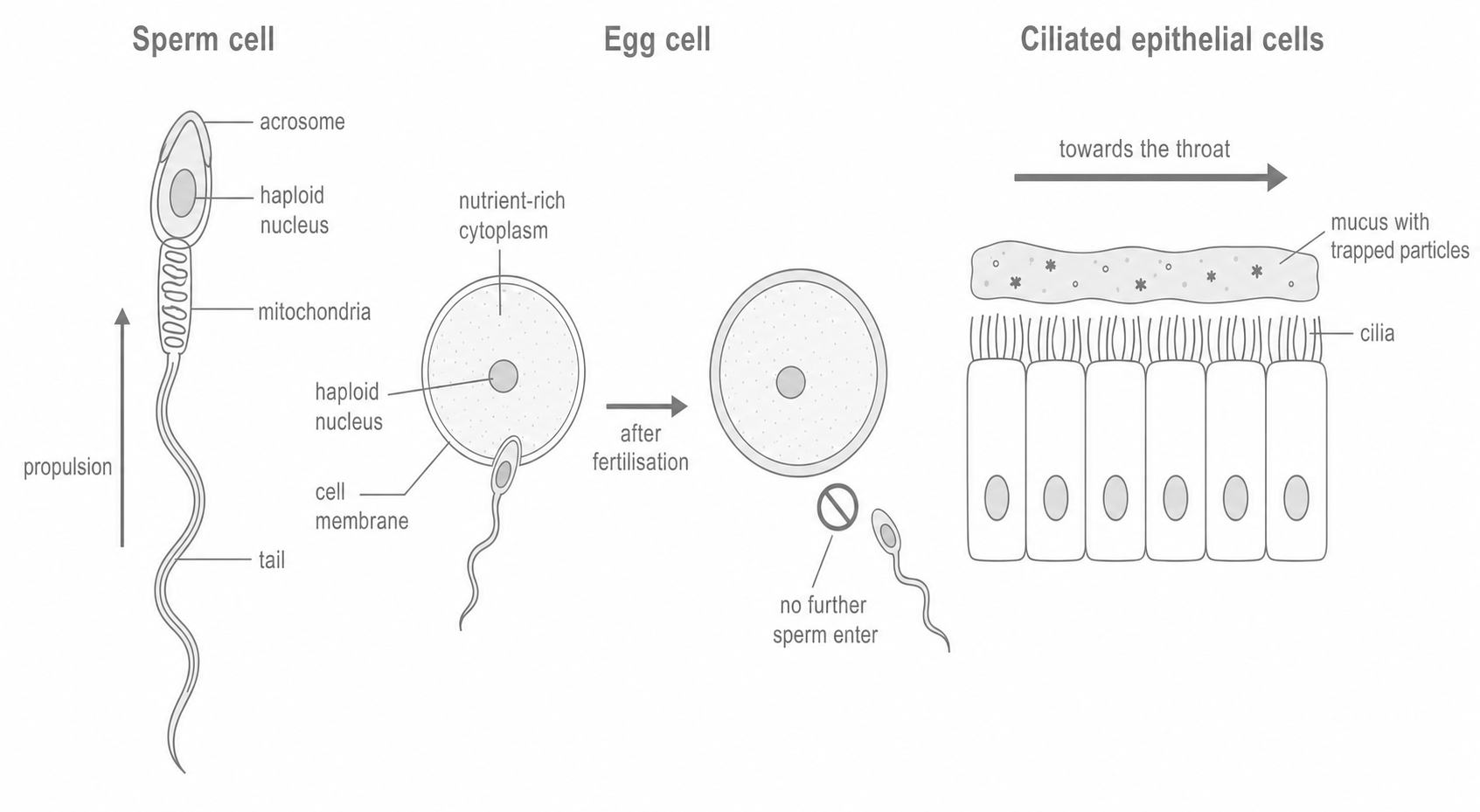
Do not confuse three movement structures. A bacterial flagellum can propel a whole bacterium; a sperm tail propels a whole sperm cell; airway cilia stay attached to an epithelial sheet and move mucus across its surface.
The unifying idea is not the shape alone. A cell is specialised when a feature causes a useful physical or chemical effect: an acrosome releases enzymes, a tail propels a cell, or cilia move material over a fixed cell surface.