Biology 1.15 - Cell transport
Distinguish diffusion, osmosis and active transport, then use concentration gradients to predict net movement into or out of a cell.
Three ways across a cell membrane
A cell membrane separates the cell contents from the surroundings. Particles on both sides are in constant random motion, but their concentrations may differ. Concentration describes how much of one named substance is present in a particular volume; a difference in concentration across a space is a concentration gradient.
Diffusion
Diffusion is the net movement of particles from a region of higher concentration to a region of lower concentration, down their concentration gradient.
Particles actually move in both directions. If more of a substance starts on one side, however, more of its particles cross away from that side than cross back, producing net movement from high to low concentration. Diffusion does not require energy from the cell. For example, if oxygen is more concentrated outside a respiring cell than inside it, the net movement of oxygen is into the cell.
Osmosis
Osmosis is the net movement of water molecules through a partially permeable membrane from a dilute solution to a more concentrated solution.
A partially permeable membrane allows some small molecules, including water, through but blocks some dissolved substances. A dilute solution has a higher concentration of water molecules than a concentrated solution, so the water moves down its own concentration gradient. Only water is named in osmosis: saying that sucrose moves by osmosis is incorrect.
Active transport
Active transport moves a substance from lower concentration to higher concentration, against its concentration gradient, using energy released by respiration.
Specific proteins in the cell membrane use that energy to move particular substances. Active transport therefore lets a living cell build up a substance even when diffusion would produce net movement in the opposite direction.
| Process | What has net movement? | Direction | Membrane needed? | Cell energy needed? |
|---|---|---|---|---|
| Diffusion | particles of a named substance | higher to lower concentration | not always, although it can occur across a cell membrane | no |
| Osmosis | water molecules only | dilute solution to more concentrated solution | yes, partially permeable | no |
| Active transport | a particular substance | lower to higher concentration | yes, using membrane proteins | yes, from respiration |
[DIAGRAM: asset_name: Biology 1.15-1.17 - Transport into and out of cells - diagram 01; asset_slug: biology_1_15_1_17_transport_into_and_out_of_cells__diagram_01; recommended_method: image_gen; description: Three side-by-side monochrome cell-membrane panels labelled Diffusion, Osmosis and Active transport; arrows show net particle movement from high to low concentration, water-only movement through a partially permeable membrane from dilute to concentrated solution, and low-to-high movement through a membrane protein powered by energy from respiration; exclude surface-area-to-volume content and organ-level examples.]
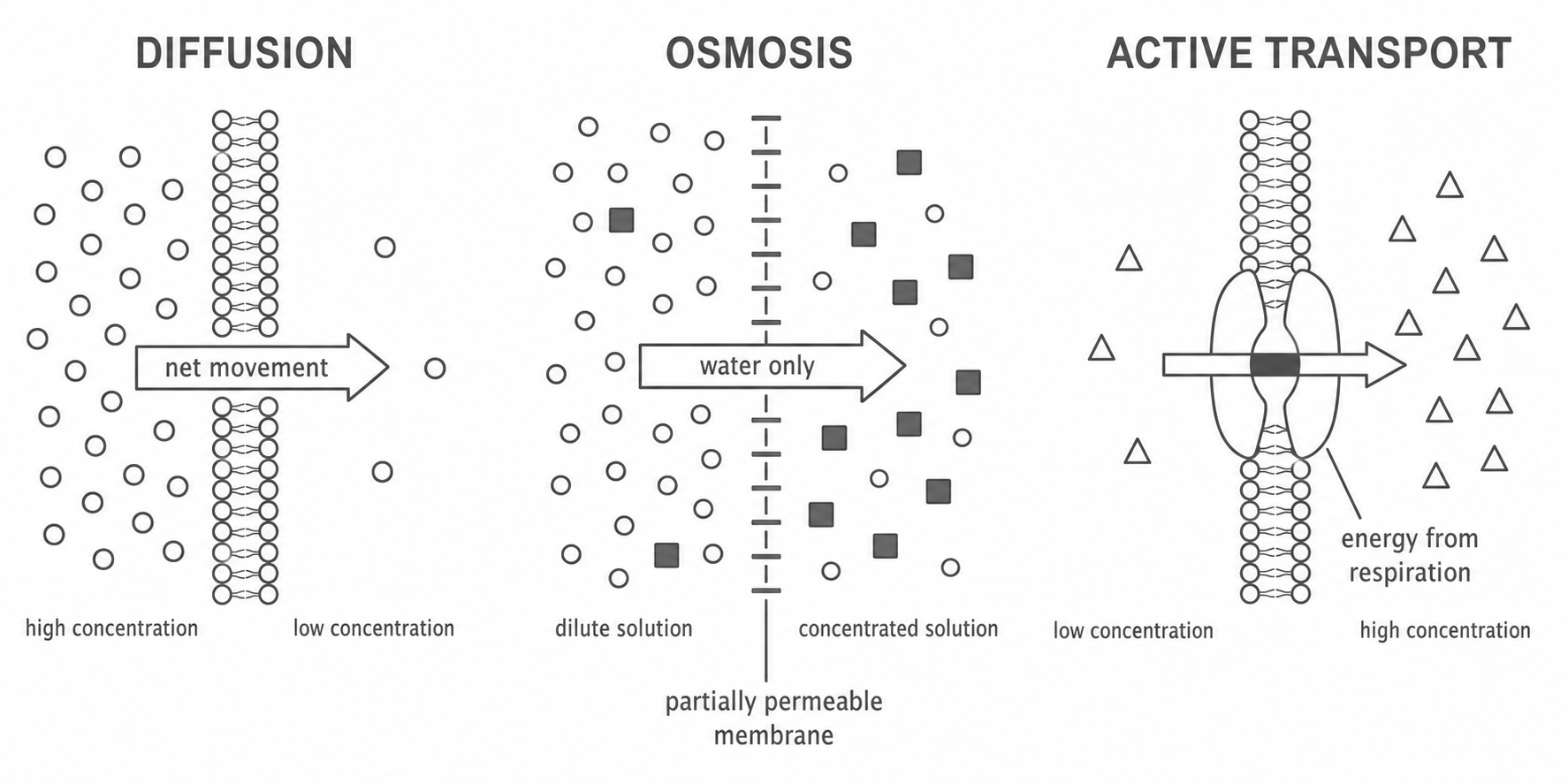
In the osmosis panel, open circles represent water and dark squares represent dissolved solute. The arrows in the diagram represent net movement, not the path of every particle. At equal concentrations, random movement continues in both directions but there is no overall net movement.
Predicting net movement
Always name the substance whose concentration you are comparing. A solution can have a high concentration of sucrose but, because dissolved sucrose reduces the proportion of water in a given volume, a lower concentration of water.
Use this route:
- Identify the substance that can cross the boundary.
- Compare its concentration on the two sides.
- Decide whether it moves down the gradient or, for active transport, against it.
- State the direction as net movement.
Suppose carbon dioxide is at higher concentration inside a cell than outside. Carbon dioxide diffuses out, from its higher concentration inside to its lower concentration outside. If the concentrations later become equal, carbon dioxide particles do not stop moving; their movements in opposite directions balance.
For osmosis, compare water rather than sucrose. If the solution outside a potato cell is more dilute than the cell contents, water is at higher concentration outside. Its net movement is through the cell membrane into the cell. In a more concentrated external solution, the direction reverses.