Biology 5.12-5.14 - Defences and immunity
Follow how physical barriers, chemicals and the specific immune response protect the body, then explain how immunisation prepares immune memory before an infection.
Barriers before entry
A pathogen is a disease-causing organism. Before a pathogen can reproduce inside the body, it usually has to cross a body surface. The skin and the linings of the airways and digestive system therefore act at the boundary between the environment and the body's internal tissues.
These first-line defences are not specific to one pathogen. They block, trap, move or chemically damage many different pathogens without first recognising a particular antigen.
| Defence | Type | Structure or property | Consequence and protective function |
|---|---|---|---|
| Skin | Physical barrier | Intact skin forms a continuous, tough outer covering | Pathogens cannot easily cross into the tissues. A cut matters because it breaks this barrier. |
| Mucus | Physical barrier | Sticky mucus lines the airways | Inhaled pathogens and particles become trapped instead of reaching delicate lung tissue. |
| Cilia | Physical barrier | Cilia are tiny hair-like structures on cells lining the airways | Coordinated beating moves pathogen-containing mucus towards the throat, where it can be swallowed or removed. Cilia move pathogens; they do not kill them directly. |
| Lysozymes | Chemical defence | Lysozyme is an enzyme in secretions such as tears and saliva | It damages the cell walls of susceptible bacteria, helping to destroy them. It is not an antibody and does not act against every pathogen. |
| Hydrochloric acid | Chemical defence | The stomach has a very low pH | The acidic conditions destroy many pathogens swallowed in food, water or mucus. The defence reduces risk; it does not make infection impossible. |
[DIAGRAM: asset_slug: biology_5_12_mucociliary_clearance; description: Mucus traps pathogens above ciliated epithelial cells; beating cilia moves it towards the throat.]
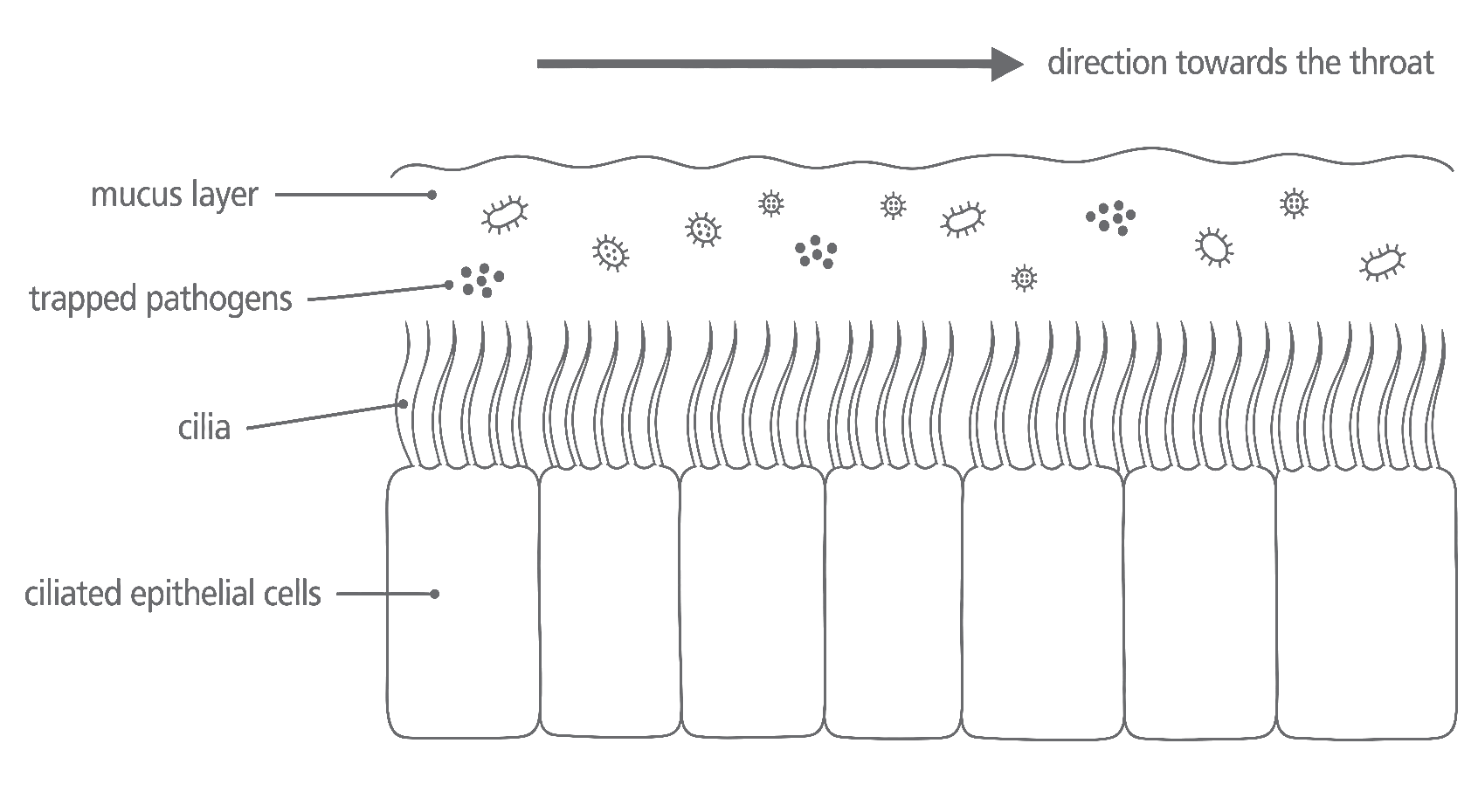
The airway defences work as a system: sticky mucus traps pathogens → beating cilia transport the mucus → fewer pathogens reach the lungs. This is a structure-to-function explanation, not just a list of two labels.
Specific primary and secondary responses
If a pathogen crosses the first-line barriers, the response moves from the body surface to the tissues. The specific immune system responds to recognisable molecules called antigens.
Antigen
An antigen is a molecule, often on the surface of a pathogen, that is recognised as foreign and triggers a specific immune response.
An antibody is a protein produced by lymphocytes. Its binding region has a complementary shape to one antigen, so an antibody that binds one antigen will not usually bind a different one. Binding helps stop the pathogen functioning and helps the body remove it. This matching is why the response is described as specific.
The primary response: first exposure
- A pathogen enters the body and exposes its antigens.
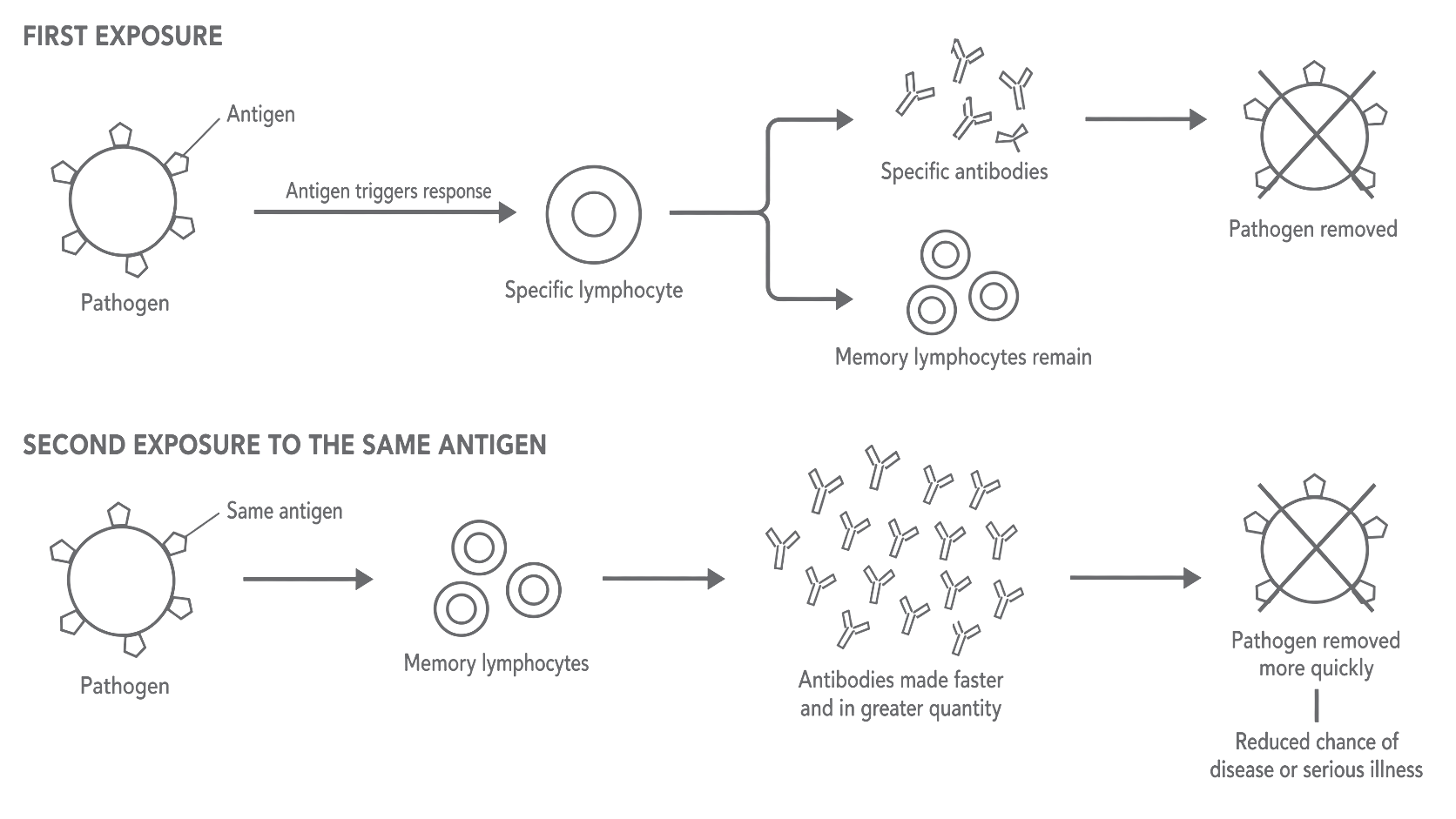
- A matching lymphocyte is activated by the antigen. The immune response produces many antibodies specific to that antigen and also produces memory lymphocytes.
- The antibodies bind to the matching antigens and help the body destroy the pathogen. This first response takes time, so the pathogen may reproduce and cause symptoms before enough antibody is present.
- After the pathogen has been removed, antibody levels may fall, but some memory lymphocytes remain in the body.
[DIAGRAM: asset_slug: biology_5_13_primary_secondary_response; description: First exposure activates specific lymphocytes and produces antibodies and memory lymphocytes; second exposure produces antibodies faster and in greater quantity, reducing the chance of serious disease.]
The secondary response: later exposure
When the same antigen enters again, its matching memory lymphocytes are already present. They recognise it quickly and lead to much faster production of many specific antibodies. The pathogen is therefore destroyed sooner, often before it can reproduce enough to cause disease.
This immune memory is not a general upgrade against every infection. A pathogen carrying different antigens needs a different specific response.
| Feature | First exposure: primary response | Later exposure to the same antigen: secondary response |
|---|---|---|
| Matching memory lymphocytes at the start | Not yet present | Already present |
| Antibody production | Slower to build up | Faster and usually greater |
| Likely outcome | Symptoms may develop before the pathogen is removed | Pathogen is often removed before disease develops |
Immunisation builds memory
Immunisation prepares the specific immune system before a person meets the active disease-causing pathogen. In the model required here, a vaccine contains an inactive form of the pathogen. It cannot reproduce and cause the disease, but its antigens are still present for the immune system to recognise.
The response follows the same mechanism as a first exposure:
- Antigens on the inactive pathogen trigger a specific immune response.
- Lymphocytes produce antibodies complementary to those antigens.
- Memory lymphocytes specific to the antigens are also produced and remain in the body.
- If the active pathogen later enters, the same antigens trigger a secondary response. The memory lymphocytes enable antibodies to be produced faster, so the pathogen is removed sooner and the chance of disease is reduced.
The vaccine does not supply ready-made antibodies or memory lymphocytes, and it does not treat an infection that is already established. It causes the person's own immune system to make a specific response. Protection takes time to develop and is directed at the antigen used in the immunisation; it is not instant protection from every pathogen.
Immunisation creates the benefits of immune memory without the person first having to experience disease caused by the active pathogen.
From barrier to immune memory
The defences form a sequence, but they do not all act in the same way or at the same place.
| Stage | Main location and timing | What it does | Specific to one antigen? |
|---|---|---|---|
| Physical and chemical defences | Body surfaces, before or during entry | Block, trap, move or chemically damage pathogens | No |
| Primary specific response | Inside the body after a new antigen enters | Produces matching antibodies and memory lymphocytes | Yes |
| Secondary specific response | Inside the body when the same antigen returns | Uses memory lymphocytes to produce matching antibodies faster | Yes |
| Immunisation | Before natural exposure to an active pathogen | Uses an inactive pathogen's antigens to create a primary response and immune memory | Yes |
For an inhaled pathogen, the route might end at the airway because mucus traps it and cilia move it away. If some pathogen crosses the lining, its antigens can trigger the slower primary response. Once memory lymphocytes have formed, a later encounter with the same antigen can be met by the faster secondary response. Immunisation deliberately prepares that final advantage in advance.