Biology 1.1 - Cell structures
Learn how the structures of animal, plant and bacterial cells make their jobs possible, and use those functions to explain similarities and differences between cells.
Cell types and common ground
A cell is the smallest unit that can carry out the processes of life. Inside a cell, smaller components perform particular jobs. These are called sub-cellular structures; structures with specialised roles inside a cell are often called organelles.
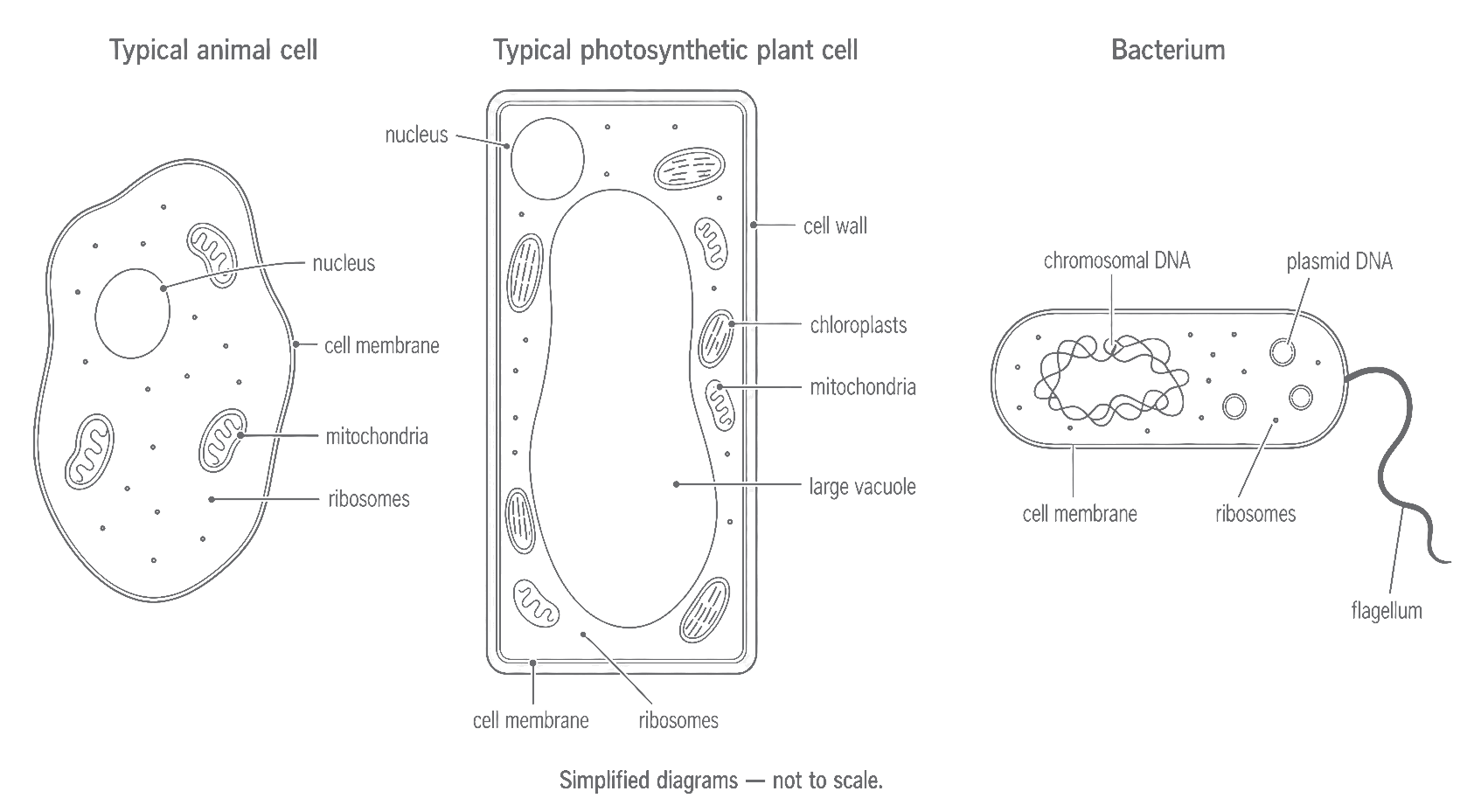
Animal and plant cells are eukaryotic. Their genetic material is enclosed inside a nucleus, and they contain membrane-bound organelles such as mitochondria. Bacterial cells are prokaryotic: their DNA is not enclosed in a nucleus, and they do not contain membrane-bound organelles such as mitochondria or chloroplasts.
This is a difference in organisation, not a claim that bacteria are incomplete cells. All three cell types have:
- a cell membrane, which controls the passage of substances into and out of the cell;
- cytoplasm, the material inside the membrane where many chemical reactions occur;
- ribosomes, where proteins are synthesised;
- DNA, which carries genetic instructions, although its location and arrangement differ.
The key question throughout this lesson is: what physical or chemical consequence does a structure have, and how does that consequence help the cell function?
Animal and plant cell systems
An animal cell contains structures that cooperate rather than working as isolated parts.
| Structure | What the structure does | Why the function matters |
|---|---|---|
| Nucleus | Contains DNA and therefore the instructions that control cell activities | The cell can make the proteins needed for its particular activities |
| Cell membrane | Forms a selectively controlled boundary around the cell | Needed substances can enter and wastes can leave while the cell's contents remain together |
| Mitochondria | Are the site of aerobic respiration, which releases energy | The released energy can be used for active cell processes |
| Ribosomes | Are the site of protein synthesis | Proteins are needed for cell structures and cell reactions |
The cell membrane does not make decisions, and mitochondria do not create energy. The membrane's structure allows it to control passage, while respiration in mitochondria transfers chemical energy into a usable form.
Plant cells contain a nucleus, cell membrane, mitochondria and ribosomes too. This matters: a plant cell photosynthesises in chloroplasts but releases energy by respiration in mitochondria. Photosynthesising plant cells also have three especially important structures.
| Plant-cell structure | Structure → consequence → function |
|---|---|
| Cell wall | A rigid cellulose layer outside the cell membrane → resists changes in shape → strengthens and supports the cell |
| Chloroplasts | Contain chlorophyll that absorbs light → light energy is available for photosynthesis → the cell can make glucose |
| Permanent vacuole | Contains cell sap and can press the cell contents against the wall → the rigid wall resists this pressure → the cell stays firm and supported |
Not every plant cell contains chloroplasts: they are present where photosynthesis occurs. The cell wall is freely permeable and is not a substitute for the cell membrane; the membrane remains the structure that controls passage into and out of the cell.
Bacterial cell organisation
A bacterium is a prokaryotic cell. Its organisation is simpler than a eukaryotic cell's because it has no nucleus and no membrane-bound organelles, but each named structure still has a specific function.
| Bacterial structure | Structure → consequence → function |
|---|---|
| Chromosomal DNA | One main circular DNA molecule lies free in the cytoplasm → genetic instructions are available without a nucleus → controls the cell's activities |
| Plasmid DNA | Small circular DNA molecules are separate from the chromosome → they carry a smaller, additional set of genes → can give the bacterium extra characteristics |
| Cell membrane | Encloses the cytoplasm and controls passage → maintains suitable conditions inside the cell |
| Ribosomes | Small structures in the cytoplasm assemble proteins → the bacterium can make the proteins it needs |
| Flagellum | A long structure extends from the cell and rotates like a propeller → pushes against the surrounding liquid → can propel the whole bacterium |
Plasmids and flagella are not present in every bacterium. If a bacterium has a flagellum, it moves the entire cell; the flagellum is not a channel carrying substances into the bacterium. The chromosomal DNA is not a nucleus and should not be drawn as an X-shaped chromosome inside one.
[DIAGRAM: asset_name: Biology 1.1 - Cell comparison; asset_slug: combined_1sc0_biology_1_1_cell_comparison; description: Labelled animal cell, photosynthetic plant cell and bacterium; simplified and not to scale. Includes the required nuclei, membranes, mitochondria, ribosomes, cell wall, chloroplasts, vacuole, chromosomal DNA, plasmids and flagellum.]