Biology 2.1 - 2.4 - Mitosis, growth and cancer
Follow how a cell copies and shares its chromosomes to make two matching daughter cells, then connect this process to growth, repair, asexual reproduction and cancer.
Preparing for division
Mitosis happens at the cell level. Inside the nucleus of a body cell, chromosomes contain DNA and carry genetic information. A diploid cell has two sets of chromosomes. The original cell is the parent cell; the two cells produced are daughter cells.
Mitosis is one part of a repeating cell cycle. Before the nucleus divides, the cell must prepare:
- During interphase, the cell grows and makes more sub-cellular structures.
- Its DNA is copied, so each chromosome has an identical copy.
- The cell prepares the structures needed for nuclear and cell division.
Interphase is therefore active preparation, not an inactive rest. Copying the chromosomes before division is essential: one copy of every chromosome can later be sent to each daughter cell.
Mitosis
Mitosis is nuclear division in which copied chromosomes are separated to produce two nuclei with identical sets of chromosomes.
The cell cycle continues through mitosis and then cytokinesis, when the cell contents divide. A useful overview is:
interphase → mitosis (prophase, metaphase, anaphase, telophase) → cytokinesis
Following the chromosomes
The named stages form one continuous process. The boundaries help us describe what happens, but cells do not pause between them.
| Stage | What happens |
|---|---|
| Interphase | The cell grows and copies its DNA. Each chromosome now has an identical copy, ready to be separated. |
| Prophase | The copied chromosomes condense, becoming shorter and more visible. The nuclear membrane breaks down and spindle fibres form. |
| Metaphase | The copied chromosomes line up across the middle, or equator, of the cell. Spindle fibres attach to them. |
| Anaphase | The two identical copies of each chromosome separate and spindle fibres move them to opposite ends of the cell. |
| Telophase | A nuclear membrane forms around each complete set of chromosomes, producing two nuclei. The chromosomes begin to uncoil. |
| Cytokinesis | The cytoplasm divides as the cell membrane separates one parent cell into two daughter cells. |
[DIAGRAM: asset_name: Biology 2.1-2.4 - Mitosis, growth and cancer - diagram 01; asset_slug: biology_2_1_2_4_mitosis_growth_and_cancer_diagram_01; recommended_method: image_gen; description: A clean monochrome six-panel left-to-right process diagram of one animal body cell through Interphase, Prophase, Metaphase, Anaphase, Telophase and Cytokinesis. Use the same small set of chromosomes consistently: copied chromosomes visible by prophase, aligned at the cell equator in metaphase, identical copies moving to opposite ends in anaphase, two re-forming nuclei in telophase, and two separate daughter cells after cytokinesis. Include exact phase labels and clear right-pointing arrows between panels; exclude meiosis, gametes, crossing over, mutation, numerical chromosome counts and decorative colour.]
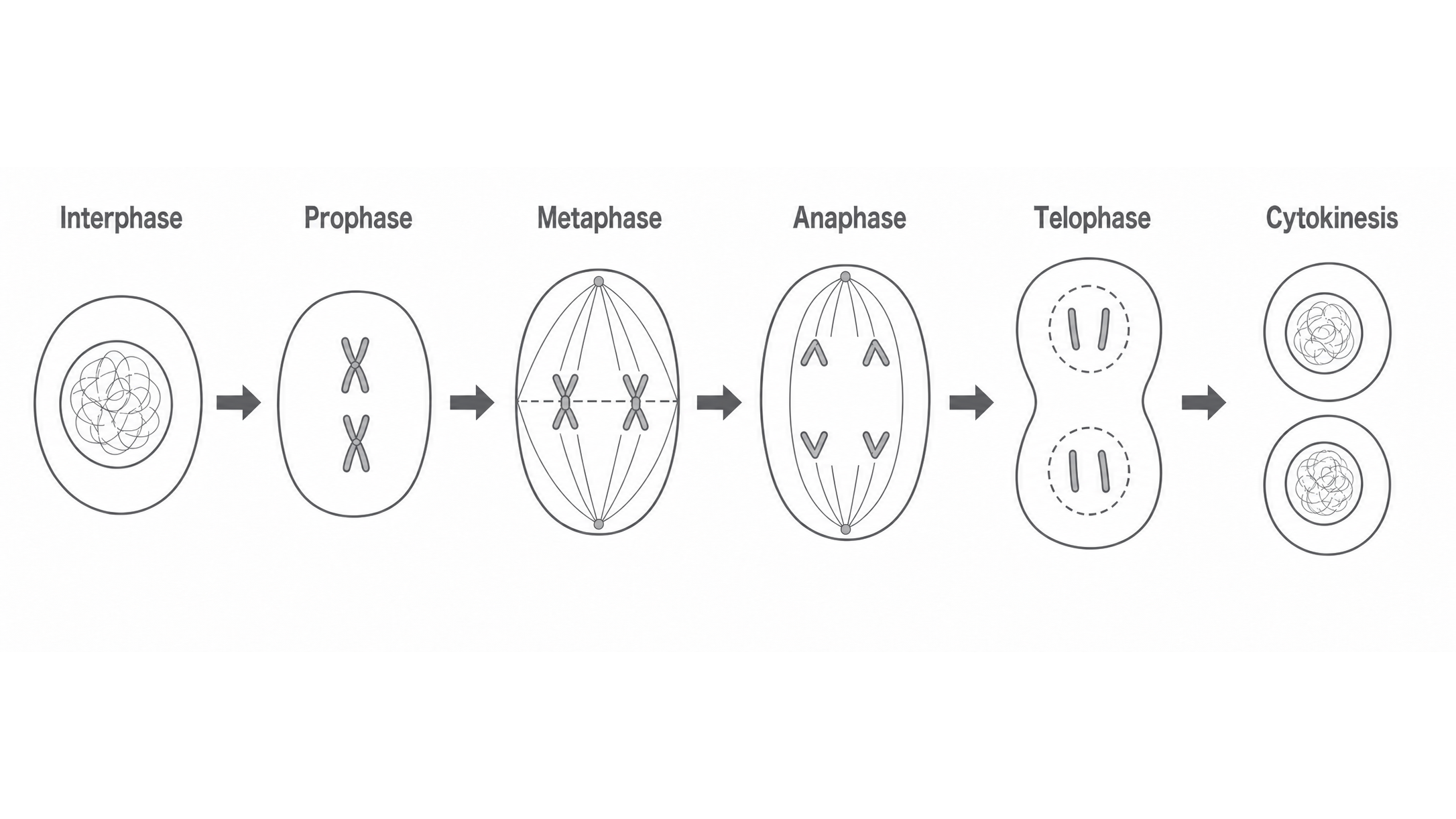
Track the chromosomes rather than memorising six unrelated pictures: copy, condense, line up, separate, enclose, split. Notice that DNA copying happened in interphase. Anaphase separates copies; it does not make them.
Why mitosis matters
After cytokinesis, the outcome is two genetically identical diploid body cells. Each daughter's nucleus contains an identical set of chromosomes to the parent cell's nucleus, so the chromosome number is maintained rather than halved.
For example, a human diploid body cell has 46 chromosomes. Copying its DNA gives two joined identical copies of each chromosome. The amount of DNA doubles in preparation for sharing between the two daughters. After the copies separate, each daughter nucleus has 46 chromosomes, arranged in the same two sets as the parent. It does not receive 23.
The logic is:
chromosomes copied once → copies separated equally → two daughter cells with matching chromosome sets
This outcome makes mitosis important in three contexts:
- Growth: repeated mitosis increases the number of cells in an organism. The essential change here is more cells, not merely larger cells.
- Repair: mitosis produces replacement cells with the same genetic information as nearby body cells, allowing damaged or worn tissue to be replaced.
- Asexual reproduction: in some organisms, mitosis produces a new individual from one parent. Because there is no fusion of gametes, the offspring are genetically identical to the parent.
When division loses control
Normal growth and repair require cell division to be controlled. Cells should enter the cycle when new cells are needed and stop dividing when they are not needed.
Cancer can begin when changes in a cell disrupt the normal controls of cell division. The changed cell then continues to divide when it should not. Repeated uncontrolled division increases the number of abnormal cells; this loss of control is the central link between the cell cycle and cancer.
Normal mitosis and cancer are therefore not opposites: cancer cells still use cell division, but the decision to divide is no longer controlled normally. Rapid division during healing is controlled and useful, so rapid division by itself does not mean cancer.
Interphase copies the chromosomes. Mitosis separates the copies into two matching nuclei, and cytokinesis separates the cell. The result is two genetically identical diploid body cells, enabling controlled growth, repair and asexual reproduction; changes that remove division control can lead to cancer.
Those links distinguish useful controlled division from the loss of control that can lead to cancer.
Link it together
You have now worked through every section of this lesson. This last exercise checks how well you can link those ideas: explain your answer in your own words, as if to a classmate, using what you learned above.