Biology 7.4 - 7.5 - The menstrual cycle
Follow changes in the ovaries and uterus through a menstrual cycle. Connect oestrogen and progesterone to the uterus lining, then add FSH, LH and feedback on Higher tier.
Cycle stages and hormones
The menstrual cycle is a repeated sequence involving the ovaries and the uterus. The ovaries are organs that contain eggs; the uterus is an organ whose inner lining is a tissue that can support an embryo. Hormones are chemical messengers carried in the blood, so a hormone released in one organ can change the activity of another.
Menstrual cycle
The sequence from the first day of one period to the day before the next period. Day 1 is the first day of menstrual bleeding.
The cycle can be followed as four linked stages.
- Menstruation: if pregnancy has not occurred, part of the uterus lining breaks down and leaves the body through the vagina. This is the period.
- Repair and thickening: the hormone oestrogen rises and causes the uterus lining to repair and become thicker.
- Ovulation: an egg is released from an ovary. A 28-day diagram often places this near day 14, but real cycle lengths vary and ovulation is not fixed to day 14.
- Maintenance: after ovulation, progesterone keeps the uterus lining thick so it is ready for a possible embryo. If pregnancy does not occur, oestrogen and progesterone fall; the lining is no longer maintained, so it is shed and the next cycle begins.
[DIAGRAM: asset_name: Biology 7.4-7.8 - Menstrual cycle, contraception and fertility - diagram 01; asset_slug: biology_7_4_7_8_menstrual_cycle_contraception_and_fertility__diagram_01; recommended_method: image_gen; description: Four-stage left-to-right common-content menstrual-cycle process diagram on white, using #6A6B6E linework: menstruation with lining shedding; oestrogen-linked lining repair and thickening; ovulation with one egg released; progesterone-linked maintenance of a thick lining; and a return arrow from maintenance to menstruation labelled that oestrogen and progesterone fall if there is no pregnancy. Exclude FSH, LH, fixed day numbers, sperm, fertilisation and implantation.]
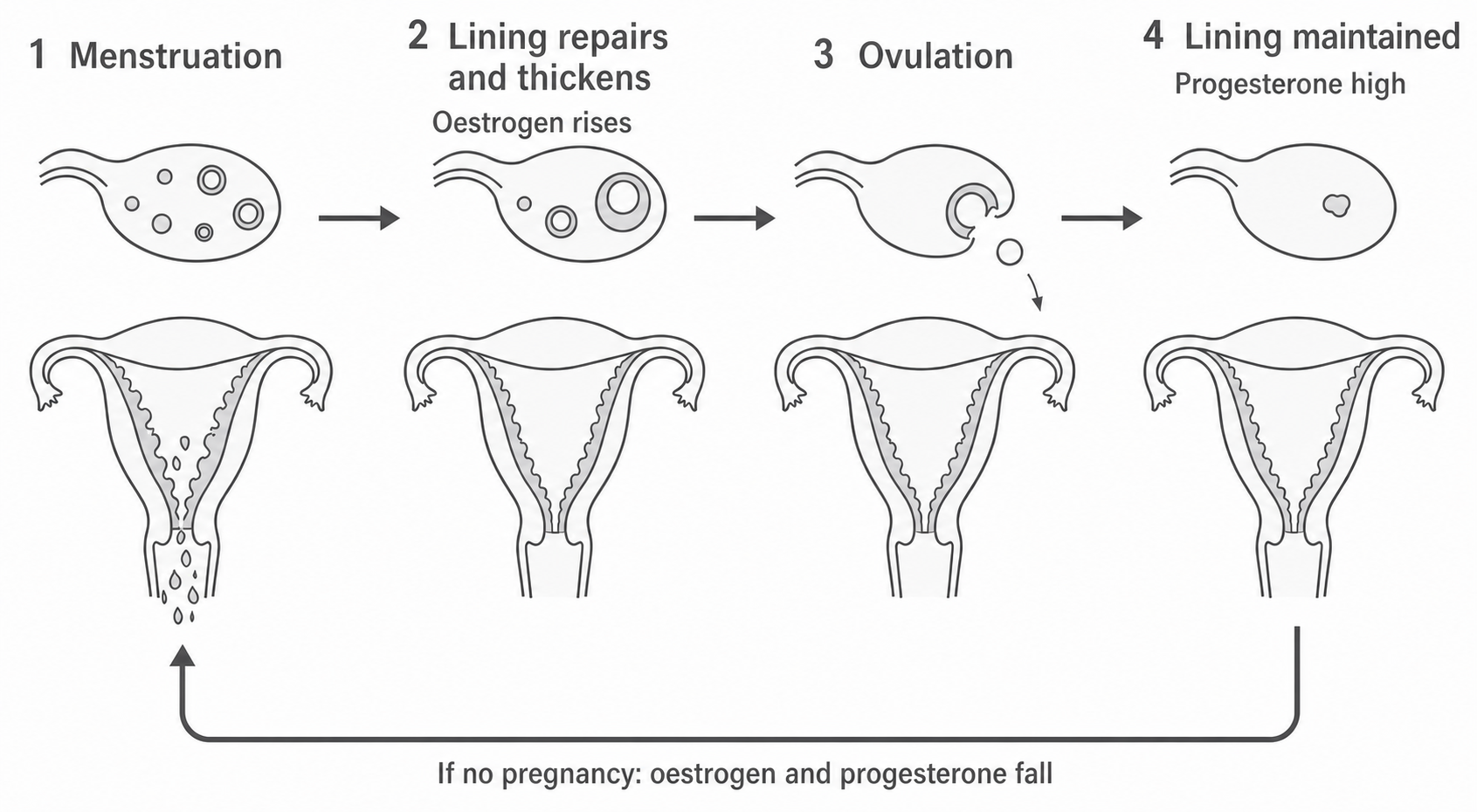
The period is therefore not the release of the egg. Ovulation is the release of an egg from an ovary; menstruation is the shedding of some uterus lining.
Control by four hormones
Higher tier only
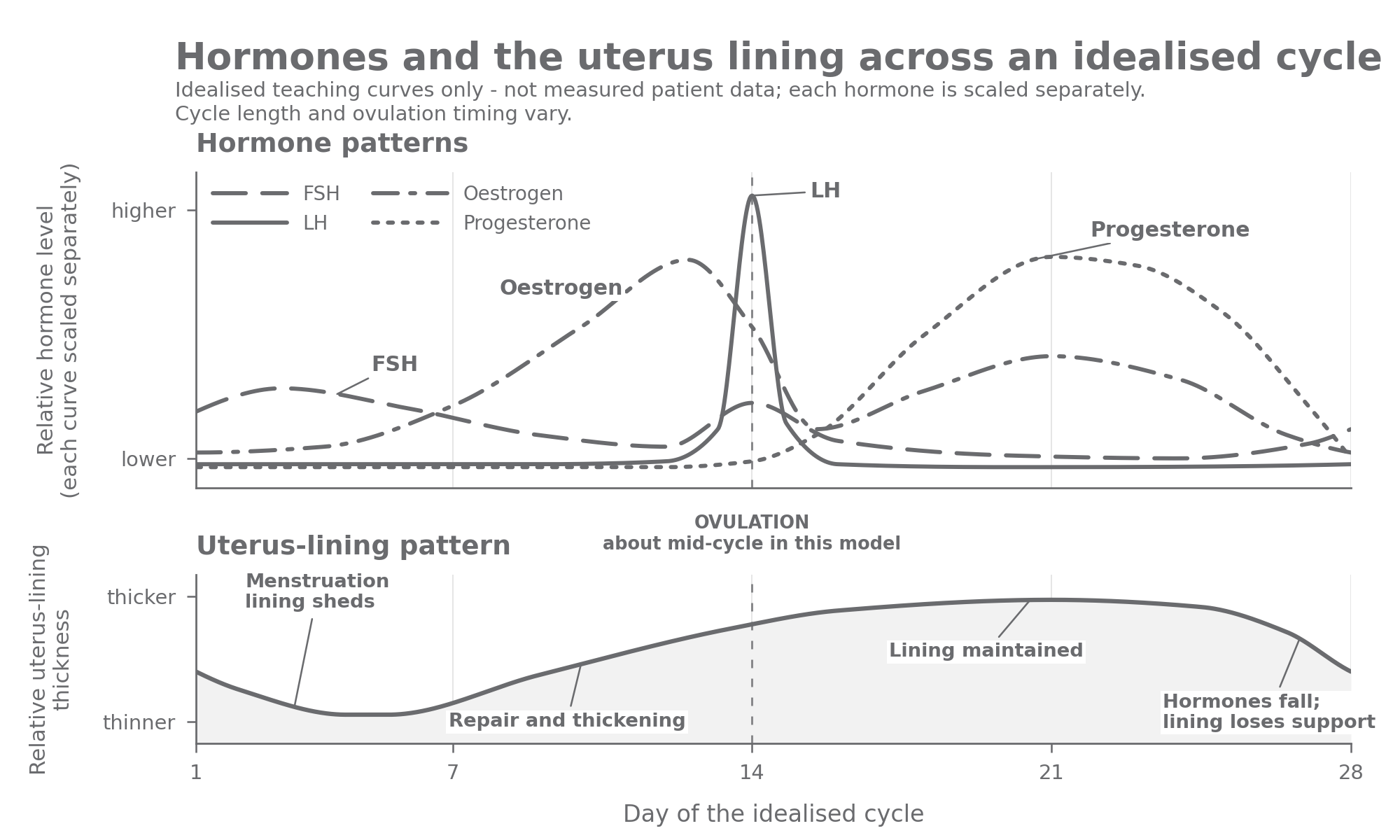
Idealised cycle: each hormone has its own relative scale, so compare timing and shape, not concentrations between different hormones.
The complete control system involves two hormones released by the pituitary gland, FSH and LH, and two hormones released by the ovaries, oestrogen and progesterone. These hormones interact through feedback: one hormone changes the release of another.
- At the start of a cycle, low oestrogen and progesterone allow FSH to rise. FSH stimulates a follicle containing an egg to mature in an ovary, and it stimulates the ovary to produce oestrogen.
- Rising oestrogen repairs and thickens the uterus lining. For most of this stage, oestrogen inhibits FSH, reducing the chance that several follicles continue to mature. When oestrogen becomes high before ovulation, its effect changes: it stimulates a surge of LH.
- The LH surge triggers ovulation, releasing the mature egg from the ovary.
- The follicle tissue left in the ovary after ovulation produces progesterone. Progesterone maintains the thick uterus lining and inhibits FSH and LH, so another egg does not mature and ovulate in the same cycle.
- If pregnancy does not occur, the hormone-producing follicle tissue breaks down. Progesterone and oestrogen fall, the lining is no longer maintained and menstruation begins. Removing their inhibition also allows FSH to rise for a new cycle.
Read the graph horizontally to follow one hormone through time. The LH surge precedes or coincides with ovulation, and progesterone rises afterwards as the lining is maintained. The vertical scales are relative and separate, so a taller LH curve does not show that blood contains more LH than progesterone. Day 14 is an illustrative midpoint, not a prediction for every real cycle.
The crucial distinction is that a moderate rise in oestrogen inhibits FSH, while a high level near ovulation stimulates LH. Treating oestrogen as simply on or off misses this change in feedback.