Biology 5.20 - Developing medicines
Follow a candidate medicine from discovery to clinical testing, measure early evidence, and learn why independent scrutiny and clear communication matter.
Discovery and development
A substance that shows a useful effect is not immediately a medicine. It is a candidate medicine: a possible treatment that still needs development and testing. Evidence is gathered in stages because each stage asks a different question and may reveal a reason to change or stop the candidate.
The first two stages find and improve a possibility:
| Stage | Main question | What researchers do |
|---|---|---|
| Discovery | Could any substance affect the chosen biological target? | Understand the disease or target, then identify or screen substances for a useful effect |
| Development | Can a promising substance become a workable candidate medicine? | Select and refine the candidate, investigate its properties, and consider how it could be made and given |
For a possible antibiotic, discovery might identify a substance that inhibits an essential bacterial process. During development, researchers would investigate whether that effect is sufficiently selective and whether the substance has suitable properties for further testing. Many candidates do not progress: a useful effect in an early study is evidence of promise, not proof that the substance is a safe and effective medicine.
The arrow from discovery to development therefore means evidence supports further work, not "the medicine is now approved". This distinction prevents a common error: discovery is finding a possibility; development is turning a promising possibility into a candidate ready for more demanding tests.
Preclinical and clinical testing
After development, testing becomes progressively closer to use in patients.
Preclinical testing happens before testing in people. Laboratory studies and other non-human models are used to investigate whether the candidate has the intended biological effect and whether it could cause harm. The evidence is used to decide whether human testing should be considered; preclinical success does not guarantee success in people.
Clinical testing involves human participants. It gathers evidence about safety and whether the candidate has the intended beneficial effect in people. A candidate reaches this stage only after earlier evidence supports progression and the required approvals are in place.
[DIAGRAM: asset_slug: biology_5_20_medicine_development; description: Discovery finds candidates, development refines a candidate, preclinical testing happens before people, and clinical testing involves people; evidence determines progression.]
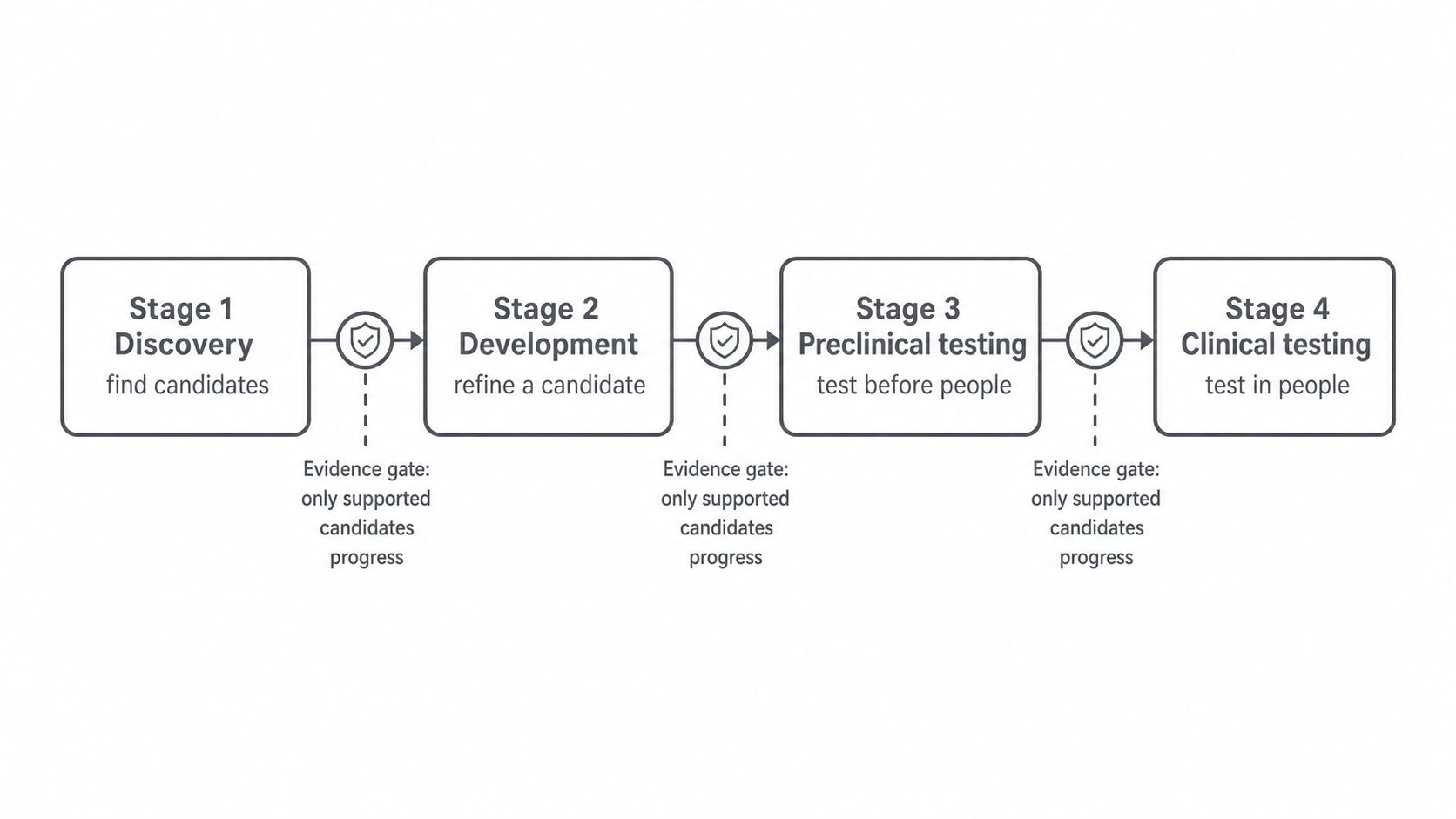
The complete assigned pathway is:
discovery → development → preclinical testing → clinical testing
The stages are ordered, but the real process is evidence-led rather than automatic. An unsuitable candidate can be changed, investigated again or stopped. The key boundary is between preclinical and clinical testing: preclinical evidence is gathered before testing in humans; clinical evidence comes from human participants.
A dose is the amount given at one time. Researchers seek a dose that provides benefit with acceptable harm; a stronger effect is not automatically a better medicine. Clinical studies begin cautiously and use increasing evidence to decide whether to test in larger groups.
A control group provides a comparison: people may improve naturally or because of other care. The comparison may receive an existing treatment, or an inactive placebo when that is appropriate. Random allocation reduces systematic differences between groups. Blinding, where participants and/or assessors do not know the allocation, reduces expectation and assessment bias. These methods improve the comparison; they do not guarantee that every bias or rare adverse effect is detected.
Measuring early antibacterial effects
A screening result needs a measurement. On a prepared agar plate, a candidate may produce a circular clear zone where visible bacterial growth is inhibited. A larger zone under the same conditions can suggest more inhibition, but diffusion, concentration and the bacterium used also affect its size. It does not by itself prove better treatment in a person.
For a circular bacterial culture or clear zone:
Use the radius, half the diameter. If a circular zone has diameter , then and
If the question asks for clear agar only, excluding a central paper disc of radius , subtract its area:
A circular culture of diameter has radius , so its area is . Check what region is requested and keep squared units. Doubling a radius multiplies the area by four, not two.
These examples interpret supplied measurements; they do not require a culture experiment. For a useful comparison, the same bacterial strain, agar conditions, exposure time and candidate concentration would be needed. Repeats help show whether a result is consistent.
Checking and communicating the evidence
An early effect justifies a claim such as “a candidate worth investigating”. A conclusion that a medicine benefits patients needs human evidence about the intended benefit, dose and harms. Even a well-run trial studies a sample of people for a limited time: rare or delayed effects can remain uncertain. A sample should represent the people the medicine is intended for. A large study of only one narrow group may not show what happens in other ages or health conditions.
Peer review means that other suitably qualified scientists examine the methods, analysis and conclusions. They may identify unsuitable controls, errors, overlooked alternative explanations or conclusions that go beyond the data. Authors can correct the work or qualify their claim. Peer review improves scrutiny; it is not a guarantee that the findings are true. Independent replication and further evidence still matter. Reporting negative results as well as positive ones avoids a misleading impression that every study found a benefit.
Results must also be communicated to different audiences:
- Researchers need methods, measurements, uncertainty and analysis so they can scrutinise and repeat the work.
- Healthcare professionals need evidence about benefits, adverse effects and which patients were studied to judge whether results apply.
- Patients and the public need understandable explanations of likely benefits, harms and uncertainties to make informed choices. Clear language should preserve the facts.
Suppose an invented trial reports the same unwanted outcome in out of people on a control treatment and out of on the candidate. The rates are and : 2 fewer people per 100 had that outcome in the candidate group. Saying only “one-third lower” gives the relative reduction but hides how common the outcome was. Reporting both counts, the group sizes, time period and uncertainty allows a more informed judgement.
Risk perception is how dangerous or beneficial something feels. A vivid personal story, a familiar brand or an alarming headline can change perception without changing the evidence. Scientific claims should be judged against the study design, effect size, limitations and independent scrutiny. A reassuring headline is not a substitute for evidence, and an adverse effect in one person does not establish its frequency.
Match the strength of the claim to the evidence. Peer review helps expose weaknesses, and clear communication lets different audiences assess what the findings mean for them.