Biology 1.7 - 1.9, 1.12 - How enzymes work
Explain enzyme specificity, denaturation and the effects of temperature, pH and substrate concentration. Connect enzyme action to the building and breakdown of biological molecules.
How an enzyme acts
Enzymes act at the molecular scale, inside cells and in fluids made by organisms. Most enzymes are proteins that act as biological catalysts: they increase the rate of a biological chemical reaction without being used up in the overall reaction. The molecule on which an enzyme acts is its substrate.
Active site
The active site is the region of an enzyme where its substrate binds and the reaction is catalysed.
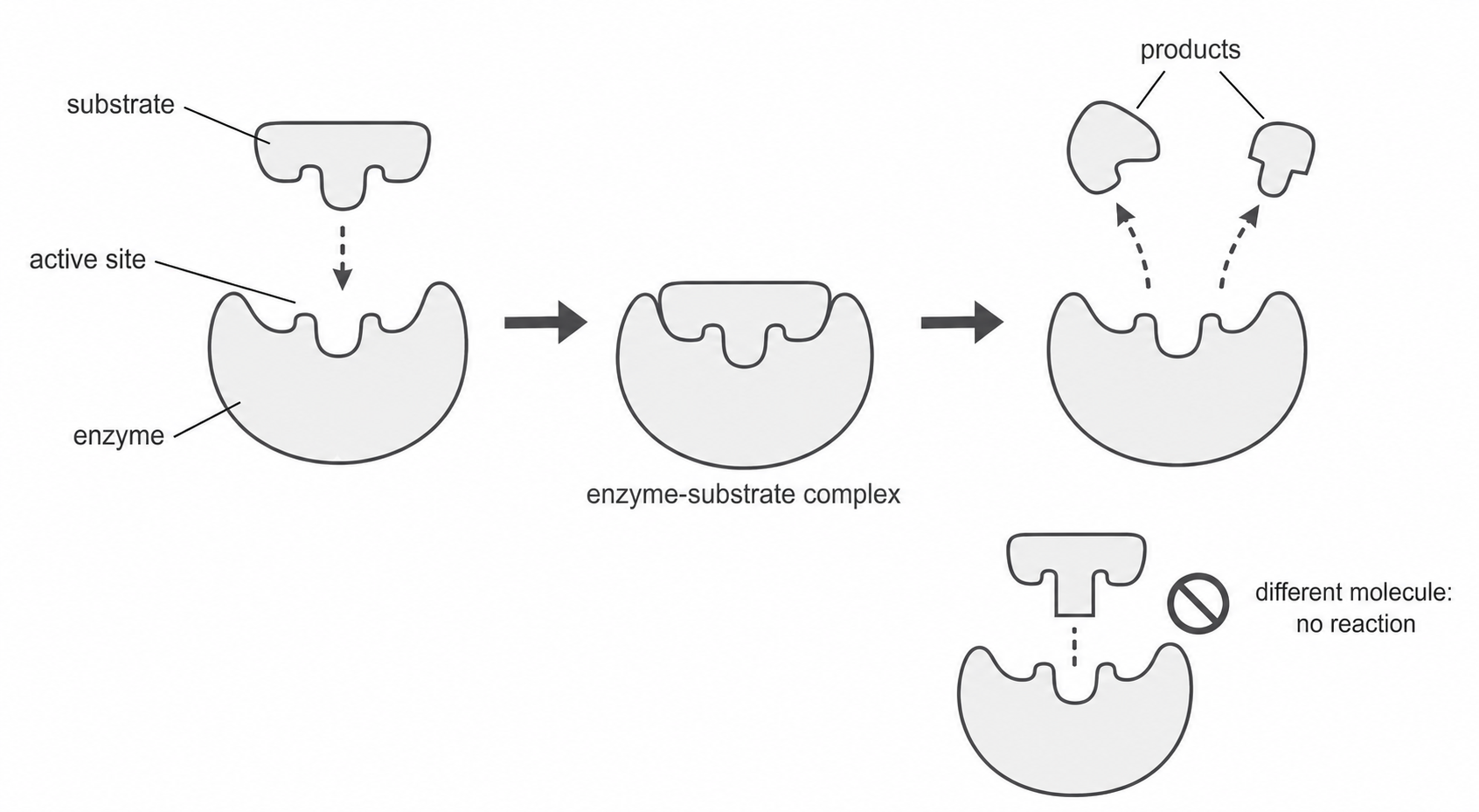
Enzyme action is an ordered process:
- Enzyme and substrate particles move and collide.
- A substrate with a complementary shape and suitable chemical properties binds at the active site. This temporary bound state is the enzyme-substrate complex.
- The reaction converts the substrate into one or more products.
- The products no longer bind in the same way, so they are released. The enzyme is chemically unchanged overall and can catalyse another reaction.
An active site is selective, not a universal docking place. Its three-dimensional shape and chemical properties allow one substrate, or a narrow group of closely related substrates, to bind in the correct way. This is enzyme specificity. “Complementary” means that the surfaces fit together; it does not mean that the enzyme and substrate have identical shapes.
The diagram is a simplified molecular model: the shapes show fit and sequence, not real size, colour or stiffness.
[DIAGRAM: asset_name: Biology 1.7-1.12 - Enzymes and biological catalysts - diagram 01; asset_slug: biology_1_7_1_12_enzymes_and_biological_catalysts__diagram_01; recommended_method: image_gen; description: A clean scientific teaching diagram on white: solid left-to-right arrows show (1) a labelled substrate approaching the complementary labelled active site of a labelled enzyme, (2) the substrate bound as a labelled enzyme-substrate complex and (3) two labelled products leaving while the enzyme retains its original active-site shape; short dashed movement arrows show approach and release. A small separate specificity inset shows a visibly different molecule approaching but unable to fit the active site, marked by a blocked symbol and no route to products. Use only #6A6B6E linework, flat neutral-grey fills and exact direct labels. Do not imply scale, show the enzyme being consumed, or add energy-profile content, lock-and-key hardware, chemical bonds, colour coding or decorative detail.]
Conditions change enzyme activity
Enzyme activity is the rate at which an enzyme-catalysed reaction proceeds. A condition affects activity by changing how often suitable enzyme-substrate complexes form, whether the active site keeps its functional shape, or both.
Temperature
At a low temperature, enzyme and substrate particles have less kinetic energy and move more slowly. There are fewer successful collisions per second, so the reaction is slow. Low temperature does not normally denature the enzyme; warming it again can increase the rate.
As temperature rises, particles move faster. Successful collisions and enzyme-substrate complexes form more often, so activity rises towards an optimum temperature, the temperature at which the measured rate is greatest.
Above the optimum, enough thermal energy disrupts interactions that maintain the enzyme's three-dimensional shape. The active site changes shape, fewer substrates bind, and the rate falls sharply. The enzyme is denatured. Denaturation is a structural change; an enzyme is not alive, so it is not scientifically useful to say that it has been “killed”.
pH
Each enzyme has an optimum pH range. Moving away from it can alter interactions that maintain the active site's shape and chemical environment. The substrate then binds less successfully, so activity falls; sufficiently extreme pH can denature the enzyme. Do not assume that every enzyme has an optimum of pH 7.
Substrate concentration
Suppose enzyme concentration stays constant. At low substrate concentration, many active sites are unoccupied. Increasing substrate concentration causes more frequent enzyme-substrate collisions, so more active sites are occupied each second and the rate rises.
At high substrate concentration, almost every active site is occupied whenever it becomes available. Enzyme concentration is now the limiting factor: adding more substrate produces little or no further increase, so the rate levels off. This saturation is not denaturation; the active sites still work, but there are no spare ones to use the extra substrate.
| Change, with other variables controlled | Effect on activity | Mechanism |
|---|---|---|
| Temperature rises below the optimum | Rate increases | Faster movement gives more successful collisions per second |
| Temperature rises above the optimum | Rate decreases sharply | Active-site shape changes, so substrate binding decreases |
| pH moves away from the optimum | Rate decreases | Active-site shape/chemical environment becomes less suitable |
| Substrate concentration rises from a low value | Rate increases | More frequent collisions occupy more active sites |
| Substrate concentration is already very high | Rate approaches a plateau | Active sites are occupied most of the time |
An optimum is the tested condition with the greatest rate, not simply the largest temperature, pH or concentration value.
Building and breaking biological molecules
Cells must both build larger molecules and break them into smaller ones. Synthesis joins smaller molecules to make a larger molecule; breakdown converts a larger molecule into smaller products. Different specific enzymes catalyse different reactions in both directions, allowing them to proceed rapidly enough under the mild conditions inside organisms.
| Biological molecule | Enzyme-catalysed synthesis | Enzyme-catalysed breakdown |
|---|---|---|
| Larger carbohydrates, such as starch | sugars are joined to make larger carbohydrates | larger carbohydrates are broken down into sugars |
| Proteins | amino acids are joined to make proteins | proteins are broken down into amino acids |
| Lipids | fatty acids and glycerol are joined to make lipids | lipids are broken down into fatty acids and glycerol |
The importance is broader than any one named example. Enzymes are biological catalysts for the networks of reactions that build cell material and make smaller molecules available for other reactions. Because the enzyme is not consumed overall, one enzyme molecule can catalyse the same specific conversion repeatedly.