Biology 5.4-5.6, 5.8 - Pathogens and transmission
Identify the pathogens behind common infections, connect them to the damage they cause, and choose prevention measures that interrupt each transmission route.
What counts as a pathogen
A pathogen is a disease-causing organism or biological agent. Pathogens include viruses, bacteria, fungi and protists. Viruses are acellular: they are infectious particles rather than cells.
Host
The organism in or on which a pathogen lives and causes infection. A host can be an animal, a human or a plant.
The pathogen and the disease are not the same thing. Plasmodium is a protist pathogen; malaria is the disease it causes. Hymenoscyphus fraxineus is a fungal pathogen; Chalara ash dieback is the disease it causes in ash trees.
| Pathogen group | What it is at cellular scale | Examples |
|---|---|---|
| Virus | Acellular infectious particle | HIV |
| Bacterium | Single-celled prokaryotic organism | Cholera bacterium, tuberculosis bacterium, Chlamydia bacterium |
| Fungus | Eukaryotic organism; many fungi produce spores | Fungus that causes Chalara ash dieback |
| Protist | Usually a single-celled eukaryotic organism | Plasmodium, which causes malaria |
The four group names classify the pathogen. They do not tell you the transmission route: two bacteria can spread in different ways, and two airborne diseases can carry different biological material through the air.
Named infections and their damage
A disease description should connect pathogen → site or target → damage or symptom. These infections affect both humans and plants.
| Infection | Pathogen group | Host target and effect |
|---|---|---|
| Cholera | Bacterium | Infection of the intestine disrupts water balance and causes severe watery diarrhoea. |
| Tuberculosis (TB) | Bacterium | The bacteria usually infect the lungs and damage lung tissue. |
| Chalara ash dieback | Fungus | The fungus infects ash trees, causing leaf loss and dark lesions in the bark. |
| Malaria | Protist | Plasmodium passes through liver cells and then infects red blood cells, so the disease damages the liver and blood. |
| HIV infection | Virus | HIV targets and destroys white blood cells. The body's defence against other infections becomes weaker and, without effective treatment, infection can progress to AIDS. |
Symptoms are evidence of damage, but a symptom is not itself the pathogen. Diarrhoea does not cause cholera, and a bark lesion does not cause Chalara; each is an effect of infection.
Break the transmission route
For a pathogen to spread, it must leave a source, travel by a route and reach a new host. Prevention works by interrupting at least one link:
infected source → transmission route → entry into a new host
Vector
A vector is a living organism that carries a pathogen from one host to another. The vector is not the pathogen. In malaria, the female Anopheles mosquito is the vector and Plasmodium is the pathogen.
| Disease | Transmission route | How the pathogen moves | Route-matched prevention |
|---|---|---|---|
| Cholera | Water | Faeces containing cholera bacteria can contaminate water or food; another person becomes infected by swallowing it. | Safe sanitation keeps faeces away from water. Treating or boiling drinking water prevents live bacteria being swallowed. Hand and food hygiene reduce contamination. |
| Tuberculosis | Airborne | An infectious person releases bacteria-containing respiratory particles by coughing or sneezing; another person inhales them, especially during close, repeated contact. | Ventilation removes or dilutes contaminated air. Covering coughs and suitable masks trap respiratory particles. Reducing close exposure to an infectious person lowers inhalation risk. |
| Chalara ash dieback | Airborne | The fungus produces spores on infected fallen ash material. Wind carries spores to healthy ash leaves and bark; moving infected plants can also carry the fungus farther. | Collecting and deep-composting or safely disposing of infected leaf litter reduces spore release. Cleaning plant debris from footwear and not moving infected planting material reduce human-assisted spread. Wind spread can be reduced but not completely stopped. |
| Malaria | Animal vector | An infected female Anopheles mosquito carries Plasmodium and can introduce it when taking a blood meal from a person. | Insecticide-treated bed nets and repellents reduce bites. Mosquito larvae develop in standing water. Draining suitable small pools removes breeding sites, reducing the number of vectors able to transfer the pathogen. |
[DIAGRAM: asset_name: Biology 5.4-5.6, 5.8 - Pathogens, transmission and prevention - diagram 01; asset_slug: biology_5_4_5_6_5_8_pathogens_transmission_and_prevention__diagram_01; recommended_method: image_gen; description: Four horizontal monochrome route lanes: cholera contaminated water to person; tuberculosis respiratory particles from coughing person to another person; Chalara wind-borne fungal spores from infected ash leaf litter to healthy ash; malaria infected female Anopheles mosquito bite to person. Each lane shows one correctly matched prevention barrier and arrowheads point from source to new host. White background, #6A6B6E linework and labels; exclude pathogen life cycles, body defences, treatment details and all adjacent separate-Biology disease examples.]
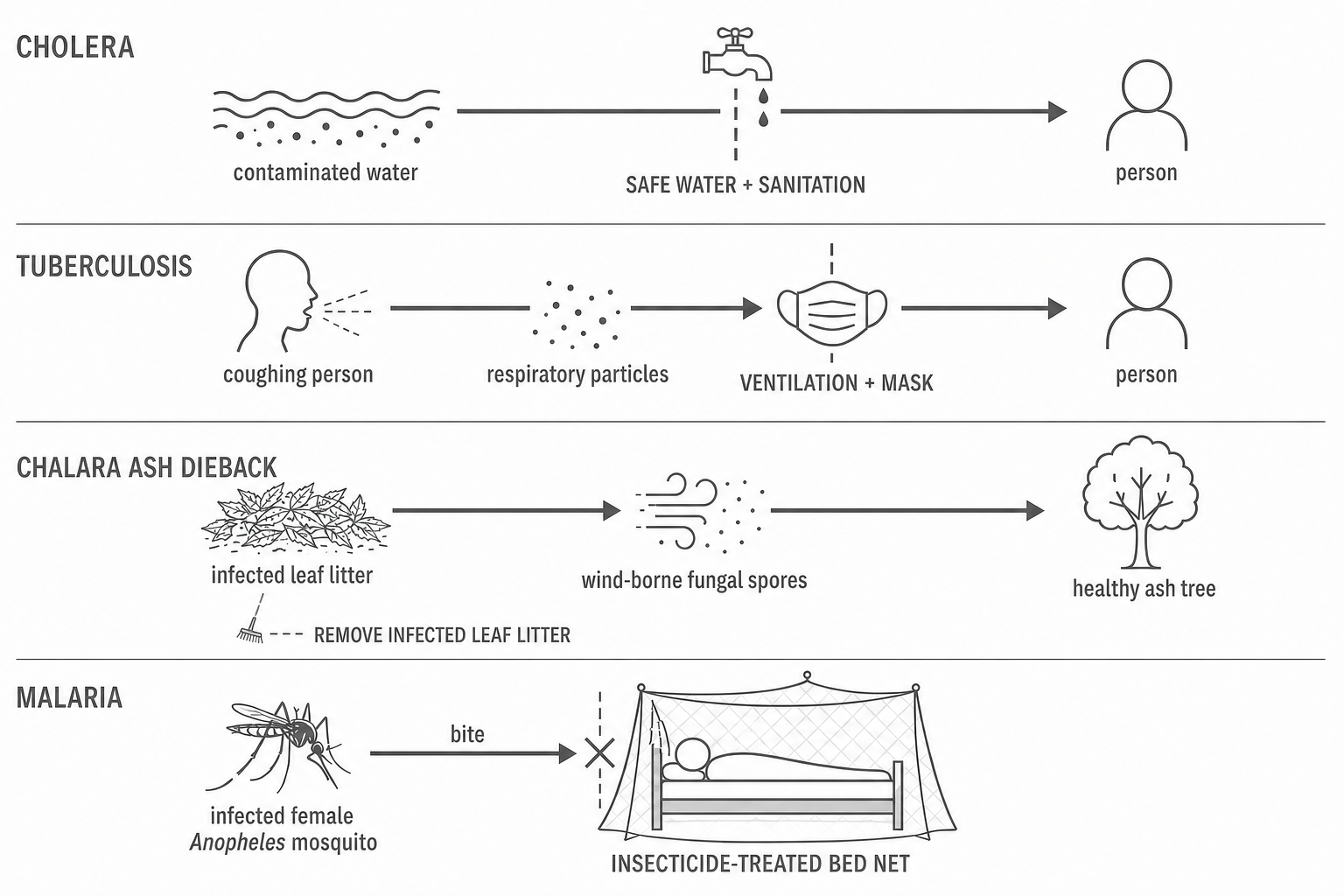
Notice that airborne names a route, not one universal particle. TB bacteria travel in respiratory particles from a human source, whereas the Chalara fungus travels as spores from infected plant material. The useful question is always: what carries this pathogen to the new host?
When comparing prevention measures in different places, consider other differences between the populations. A fall in cases supports a measure, but uncontrolled changes in exposure, reporting or other prevention can also affect the result.
Sexually transmitted infections
A sexually transmitted infection (STI) is an infection that can pass between people during sexual contact. The route matters because pathogens can be carried in body fluids and cross moist body surfaces or small breaks in tissue.
Chlamydia is caused by a bacterium. It can pass in semen or vaginal fluid during vaginal, anal or oral sex without a barrier, and it can be transferred on shared sex toys. A person may have no symptoms, so testing matters: identifying infection allows the person and sexual partners to follow treatment advice and avoid unknowingly continuing the chain of transmission.
HIV is a virus. During sexual transmission it can pass in infected blood, semen, vaginal fluid or rectal fluid. It can also spread when needles are shared because blood can pass directly between people. HIV is not spread by hugging, sharing food or ordinary social contact.
Ways to reduce or prevent spread follow directly from the routes:
- External or internal condoms and other suitable barriers reduce direct contact and the exchange of infected body fluids.
- Testing can reveal infection even when there are no symptoms; following medical advice and avoiding sexual contact until advised reduce onward transmission.
- Not sharing needles, and using new sterile equipment, prevents blood-to-blood transfer of HIV.
- Hormonal contraception such as the pill, implant or injection can prevent pregnancy but does not form a physical barrier, so it does not prevent Chlamydia or HIV transmission.
Match prevention to the route
The same reasoning works in an unfamiliar situation:
- Identify the pathogen and do not confuse it with the disease or vector.
- Identify the source, the material that carries the pathogen and the entry route into a new host.
- Choose a measure that interrupts that exact route.
- Explain the consequence: fewer pathogens reach new hosts, so the probability of new infection falls.
This explains why one measure cannot fit every disease. Safe drinking water interrupts ingestion of cholera bacteria but does not stop a mosquito bite. A bed net interrupts malaria's vector route but does not remove TB bacteria from shared air. A condom reduces infected-fluid exchange during sexual contact but does not prevent wind-borne fungal spores reaching ash leaves.
Pathogen type tells you what causes the disease. Transmission route tells you how it reaches a new host. Effective prevention is a barrier placed on that route.